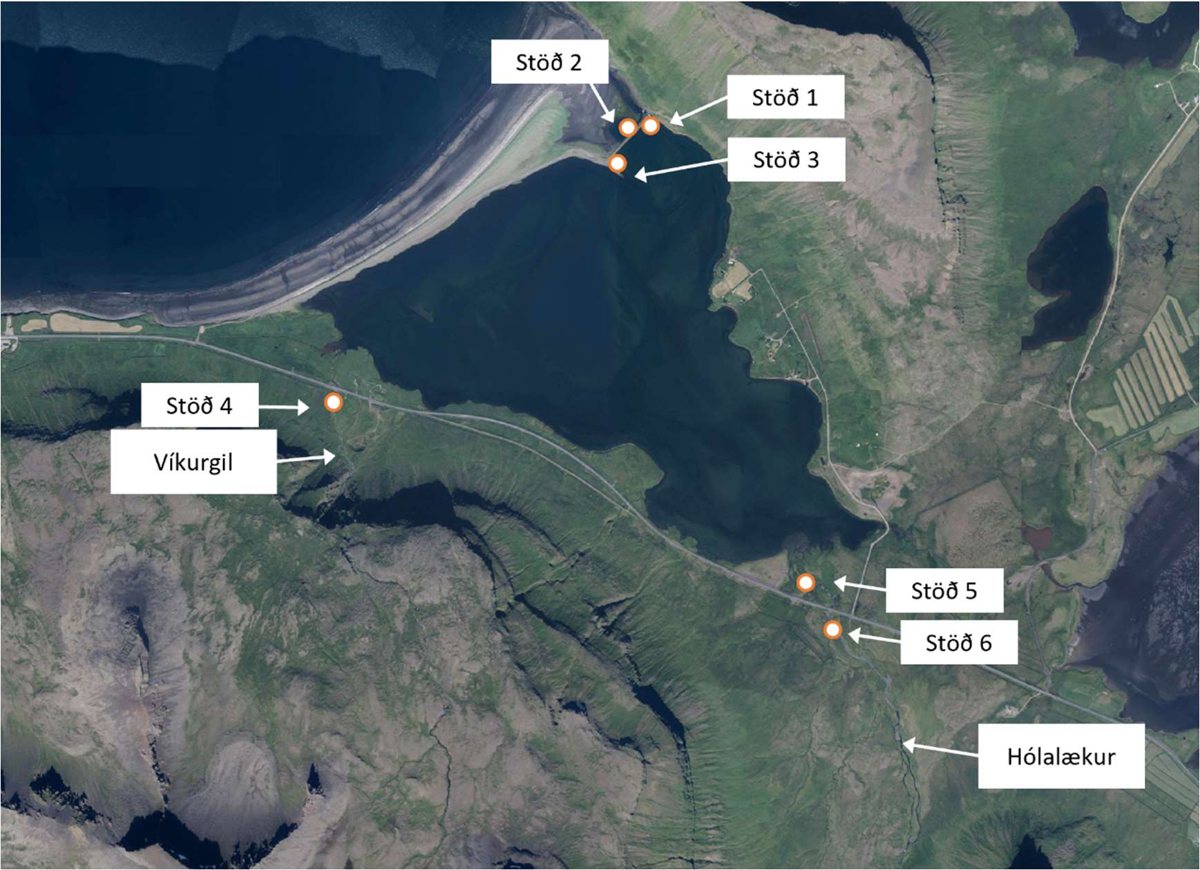
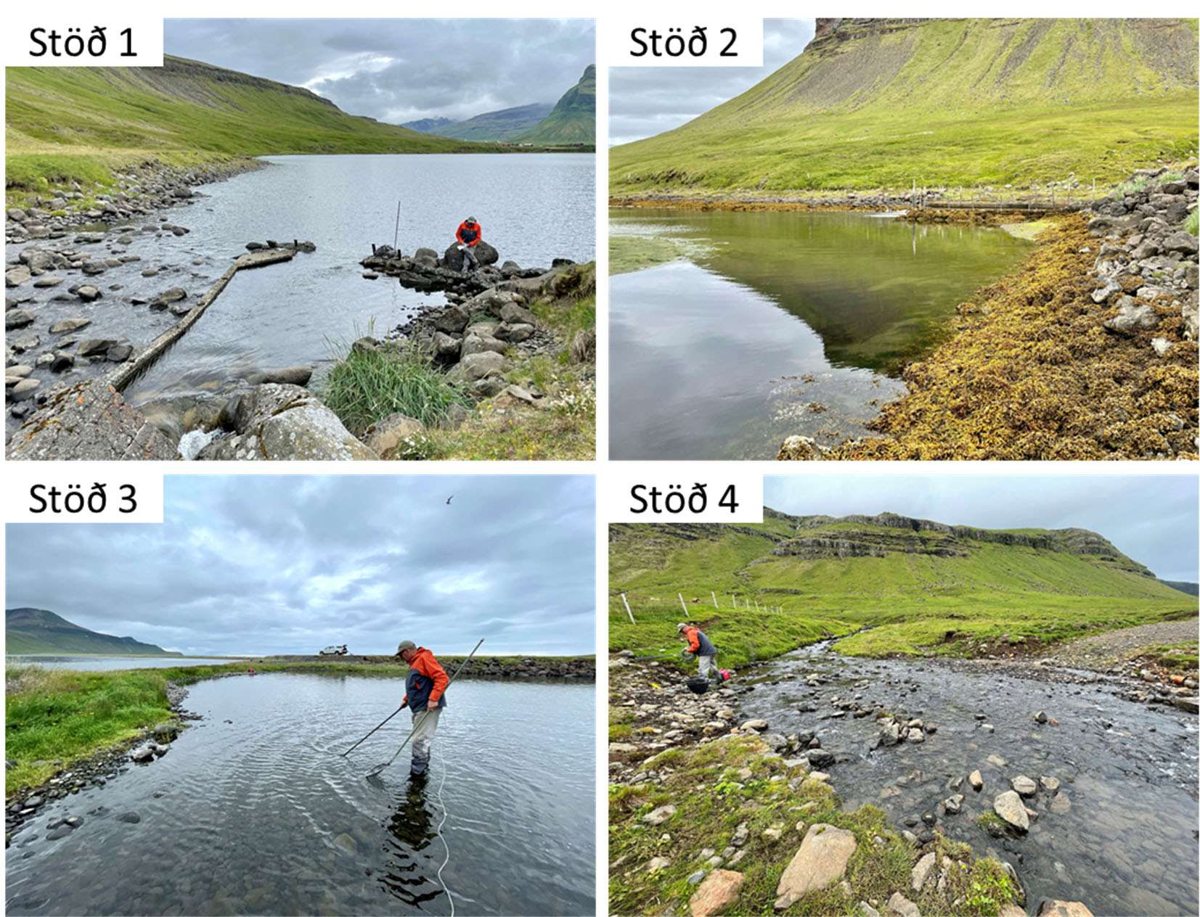
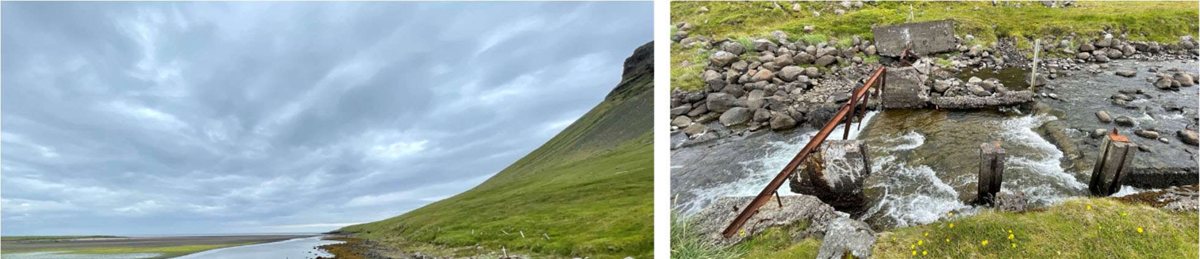
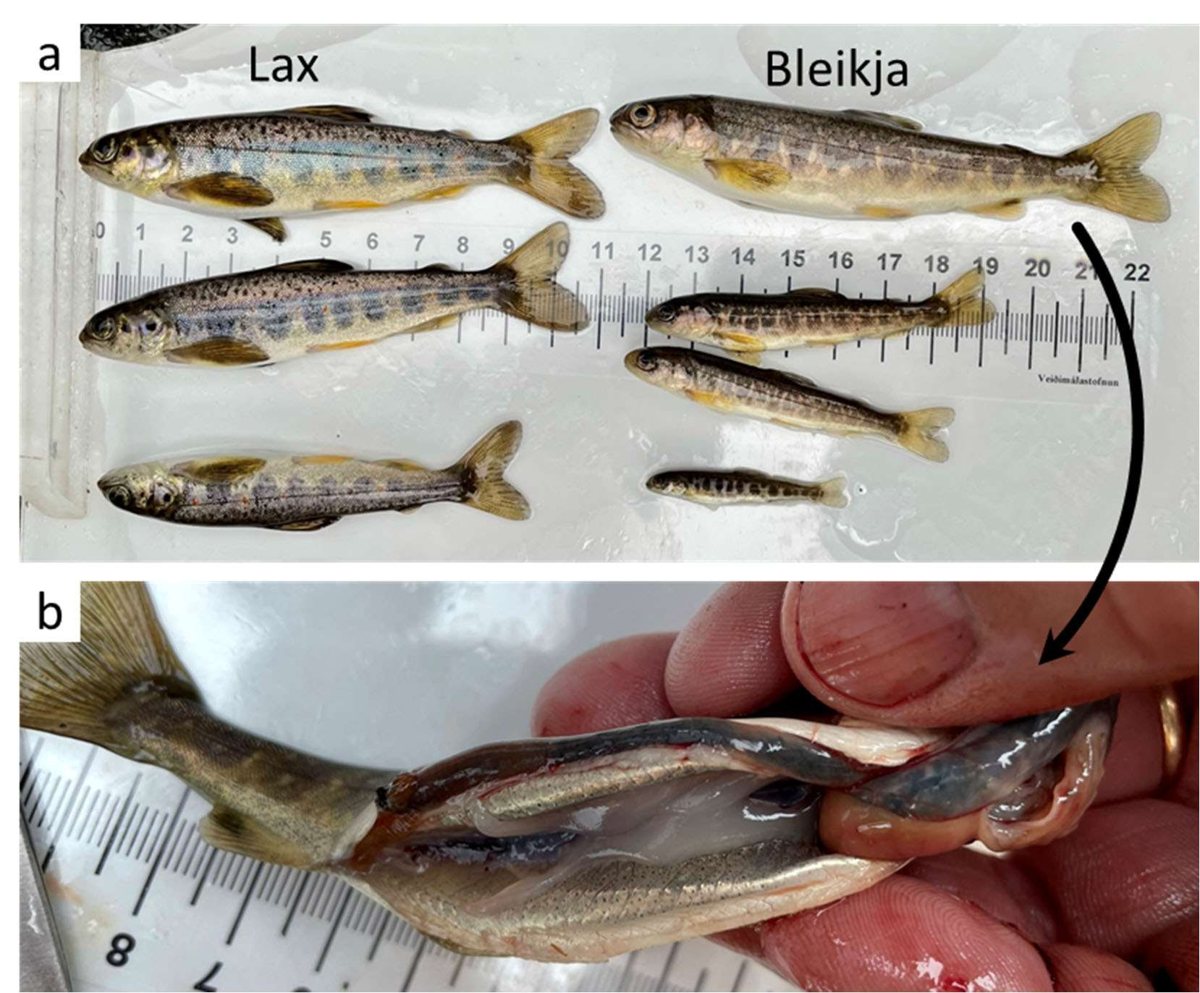
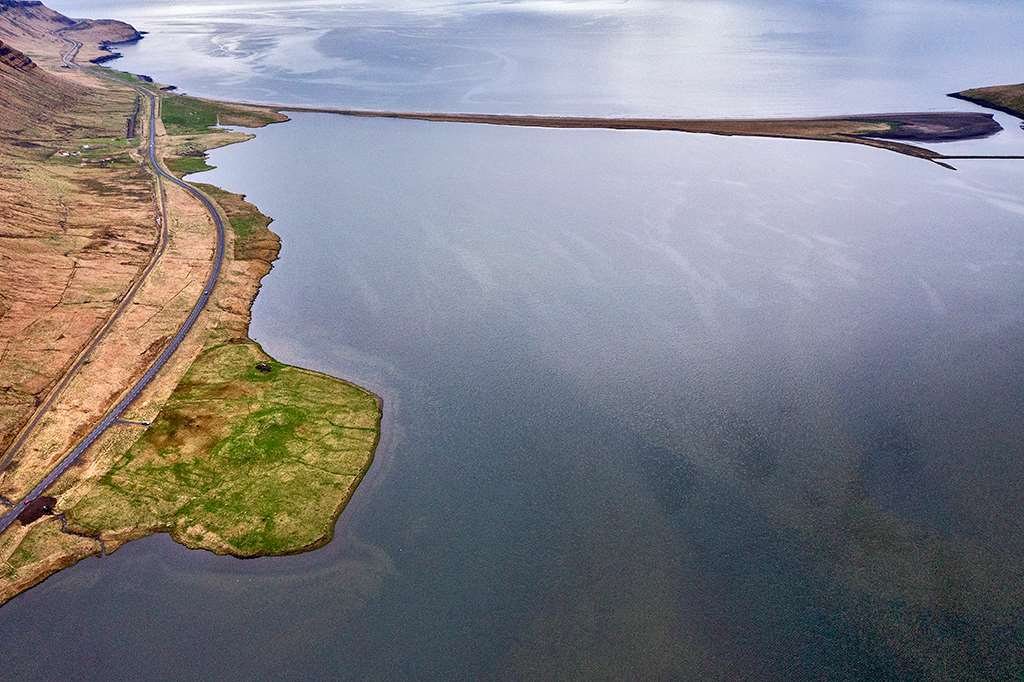
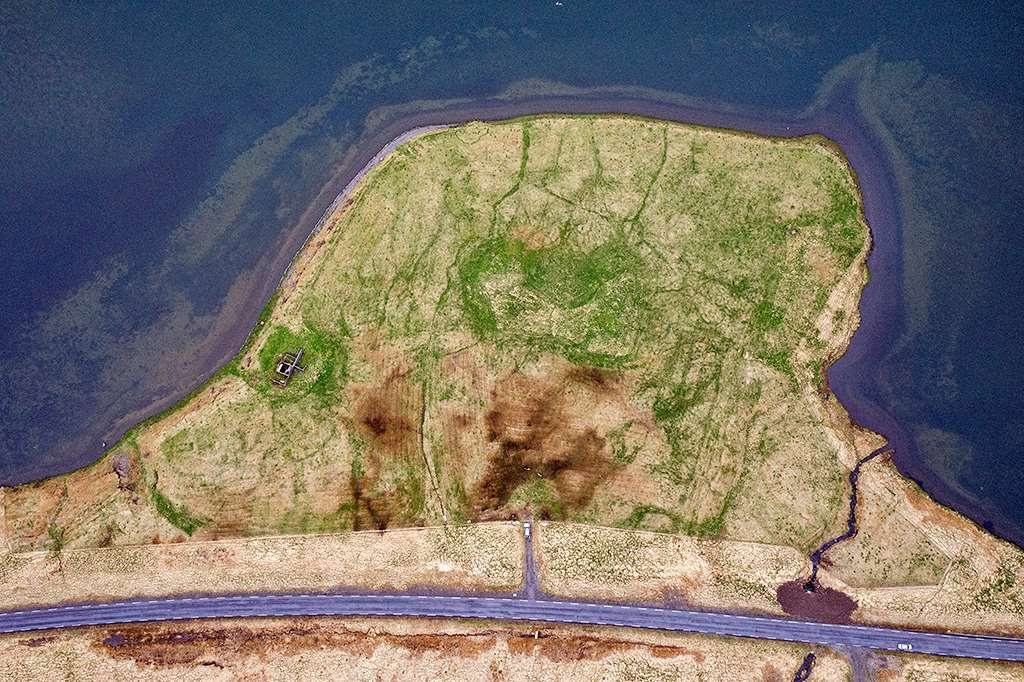
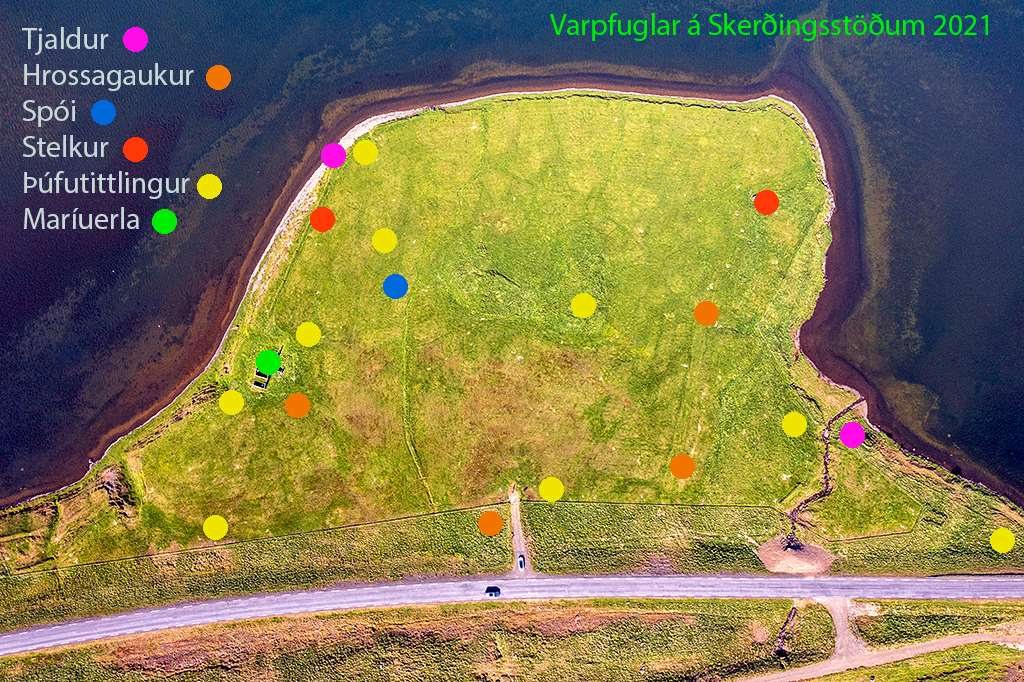
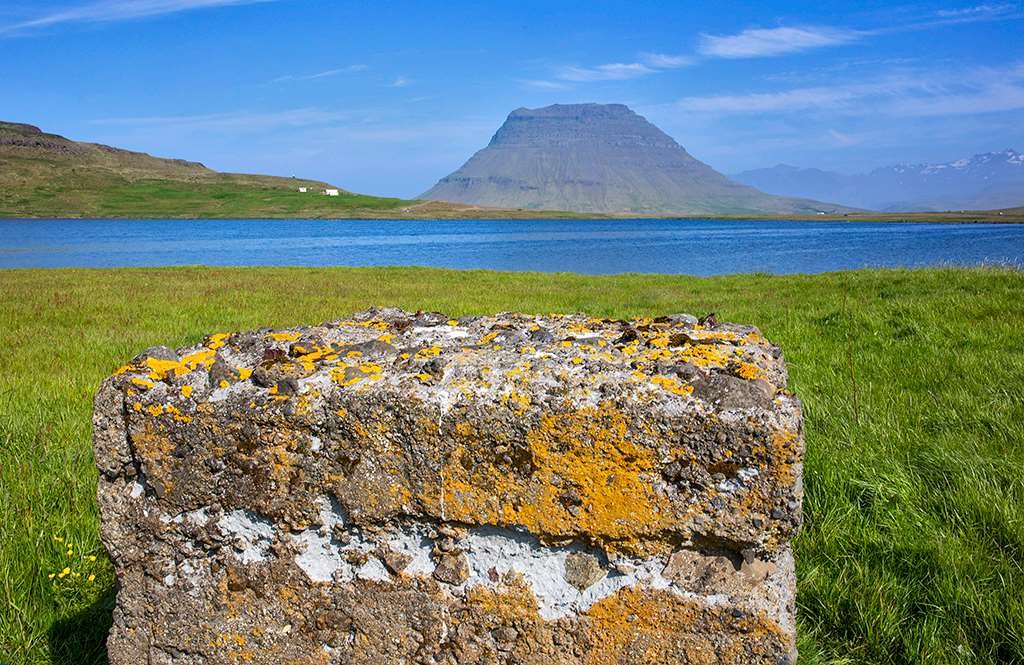
Before anything was built, two independent field surveys in 2021 recorded what lives on this land and in the lagoon beside it: the birds that breed on the point, the fish that run up from the fjord, the plants that make up each habitat. This page is that baseline, species by species, with what the surveyors found here, what is known about each one, and the months you are likely to meet it. The Outpost, Districthive's Human Recharging Station, now stands on the point; later counts will be compared against these.
66 of the recorded plants are in leaf or flower this month.
Months are drawn from each species' known Icelandic calendar (breeding, passage, wintering, growing season), not from counts made here every month. The survey dates themselves are given on every card.
The year, month by month
How many of the recorded species you can expect in each month, and how many are breeding, spawning or in flower. The pale bar is every species present; the solid bar is the subset in its season. The current month is shaded.
Birds
34 species
presentbreeding
Fish
4 species
presentspawning
Plants
67 species
presentin flower
Invertebrates
3 species
present
Table view
Group
Jan
Feb
Mar
Apr
May
Jun
Jul
Aug
Sep
Oct
Nov
Dec
Birds present
15
15
17
30
34
32
32
33
32
27
16
15
Birds breeding
0
0
0
3
26
31
30
13
4
0
0
0
Fish present
3
3
3
4
4
4
4
4
4
4
3
3
Fish spawning
0
0
0
0
0
0
0
0
2
3
3
1
Plants present
4
4
4
5
65
67
67
67
66
16
4
4
Plants in flower
0
0
0
0
10
52
58
28
5
2
0
0
Invertebrates present
3
3
3
3
3
3
3
3
3
3
3
3
Bird calendar
Residents first, then arrivals in order. Solid cells are the breeding months.
Two comparisons. First, the surveyors' own count days, eleven visits between 2011 and 2021, set against the period each species is expected here: a ring marks a month in which the species was actually counted on one of those days. Second, every sighting logged since by the team on the operations dashboard, and later by the wildlife scanner, set against the 41 birds, fish and invertebrates of the baseline. Plants are checked by season rather than by sighting. Guest reports are not logged, since they cannot be checked.
0of 41 seen again
41not seen yet
0species new to this place
0sightings logged
Expected and seen, by month
species with any sighting in that month since the baseline
expected from the baselineseen again
Sightings over time
logged per month since the baseline surveys; the survey days are marked
No sightings logged yet. The register opens on the operations dashboard; the baseline stands alone until the first one.
baseline survey daysightings logged
The survey days
what was done on each visit and how many species were recorded
26 Jun 2011lagoon count4 species
28 Sep 2015lagoon count15 species
15 Jul 2017lagoon count19 species
29 Aug 2018lagoon count12 species
5 May 2021lagoon count11 species
4 Jun 2021lagoon count and territory mapping28 species
3 Jul 2021lagoon count and territory mapping20 species
24 Jul 2021lagoon count14 species
4 Aug 2021electrofishing2 species
2 Sep 2021lagoon count and vegetation12 species
5 Oct 2021lagoon count9 species
Counts on the lagoon were made by telescope from the main road; the 2021 visits also mapped territories on the point, fished the streams and walked the vegetation. Sampling on eleven days cannot show every month, so the rings below are evidence of presence, never of absence.
Species by species
expected period in colour; a ring where the surveyors counted it on a survey day; a dot where the register has a sighting
expectedbreeding, spawningcounted on a survey dayregister sighting
Sightings are logged on the operations dashboard by the team, and later by the wildlife scanner and the acoustic monitors; each carries a date, a count where given, a place and a confidence, never a person. Guest reports are not logged.
Birds 34
Jinesh PS · CC BY-SA 4.0
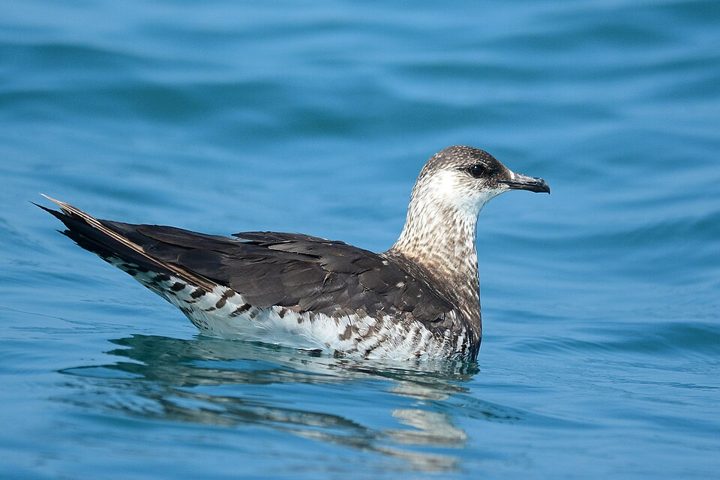
Arctic skua
kjói · Stercorarius parasiticus
Single bird seen on the lagoon, 3 July 2021
In the survey
The survey recorded a single arctic skua at Lárvaðall and Skerðingsstaðir. Bird and vegetation survey 2021, p. 7
The report lists the arctic skua among the species found in the study area that are classed as endangered (EN) on the Icelandic Red List, the same category as the greater scaup. Bird and vegetation survey 2021, p. 9
In the appendix count table it is species number 21, with one bird counted on the Lárvaðall lagoon on 3 July 2021 and no other record. Bird and vegetation survey 2021, p. 12
About
A slim, dark, falcon-like seabird 41 to 48 cm long with a wingspan of 107 to 125 cm, the breeding adult carrying two pointed central tail feathers that stick out about 7 cm beyond the rest of the tail.
It comes in a pale form with white underparts and a dark cap, an all-dark brown form and intermediates between them, and all of them show a white flash near the wingtip in flight.
It is a pirate, chasing terns, gulls and other seabirds with twisting flight until they drop or cough up their fish, and on the breeding ground it also takes small birds, eggs, chicks and insects.
In Iceland it is a summer visitor arriving in early May, nesting on lowland moss heath and sandy plains close to the coast, and the Icelandic Institute of Natural History puts the population at about 11,000 pairs.
Icelandic numbers fell sharply in the early 2000s and are still dropping by about 2.6 per cent a year, so the species was placed in the endangered category on the Icelandic Red List in 2018 even though it is of least concern worldwide.
It winters far out at sea in the South Atlantic, and anyone who walks too close to a nest can expect to be dive-bombed by the parents.
Breeding season
JFMAMJJASOND
Summer visitor, arrives in early May, eggs late May to June, chicks fledge late July to August, gone by September
Most numerous bird: two colonies of about 50 pairs each
In the survey
The arctic tern was the most numerous species in the bird counts on Lárvaðall. Bird and vegetation survey 2021, p. 6
It breeds in two small colonies on the north side of the lagoon, on Víkurrif and at Mýrarhús/Lá, with about 50 pairs at each site. Bird and vegetation survey 2021, p. 6
The 142 arctic terns counted on 3 July 2021 were the largest count of any species in the whole survey table. Bird and vegetation survey 2021, p. 12
Other counts on the lagoon gave 100 birds on 15 July 2017, 99 on 4 June 2021 and 100 on 24 July 2021. Bird and vegetation survey 2021, p. 12
Terns were noted but not counted on 26 June 2011, when only ducks were counted. Bird and vegetation survey 2021, p. 12
None were seen on the spring count of 5 May 2021 or on the autumn counts of 28 September 2015, 29 August 2018, 2 September 2021 and 5 October 2021, as expected for a summer visitor. Bird and vegetation survey 2021, p. 12
The survey lists the arctic tern as vulnerable (VU) on the Icelandic Red List, together with the great northern diver, oystercatcher, kittiwake and eider. Bird and vegetation survey 2021, p. 9
About
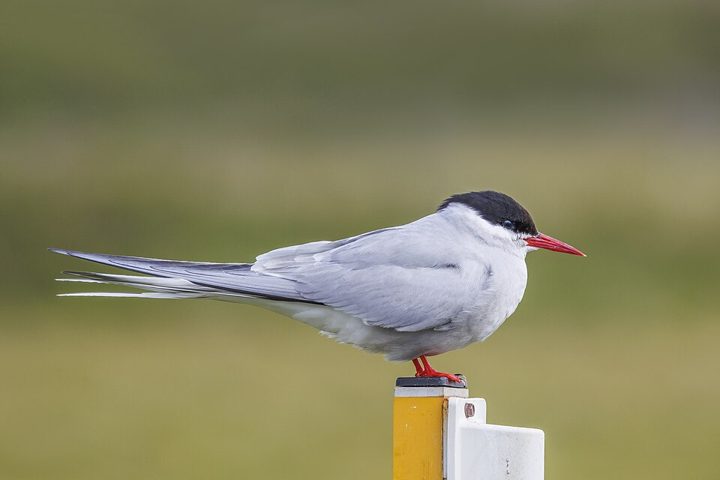
A slim, buoyant seabird about 35 cm long with a wingspan near 80 cm, recognised by its black cap, deep red bill and legs, pale grey body and long forked tail streamers.
It feeds mainly on small fish, above all sandeels on the coast and sticklebacks inland, hovering over the water and plunging in head first, and it also takes small crustaceans and insects.
Náttúrufræðistofnun puts the Icelandic breeding population at about 150,000 to 250,000 pairs, and Breiðafjörður alone held roughly 15,000 pairs in 2016, which makes it an internationally important breeding area for the species.
It makes the longest migration of any animal, flying from Iceland to Antarctic waters and back each year, a round trip of roughly 70,000 km that gives it two summers a year.
Since 2005 many Icelandic colonies have raised few or no chicks because sandeel stocks crashed, which is why the species was uplisted to vulnerable on the national red list in 2018.
Terns defend their colony fiercely and will dive at the head of anyone who walks too close, so Icelanders hold a stick or a hand above their heads when passing a colony.
Breeding season
JFMAMJJASOND
Summer visitor, arrives in May, eggs and chicks in June and July, gone by early September
Vulnerable (VU) on the Icelandic Red List 2018, protected by law
Commonest gull, foraging flocks: up to 87 on the lagoon
In the survey
The black-headed gull was the commonest gull recorded during the vegetation and bird survey. Bird and vegetation survey 2021, p. 7
Twice a flock was seen foraging, in the hayfield at Skerðingsstaðir and on small invertebrates on the Lárvaðall lagoon. Bird and vegetation survey 2021, p. 7
The highest counts on the Lárvaðall lagoon were 87 on 2 September 2021 and 81 on 4 June 2021. Bird and vegetation survey 2021, p. 12
The other counts on the lagoon were 15 on 28 September 2015, 2 on 15 July 2017, 2 on 29 August 2018, 13 on 5 May 2021 and 5 on 3 July 2021. Bird and vegetation survey 2021, p. 12
None were recorded on the lagoon on 26 June 2011, 24 July 2021 or 5 October 2021. Bird and vegetation survey 2021, p. 12
About
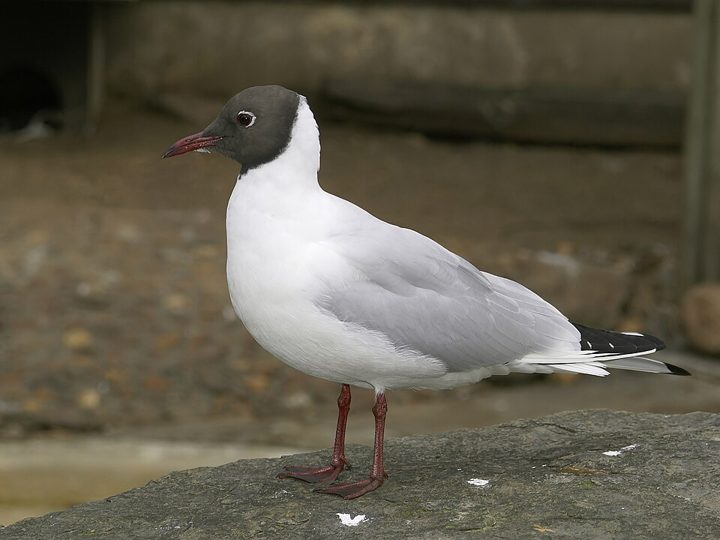
A small, neat gull with a red bill, red legs and a white leading edge to the outer wing; in summer it wears a chocolate-brown hood that only looks black from a distance, and in winter the hood is lost, leaving just dark spots above and behind the eye.
It measures 34 to 39 cm from bill to tail, spans 100 to 110 cm across the wings and weighs 166 to 400 g, much smaller than the herring gull.
It is a bold, opportunistic feeder that eats insects, snails, worms and other invertebrates, plus small fish, berries and scraps, and it will follow a mower or plough to snap up whatever is turned up.
It is a newcomer to Iceland, colonising the country from around 1930 and increasing rapidly, with the population thought to have peaked at roughly 25,000 to 30,000 pairs shortly before 1990.
Most Icelandic birds migrate to western Europe for the winter, though thousands stay behind around harbours and towns in the south-west and north of the country.
Its species name ridibundus is Latin for laughing, a nod to the noisy chatter of a colony, and ducks and waders like to nest among the gulls because the colony drives off any intruder that comes near.
Breeding season
JFMAMJJASOND
Summer visitor, about April to early October, none seen on 5 October 2021; the survey recorded only foraging flocks on the point, not nesting
Least Concern (LC) on the Icelandic Red List of birds 2025
Kittiwakes were seen at Lárvaðall, alongside only a few gulls of other species. Bird and vegetation survey 2021, p. 7
The count on the lagoon was 2 kittiwakes on 4 June 2021 and 1 on 3 July 2021, listed as species number 22 in the report's appendix table. Bird and vegetation survey 2021, p. 12
The report names the kittiwake among the red-listed birds of the Skerðingsstaðir and Lárvaðall area, classed as vulnerable (VU) on the Icelandic Red List of 2018 alongside the great northern diver, oystercatcher, arctic tern and eider. Bird and vegetation survey 2021, p. 9
About
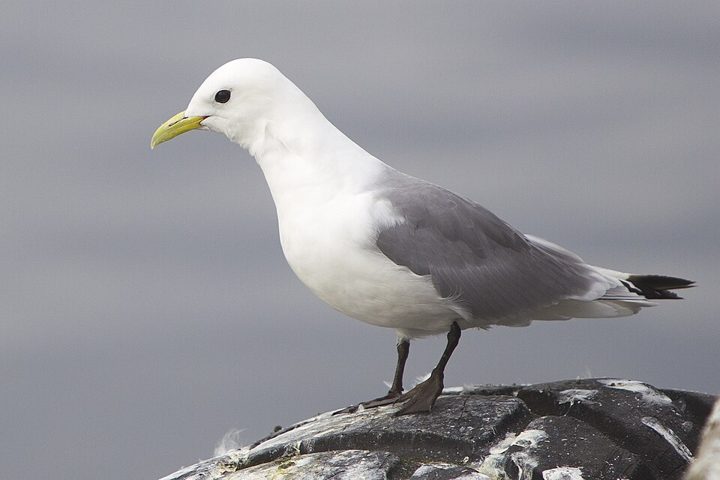
A small, neat gull with a yellow bill, black legs and wingtips that look dipped in ink, without the white spots other gulls show.
It is 37 to 41 cm long with a wingspan of 91 to 105 cm, clearly smaller than the great black-backed and glaucous gulls that are common on Icelandic coasts.
It feeds out at sea, snatching sandeels, capelin and other small fish from the surface, and unlike other gulls it does not scavenge at rubbish tips.
It is the only Icelandic gull that nests on sheer cliff ledges, and about 580,000 pairs bred around the country in 2005 to 2009, the biggest colony at Hornvík in the Westfjords and another large one at Látrabjarg across Breiðafjörður from Snæfellsnes.
Numbers have fallen by about 40 per cent worldwide in three generations, so it is classed as vulnerable both globally and on the Icelandic Red List.
Its English name is its own call, a shrill kittee-wa-aake shouted from the ledges, and in midwinter it keeps far from shore, around Iceland and east of Newfoundland.
Present
JFMAMJJASOND
In Icelandic waters all year, at the cliff colonies from spring to August and mostly far out at sea in winter
Vulnerable (VU) on the Icelandic Red List, 2018 and 2025
Seen, breeding not confirmed: 3 on the lagoon, 4 June 2021
In the survey
The 2021 bird survey recorded black-tailed godwit at Skerðingsstaðir among the wader species found in addition to the four waders that breed there, without confirming that it breeds on the site. Bird and vegetation survey 2021, p. 7
In the survey's appendix table of birds counted on the Lárvaðall lagoon, black-tailed godwit is species number 18, with a single record of 3 birds on 4 June 2021. Bird and vegetation survey 2021, p. 12
About
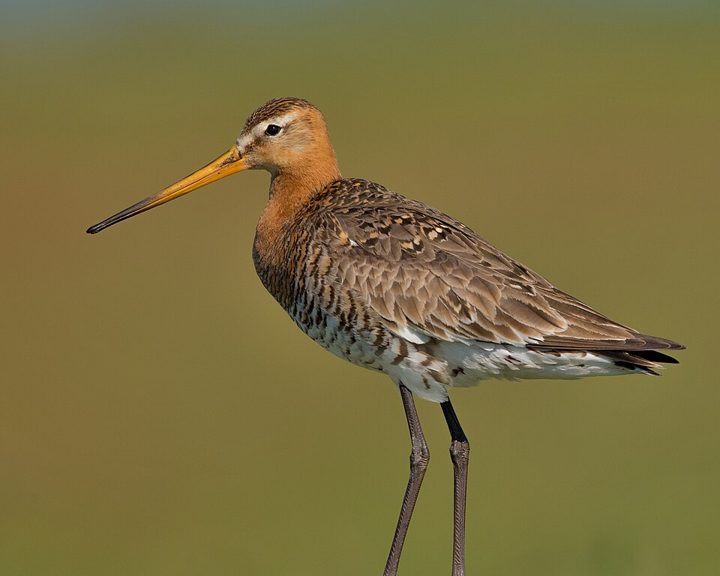
A large, long-legged wader with a long straight bill, yellowish or orange-pink at the base and dark at the tip in summer, when it also wears a rusty orange head, neck and breast, and in flight it shows a bold black and white wingbar, a white rump and the black tail band that gives it its name.
It measures about 42 cm from bill to tail with a wingspan of 70 to 82 cm, males weighing around 280 g and females about 340 g, and it is much like the bar-tailed godwit in size and shape but stands taller.
It feeds mainly on invertebrates, probing soft mud and wet grassland with its long bill, often with its head right under the water, for worms, molluscs, beetles, flies and other insects, and it adds some water plants to its diet in winter and on migration.
Icelandic birds belong to the subspecies islandica, which breeds almost nowhere but Iceland, and Náttúrufræðistofnun Íslands puts the Icelandic population at about 68,000 pairs, nearly all nesting below 300 m.
Once confined to the south and south-west of Iceland, it has spread across the whole country over the past century and now breeds in every region, nesting in marshes, flood meadows and bogs, and it winters in Britain and Ireland and along the west coast of Europe from the Netherlands south to Spain and Portugal.
Icelandic pairs spend the winter apart yet arrive back on their breeding grounds within an average of three days of each other.
Present
JFMAMJJASOND
Summer visitor, arrives mid April to mid May, eggs and chicks May to July, flocks leave from late July and most are gone by September
Near Threatened (NT) on the Icelandic and IUCN red lists; protected in Iceland
Not mentioned on Lárvaðall; heavy traffic on neighbouring Hálsvaðall
In the survey
The only mention of brent geese in the surveys is on Hálsvaðall, the neighbouring lagoon a short distance east of Lárvaðall, where the report describes mudflats with heavy traffic of birds such as waders, brent geese and eiders. Bird and vegetation survey 2021, p. 9
The report gives no count of brent geese on Hálsvaðall, only the description 'mikil umferð', heavy traffic. Bird and vegetation survey 2021, p. 9
Hálsvaðall is used as a comparison because its bird life is said to resemble what Lárvaðall had before its outlet was dammed, and what Lárvaðall could presumably regain if it were restored. Bird and vegetation survey 2021, p. 9
About
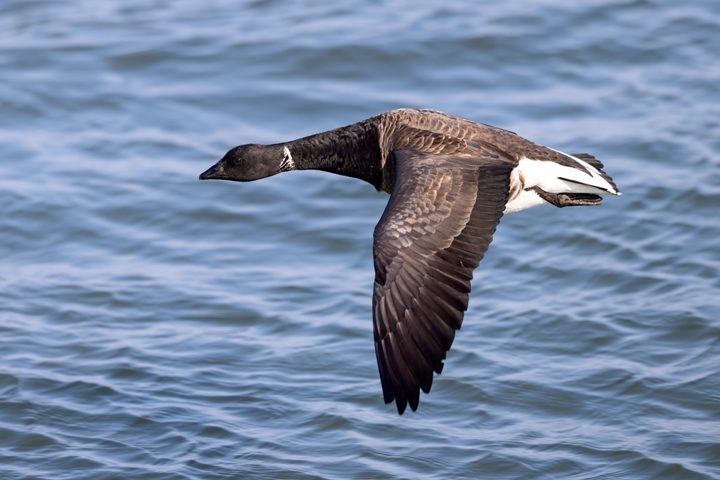
The smallest goose seen in Iceland, 55 to 66 cm long and about the size of a mallard, with a black head, neck and breast, a small white patch on either side of the neck and, in the pale-bellied form that visits Iceland, flanks and belly noticeably paler than the back.
Outside the breeding season it lives on the coast, grazing eelgrass and green algae on mudflats at low tide, and in Iceland the flocks also graze grass and winter-sown cereal fields.
The birds that pass through Iceland belong to the pale-bellied subspecies hrota and to the population that breeds in the Canadian High Arctic and winters almost entirely in Ireland, some 35,000 to 40,000 birds between 2005 and 2018, so nearly the whole population stops in Iceland twice a year.
Faxaflói and Breiðafjörður are the main staging grounds, and spring counts between 1990 and 2010 put about 55 per cent of the birds in Iceland on Breiðafjörður alone.
The species does not normally breed in Iceland; the first known nest was found at Bessastaðanes near Reykjavík in 2018.
When a wasting disease destroyed the eelgrass beds on both sides of the North Atlantic in the early 1930s brent goose numbers collapsed, and the birds recovered partly by turning to sea lettuce and other food.
Passing through
JFMAMJJASOND
Passage migrant only: flocks arrive from Ireland in early April, peak around 10 May and leave in the last days of May for Arctic Canada, then pass back through from the second half of August into early November
Protected under Icelandic law (no. 64/1994); Least Concern on the Icelandic Red List 2025
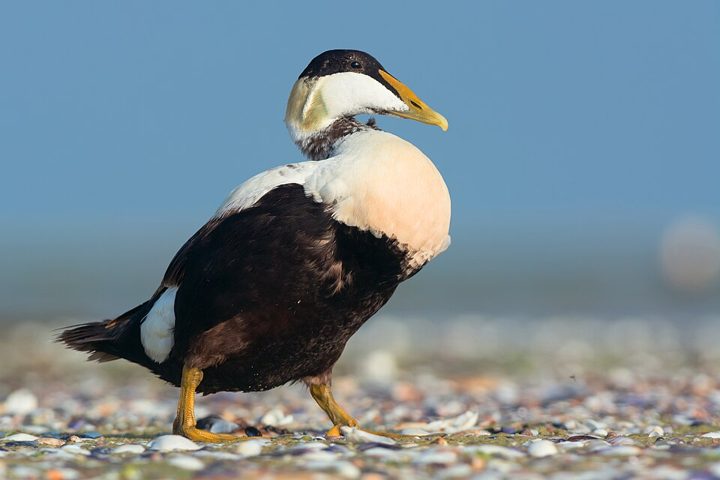
On 4 June 2021 the survey counted 7 male and 3 female eiders on Lárvaðall, and on 3 July 2021 it found 2 females. Bird and vegetation survey 2021, p. 12
Earlier counts on the lagoon gave 50 eiders on 28 September 2015 and 20 on 15 July 2017. Bird and vegetation survey 2021, p. 12
Eiders were not recorded on the 2021 counts of 5 May, 24 July, 2 September or 5 October. Bird and vegetation survey 2021, p. 12
In the report's count table the males appear under the Icelandic word bliki and the females under kolla, the eider being the only duck for which Icelandic uses separate everyday names for the two sexes. Bird and vegetation survey 2021, p. 12
Eider ducklings were seen on Lárvaðall in 2017. Bird and vegetation survey 2021, p. 6
On Hálsvaðall, the neighbouring lagoon a short distance to the east, the mudflats carry heavy traffic of waders, brent geese and eiders. Bird and vegetation survey 2021, p. 9
The report suggests that if Lárvaðall's outlet were opened and the sea allowed to flow freely in and out, its bird life would presumably become similar to Hálsvaðall's. Bird and vegetation survey 2021, p. 9
The report names the eider among the red-listed vulnerable species of the study area, together with great northern diver, oystercatcher, arctic tern and kittiwake. Bird and vegetation survey 2021, p. 9
About
Iceland's largest duck: the drake is white above and black below with a pale green nape, the female is barred brown all over, and both are around 60 cm long with a wingspan close to a metre.
It dives for blue mussels and other shellfish, crabs and sea urchins, swallowing them whole and crushing the shells in its muscular gizzard.
A sea duck through and through, it stays on the Icelandic coast all year and gathers in large rafts on sheltered bays and fjords in winter.
Iceland holds around 300,000 breeding pairs, and Breiðafjörður alone has close to 60,000 of them, a fifth of the national total, spread over its thousands of islands and skerries.
The duck lines her nest with down plucked from her own breast, and Icelandic farmers have gathered this eiderdown for centuries, replacing it with hay so the eggs stay warm, which is why Iceland supplies around three quarters or more of the world's eiderdown.
Ducklings leave the nest within a day of hatching and gather into crèches watched over by several females, while the drakes play no part in raising them.
Present all year
JFMAMJJASOND
Resident all year; eggs in May and June, ducklings on the water from June into July, large winter flocks on the fjord
Vulnerable (VU) on the 2018 Icelandic Red List cited by the report, Near Threatened (NT) on the 2025 list; fully protected in Iceland since 1847
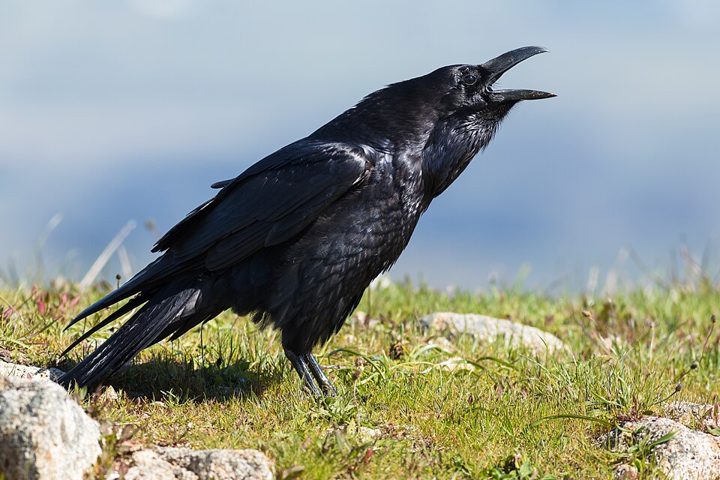
Ravens were seen at Skerðingsstaðir during the 2021 survey, one of only four passerine species recorded there. Bird and vegetation survey 2021, p. 7
The survey does not say whether ravens breed on the point. Bird and vegetation survey 2021, p. 7
In the lagoon counts the raven is listed as species number 33, the last species in the appendix table. Bird and vegetation survey 2021, p. 12
On the Lárvaðall lagoon 15 ravens were counted on 28 September 2015, 3 on 29 August 2018, 2 on 4 June 2021, 11 on 2 September 2021 and 2 on 5 October 2021. Bird and vegetation survey 2021, p. 12
The two highest counts, 15 on 28 September 2015 and 11 on 2 September 2021, both fell on autumn dates. Bird and vegetation survey 2021, p. 12
About
The raven is the heaviest of all songbirds, about 63 cm long and weighing around 1.5 kilograms, and is told from a crow by its heavy bill, shaggy throat feathers, wedge-shaped tail and deep croaking call.
It eats almost anything, from carrion and shellfish on the shore to the eggs and chicks of other birds, small mammals, berries and scraps around farms.
In Iceland it is a full resident that nests on cliffs and crags in every part of the country, though young birds wander widely before they settle and pair for life.
It is one of the earliest breeders in Iceland, laying 4 to 6 eggs in spring, with the chicks hatching after about three weeks.
The Icelandic population was put at around 2,000 pairs in 1985 and has declined since, so the raven is listed as Vulnerable on the Icelandic Red List even though it may still be hunted all year round.
Ravens run through Icelandic story: Hrafna-Flóki released three to find the island, Odin's ravens Huginn and Muninn flew the world each day to bring him news, and folk belief says ravens hold a parliament, a hrafnaþing, each spring and autumn.
Present
JFMAMJJASOND
Resident all year; eggs in April, sometimes late March, young in the nest through May and June, flocks gather in autumn
Vulnerable (VU) on the Icelandic Red List of birds
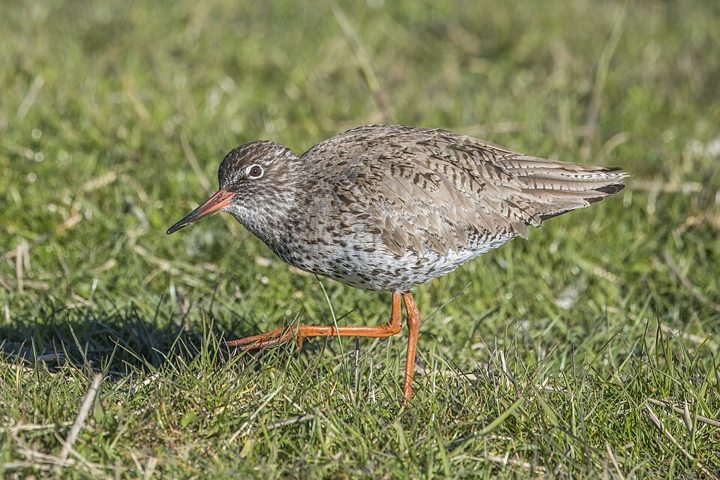
The breeding bird mapping visits of 4 June and 3 July 2021 found 2 pairs of redshanks breeding on the Skerðingsstaðir land, one of 6 moorland bird species recorded there. Bird and vegetation survey 2021, p. 5
Table 1 gives 2 pairs and a density of 38 pairs per km², and Figure 3 places the two territories in the north-west near the shore and on the north-east edge of the land. Bird and vegetation survey 2021, p. 6
The report notes that the redshank is on the Icelandic red list as near threatened (NT), but with only two pairs found and redshanks used to living close to people it expects the effects to be insignificant. Bird and vegetation survey 2021, p. 9
On the Lárvaðall lagoon the counts were 8 on 15 July 2017, 3 on 5 May 2021, 8 on 4 June 2021, 10 on 3 July 2021 and 4 on 24 July 2021, with 10 the highest. Bird and vegetation survey 2021, p. 12
About
A medium sized wader about 28 cm long, with bright orange-red legs, an orange-red base to its straight dark-tipped bill and a broad white trailing edge to each wing that flashes in flight.
Like most waders it feeds on small invertebrates, insects, worms, snails and small crustaceans, picked from wet grassland, mud and the tideline.
In Iceland it is a common lowland bird of wet meadows, marshes and farmland all round the country, and the Icelandic population is put at about 75,000 pairs, one of the largest in Europe.
Icelandic birds belong to their own subspecies, robusta, which is larger than the redshanks of mainland Europe and winters around the North Sea, many of them on the estuaries of Britain and Ireland.
The nest is a cup hidden in a grass tussock and covered over by the surrounding vegetation, and the usual clutch is four eggs laid from late May.
Known as the sentinel or warden of the marshes, it is usually the first bird to spot an intruder and takes off with a loud piping alarm that puts every other bird up as well.
Breeding season
JFMAMJJASOND
Summer visitor, back in April, eggs and chicks late May to July, most gone by October to winter around the North Sea
Near threatened (NT) on the 2018 Icelandic red list cited by the report, raised to vulnerable (VU) in 2025; protected in Iceland
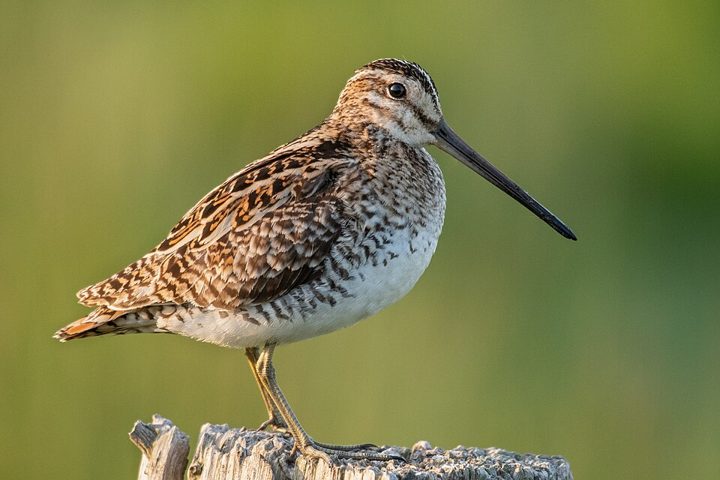
Four common snipe showing breeding behaviour were found on the Skerðingsstaðir land during the breeding bird mapping visits of 4 June and 3 July 2021. Bird and vegetation survey 2021, p. 5
The snipe was one of 6 moorland bird species recorded in the breeding bird mapping. Bird and vegetation survey 2021, p. 5
Table 1 gives 4 pairs of snipe on the Skerðingsstaðir land, a density of 76 pairs per square kilometre. Bird and vegetation survey 2021, p. 6
Figure 3 maps the four snipe territories: one centre-east, one in the south-west near the old ruin, one south-east of the centre and one by the gate at the road. Bird and vegetation survey 2021, p. 6
Counts on the Lárvaðall lagoon found 10 snipe on 15 July 2017, 4 on 5 May 2021, 5 on 4 June 2021 and 5 on 3 July 2021. Bird and vegetation survey 2021, p. 12
About
A plump, streaky brown wader with a straight bill about a quarter of its body length, it sits tight in the grass and bursts up in a zigzag flight with a rasping call when disturbed.
Adults are 25 to 27 cm long with a wingspan of 44 to 47 cm and weigh 80 to 140 g.
It probes soft mud and wet turf for earthworms and insect larvae, feeling for them with the sensitive, flexible tip of its bill.
It breeds in bogs, wet meadows and grassland across lowland Iceland, most densely in the western half of the country, and nearly all Icelandic birds spend the winter in Ireland and western Europe.
Iceland holds around 300,000 breeding pairs, more than 95 percent of the subspecies faeroeensis, which breeds only in Iceland, the Faroes, Orkney and Shetland.
Its Icelandic name means horse cuckoo, after the neighing drum the male makes in display flight with its fanned outer tail feathers, and folklore says the direction from which you first hear it in spring foretells your year, with wealth from the east, bliss from the south, misery from the west and death from the north.
Breeding season
JFMAMJJASOND
Summer visitor, arrives in April, leaves in September and October, a few winter in Iceland
Least Concern on the Icelandic Red List, protected, not a huntable species
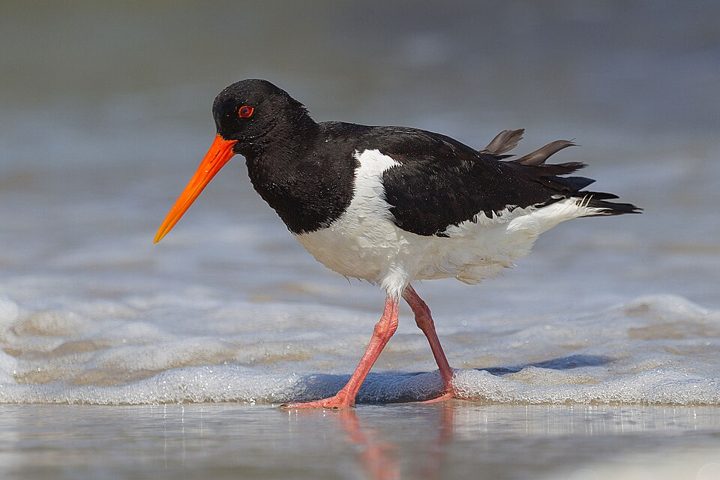
Two pairs of oystercatchers were found breeding on the Skerðingsstaðir land during the mapping visits of 4 June and 3 July 2021. Bird and vegetation survey 2021, p. 5
It was one of 6 moorland bird species found breeding in the survey of the land. Bird and vegetation survey 2021, p. 5
The two pairs give a density of 38 pairs per square kilometre in the survey's table of breeding birds. Bird and vegetation survey 2021, p. 6
The two territories lay one on the north-west shore and one on the east side of the land by the stream mouth. Bird and vegetation survey 2021, p. 6
Of the birds breeding at Skerðingsstaðir the oystercatcher is on the Icelandic red list as vulnerable, but the report notes that oystercatchers are used to living close to people and expects the effect of the hotel on them to be insignificant. Bird and vegetation survey 2021, p. 9
The report names it among five vulnerable red-list species in the survey, alongside the great northern diver, arctic tern, kittiwake and eider. Bird and vegetation survey 2021, p. 9
On the Lárvaðall lagoon counts the highest number was 5 birds on 4 June 2021, with 3 on 15 July 2017, 2 on 29 August 2018, 2 on 5 May 2021, 1 on 3 July 2021 and 2 on 24 July 2021. Bird and vegetation survey 2021, p. 12
None were seen on the lagoon counts of 2 September and 5 October 2021. Bird and vegetation survey 2021, p. 12
About
A large black and white wader with a long straight orange-red bill, red eyes and short dull pink legs, easy to know by its loud piping call that carries right across the shore.
It is about 40 to 45 cm long with a wingspan of 80 to 85 cm, weighs 460 to 620 g, and the bill alone is 8 to 9 cm.
Despite the name oysters are a small part of its diet, and it lives mainly on mussels, cockles and other shellfish on the shore and on earthworms in fields.
Birds with broad bill tips prise or hammer open shellfish while pointed-billed birds dig for worms, and each bird specialises in one technique learnt from its parents.
In Iceland it is a lowland bird of coasts, river banks and lake shores all round the country, and it has long been most numerous around Faxaflói and Breiðafjörður.
About 13,000 pairs breed in Iceland, and while most cross the Atlantic to winter in Britain and Ireland, several thousand, roughly a third of the population, stay in Iceland, mainly at Breiðafjörður, Faxaflói and Hornafjörður.
Unusually for a wader both parents feed the chicks, and a bird ringed in England in 1982 was caught again in 2025, at least 46 years old.
Breeding season
JFMAMJJASOND
Most arrive in late March and leave the breeding grounds by September, but several thousand winter in Iceland, many of them in Breiðafjörður, so a few are about all year
Vulnerable (VU) on the Icelandic Red List 2018; protected under law 64/1994, no hunting
Common on the lagoon, not breeding: 60 counted October 2021
In the survey
In summer 2021 the wigeon was one of the commonest ducks on Lárvaðall, yet the report singles it out as the one common duck not found breeding there. Bird and vegetation survey 2021, p. 6
The ducks kept mainly to the coves on the south side of the lagoon, near the main road. Bird and vegetation survey 2021, p. 6
A single drake was counted on the lagoon on 4 June 2021. Bird and vegetation survey 2021, p. 11
Sixty birds on 5 October 2021 is the largest wigeon count in the report's appendix table. Bird and vegetation survey 2021, p. 11
An earlier autumn count found 5 birds on 28 September 2015. Bird and vegetation survey 2021, p. 11
The report calls it by its short name, rauðhöfði, which simply means red head. Bird and vegetation survey 2021, p. 11
About
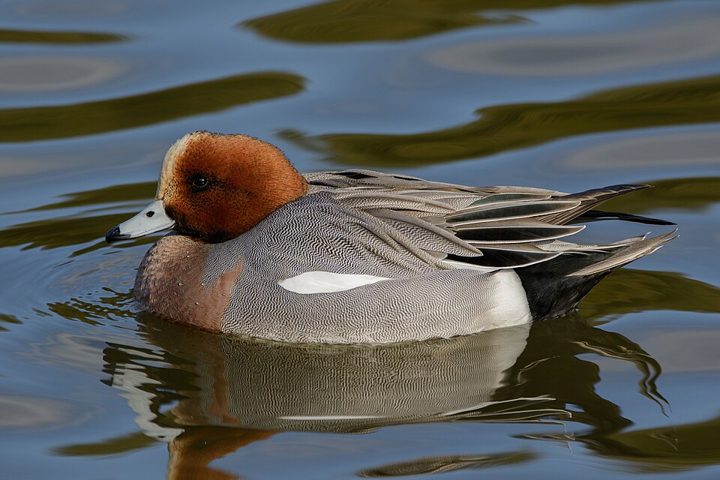
The drake has a chestnut head with a cream forehead, a pink breast and a grey body, and gives the far carrying rising whistle, whee-oo, while the duck is a plainer brown.
It is a medium sized dabbling duck, 42 to 52 cm long with a wingspan of 71 to 80 cm, weighing between about 500 g and 1 kg.
It is the most grass loving of the ducks, grazing readily on land like a small goose and dabbling in shallow water for pondweed, horsetail and other plants.
In Iceland it breeds by lowland lakes and marshes across the country, with Mývatn in the north its great stronghold, where 1,000 to 2,000 drakes are counted each spring, and the whole Icelandic population is put at 4,000 to 6,000 pairs.
Most Icelandic wigeon cross the sea to winter in Britain and Ireland, mainly Scotland, though 2,000 to 4,000 stay through the winter, mostly in the south and south west of the country.
Counts at Mývatn fell by more than 40 per cent between 2012 and 2024, which moved the species to near threatened on the 2025 Icelandic Red List.
Present
JFMAMJJASOND
Arrives in April, flocks build on the lagoon in autumn and most have left by November; not found breeding at Lárvaðall, though it nests elsewhere in lowland West Iceland
Near threatened on the Icelandic Red List 2025; huntable 1 September to 15 March
Seen, breeding not confirmed: 3 on Lárvaðall, June 2021
In the survey
The golden plover was one of the additional wader species found at Skerðingsstaðir besides the four that breed there, and the report does not say whether it breeds on the site. Bird and vegetation survey 2021, p. 7
On the lagoon count of 4 June 2021, 3 golden plovers were recorded on Lárvaðall. Bird and vegetation survey 2021, p. 12
An autumn flock of 25 golden plovers was counted on Lárvaðall on 28 September 2015, in the earlier lagoon count listed in the report's appendix table. Bird and vegetation survey 2021, p. 12
About
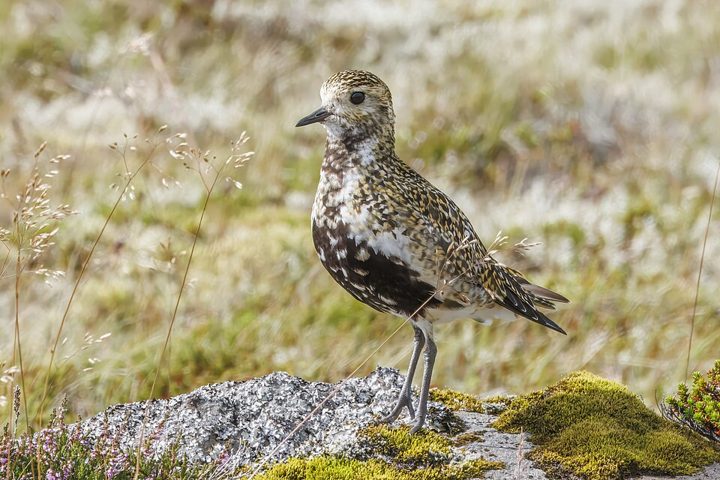
In summer the golden plover is unmistakable, with a gold-spangled back and a black face, throat and belly framed by a white border, and its plaintive single whistle carries far across the heath.
It is a fairly large plover, about 26 to 29 cm long with a wingspan of 67 to 76 cm, and it runs a few steps, pauses and tilts forward to feed in the typical plover manner.
It feeds mainly on beetles, craneflies, earthworms, snails and other small creatures picked from the ground, and takes berries such as crowberry in autumn.
In Iceland it nests on heathland and moorland right across the country, with about two thirds of the population breeding below 300 metres, so the lowland heaths of Snæfellsnes suit it well.
Iceland holds a large share of the world population, with an estimated 396,000 breeding pairs, though monitoring has shown a decline of roughly 40 per cent that placed it on the Icelandic Red List.
The arrival of the first lóa in late March is reported in the national news each year as the sign that spring has come, and Icelanders say it comes to sing away the snow.
Present
JFMAMJJASOND
Summer visitor, first birds in late March and most in April, eggs and chicks May to July, flocks gather on shores and fields before leaving in October and November
Vulnerable (VU) on the Icelandic Red List, protected under Act 64/1994
Regular visitor in small flocks; 35 counted in September 2015
In the survey
Glaucous gulls were seen regularly around Lárvaðall and Skerðingsstaðir in 2021, but only in small flocks. Bird and vegetation survey 2021, p. 7
The largest glaucous gull colony in Iceland lies a short distance away at Mýrarhyrna, which is why the birds turn up here so often. Bird and vegetation survey 2021, p. 7
The survey lists the glaucous gull among the species found in the study area that are on the Icelandic Red List as endangered (EN), the same category as the greater scaup. Bird and vegetation survey 2021, p. 9
Counts on the Lárvaðall lagoon in 2021 were 4 on 5 May, 11 on 4 June, 2 on 3 July, 12 on 24 July and 4 on 5 October. Bird and vegetation survey 2021, p. 12
Earlier counts on the lagoon were 35 on 28 September 2015, the highest figure in the survey's table, and 5 on 15 July 2017. Bird and vegetation survey 2021, p. 12
None were recorded on the lagoon on 26 June 2011, 29 August 2018 or 2 September 2021. Bird and vegetation survey 2021, p. 12
About
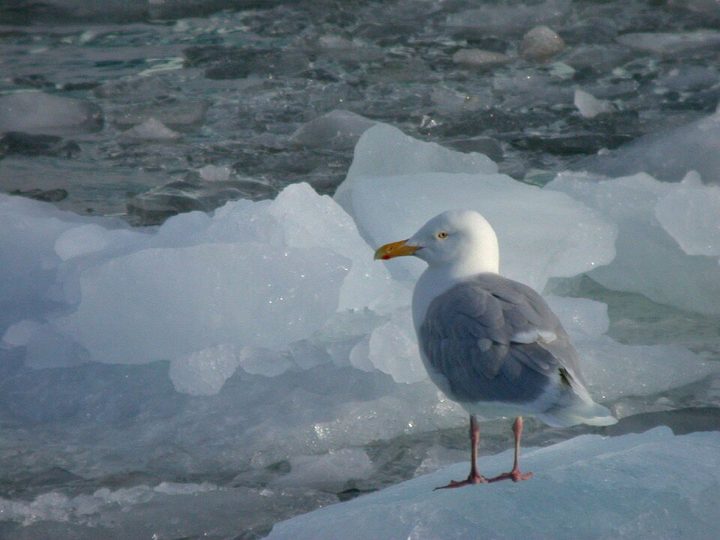
A very large, pale grey and white gull with pure white wingtips and no black anywhere in the wings or tail, second in size among the world's gulls only to the great black-backed gull.
Adults are 55 to 77 cm long with a wingspan of 132 to 170 cm, and the heavy yellow bill carries a red spot near the tip of the lower mandible.
Around Iceland its main food is sand eel and capelin, but it also picks mussels, crabs and starfish off the shore, scavenges scraps around fishing boats and takes carrion and the eggs and young of other birds.
In Iceland it nests almost only in the west, chiefly around Breiðafjörður and in the Westfjords, and the largest colony in the country is on the mountain Mýrarhyrna beside Grundarfjörður.
Icelandic breeders stay all year, but the breeding population fell from 10,000 to 15,000 pairs around 1990 to about 2,400 pairs in 2005 to 2009, with most colonies losing 80 percent or more of their birds.
In Iceland it interbreeds with the herring gull and birds of every intermediate shade are known, and an older English name for the species is burgomaster, the title of a Dutch town mayor.
Present
JFMAMJJASOND
Resident all year around Breiðafjörður, with birds from Greenland and Svalbard probably joining in winter; eggs from May and chicks on the nesting grounds until late July
Endangered (EN) on the Icelandic Red List for birds (2018, kept in 2025); may still be hunted 1 September to 15 March
Frequent visitor in small flocks, peak 12 in October 2021
In the survey
The survey found the great black-backed gull a frequent visitor at Lárvaðall, though only small flocks were seen. Bird and vegetation survey 2021, p. 7
The survey lists it among the birds of the Skerðingsstaðir and Lárvaðall study area that stood on the Icelandic Red List as endangered (EN), the same category as the greater scaup. Bird and vegetation survey 2021, p. 9
It was counted on the lagoon on nine of the ten count dates, missing only 26 June 2011 when just ducks were counted. Bird and vegetation survey 2021, p. 12
The highest counts on Lárvaðall were 12 birds on 5 October 2021 and 10 on 28 September 2015. Bird and vegetation survey 2021, p. 12
Through the 2021 survey year the counts were 3 on 5 May, 4 on 4 June, 3 on 3 July, 2 on 24 July, 2 on 2 September and 12 on 5 October. Bird and vegetation survey 2021, p. 12
Earlier visits produced single birds, 1 on 15 July 2017 and 1 on 29 August 2018. Bird and vegetation survey 2021, p. 12
About
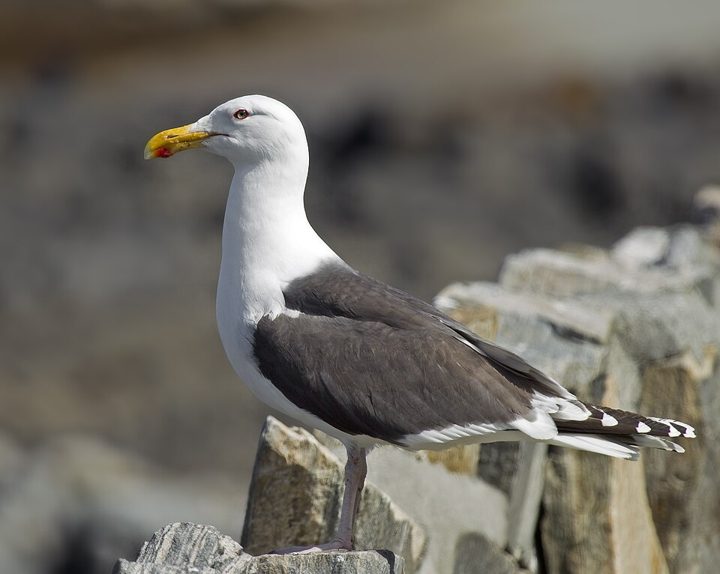
It is the largest gull in the world, with a white head and body, slate-black back and wings, pink legs and a heavy yellow bill with a red spot.
Adults measure 64 to 79 cm long with a wingspan of 1.5 to 1.7 metres, and the heaviest birds weigh more than 2 kg.
It eats fish, crabs and carrion, robs other birds of their catch, and takes the eggs and chicks of seabirds and even adult puffins.
It breeds on coasts all around Iceland and mostly stays through the winter, and Breiðafjörður holds about half of Iceland's breeding pairs and the country's only internationally important breeding area.
Iceland's population has fallen from roughly 50,000 pairs in 1982 to an estimated 6,000 to 8,000 pairs in 2016, and the winter count index dropped 84 per cent between 1987 and 2024.
Its Icelandic name svartbakur simply means black back, and although the bird is protected by law it may still be shot all year round under a 1994 regulation.
Breeding season
JFMAMJJASOND
Resident all year in Breiðafjörður; eggs on islands and skerries from early May, chicks on the wing from late July into August
Icelandic Red List: critically endangered (CR) since 2025, endangered (EN) in 2018; may be hunted all year
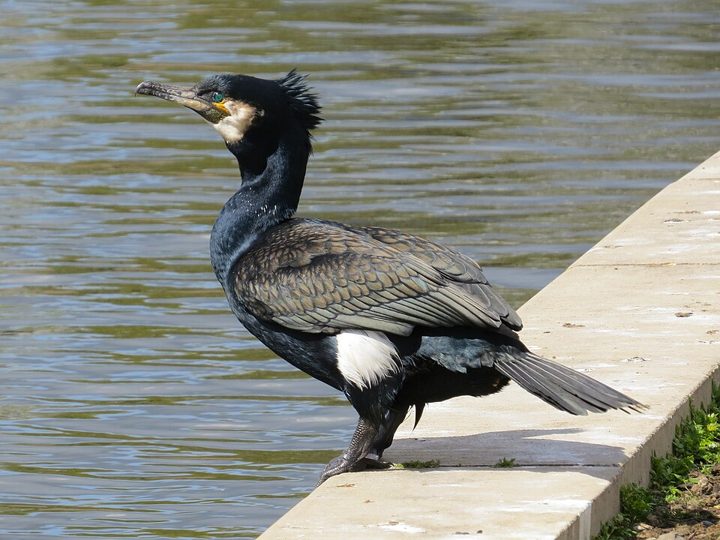
Great cormorants were counted on Lárvaðall lagoon on all four survey dates: 3 on 28 September 2015, 6 on 29 August 2018, 1 on 24 July 2021 and 6 on 2 September 2021. Bird and vegetation survey 2021, p. 12
The two highest counts, 6 birds each, fell on the late-summer dates of 29 August 2018 and 2 September 2021. Bird and vegetation survey 2021, p. 12
The lowest count was a single bird on 24 July 2021. Bird and vegetation survey 2021, p. 12
It appears as species number 12 in the report's appendix table of birds counted on the lagoon. Bird and vegetation survey 2021, p. 12
About
A big, dark, long-necked waterbird, 70 to 102 cm long with a wingspan of 121 to 160 cm, usually seen swimming low in the water or standing upright on a rock or post.
After fishing it perches with its wings held open to dry them, a pose Icelanders call 'að messa', saying mass, and one you can pick out from far across the lagoon.
It dives from the surface and chases fish underwater, driven by its large webbed feet, and in Iceland it eats mainly bottom fish such as flatfish and sculpins along with small saithe, small cod and lumpfish.
It lives in Iceland all year round, and nearly the whole population breeds on skerries and islands in Breiðafjörður and northern Faxaflói, so Lárvaðall lies in the heart of its Icelandic range.
Náttúrufræðistofnun counts the nests in about 200 colonies every May, largely from aerial photographs; the total fell to a low of 2,346 nests in 1995, passed 5,700 pairs in 2014, crashed when storm waves of over 10 metres washed whole colonies away in May 2023, and had recovered to 4,727 nests by 2025.
The Icelandic name dílaskarfur comes from the large white patch, a díll, on each thigh that adults wear in breeding plumage.
Breeding season
JFMAMJJASOND
Resident all year; eggs from April on Breiðafjörður skerries, nests counted each May, and lagoon numbers were highest in late summer
Icelandic Red List 2025: Least Concern (LC); huntable 1 September to 15 March
Breeds here: one pair raised young, up to 6 counted
In the survey
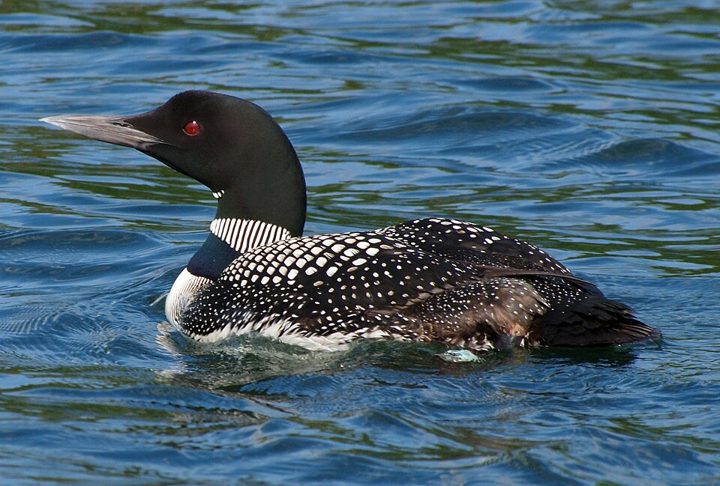
A pair of great northern divers bred on the eastern side of Lárvaðall and raised young. Bird and vegetation survey 2021, p. 7
The survey describes the great northern diver as both a breeding bird and a late-summer guest on Lárvaðall. Bird and vegetation survey 2021, p. 9
The report notes it is on the Icelandic red list as vulnerable (VU), alongside the oystercatcher, arctic tern, kittiwake and eider. Bird and vegetation survey 2021, p. 9
Six adults were on the lagoon on 15 July 2017, the highest number in any of the ten counts. Bird and vegetation survey 2021, p. 12
It was recorded on nine of the ten lagoon counts made between 2011 and 2021, missing only on 5 October 2021. Bird and vegetation survey 2021, p. 12
In 2021 the counts were 2 birds on 5 May, 2 on 4 June, 1 on 3 July, 3 on 24 July and 2 on 2 September. Bird and vegetation survey 2021, p. 12
Earlier counts gave 1 bird on 26 June 2011, 1 on 28 September 2015 and 2 on 29 August 2018. Bird and vegetation survey 2021, p. 12
About
A big, heavy diver, 66 to 91 cm long with a wingspan of 127 to 147 cm and a weight of around 3.5 kg, known in summer by its dagger bill, black head and chequered black and white back.
Fish make up about four fifths of its diet, caught by diving from the surface, and its legs are set so far back on the body that it can barely walk on land.
Iceland is the only place in Europe where it breeds regularly, roughly 200 to 300 pairs on lakes and ponds with fish from the lowlands up to about 600 m, densest in the west around Mýrar, Borgarfjörður and the heaths above Dalir and in the north around Mývatn.
Some Icelandic birds stay all winter at sea along the coast, while the rest cross to the seas around the British Isles and western Europe.
The pair lays one or two eggs, usually two, in a nest right at the water's edge, and the chicks often ride on a parent's back in their first days.
Its long wails and yodelling calls carry far over still water, and Icelandic folklore made it a weather prophet: calling on the water meant wet weather was coming, calling in flight meant wind.
Breeding season
JFMAMJJASOND
Pairs return to the lagoon in spring, eggs from late May, chicks June to August; counted here from May to September, and a few winter at sea around the coast
Vulnerable (VU) on the Icelandic Red List; fully protected; Icelandic responsibility species
Chuck Homler d/b/a Focus On Wildlife · CC BY-SA 4.0
Greater scaup
duggönd · Aythya marila
Common breeder on Lárvaðall: 41 counted on 2 September 2021
In the survey
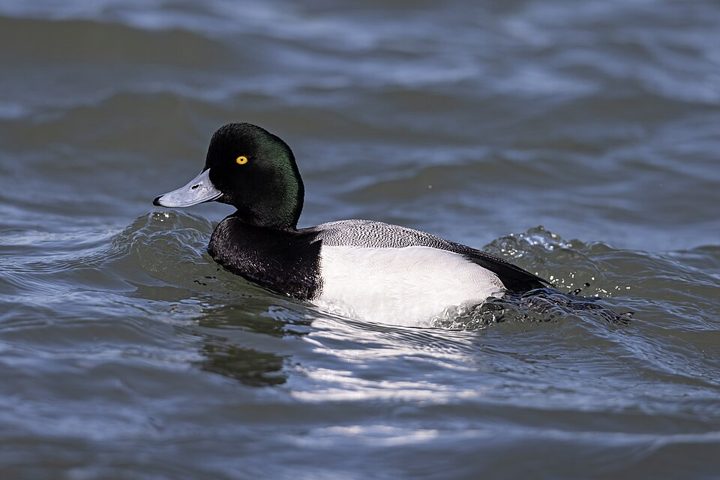
The greater scaup is one of the commonest birds on Lárvaðall, breeding there and, later in the summer, some of them moult their flight feathers on the lagoon. Bird and vegetation survey 2021, p. 9
It is a common breeding bird at Lárvaðall, and together with the other breeding ducks reared some tens of young in summer 2021. Bird and vegetation survey 2021, p. 6
The ducks keep mainly to the coves on the south side of the lagoon, near the main road. Bird and vegetation survey 2021, p. 6
On 4 June 2021 the count on the lagoon was 11 drakes and 9 females. Bird and vegetation survey 2021, p. 12
On 2 September 2021 the count reached 14 females and 27 unsexed or young birds, 41 in all, the highest total for the species. Bird and vegetation survey 2021, p. 12
None were recorded on 5 May or 3 July 2021, but 10 females and 2 unsexed or young birds were seen on 24 July and 5 birds remained on 5 October 2021. Bird and vegetation survey 2021, p. 12
Earlier counts on the lagoon include 25 birds on 26 June 2011, 10 on 28 September 2015, 2 females on 15 July 2017 and 18 on 29 August 2018. Bird and vegetation survey 2021, p. 12
The report notes that the greater scaup is on the Icelandic Red List as an endangered species (EN). Bird and vegetation survey 2021, p. 9
About
A stocky diving duck some 40 to 55 cm long, the drake with a black head glossed green, black breast, pale grey back, white flanks and a pale blue bill, while the brown female shows a broad white patch around the base of the bill.
It dives to the bottom for midge larvae, crustaceans, water snails and small mussels, takes some pondweed and green algae, and will also eat sticklebacks, staying under for up to a minute.
Iceland holds roughly 3,000 to 5,000 pairs, a large share of them at Mývatn, where about 2,000 drakes were once counted each spring but only 400 to 1,000 since 2010, a fall of about 55 per cent between 2009 and 2024.
Most Icelandic birds are migrants, arriving in late April and May and leaving in September and October for the coasts of Ireland, Britain and the Netherlands, though a few hundred winter off south-west Iceland.
Like all ducks it becomes flightless for a few weeks in late summer while it moults its flight feathers, which is why quiet, food-rich lagoons such as Lárvaðall matter to it.
It may still be hunted in Iceland from 1 September to 15 March, even though the national Red List classes it as endangered, but very few are actually shot.
Present
JFMAMJJASOND
Summer visitor, arrives late April or May, most gone by mid October; eggs in June, ducklings on the lagoon in July and August
Chuck Homler d/b/a Focus On Wildlife · CC BY-SA 4.0
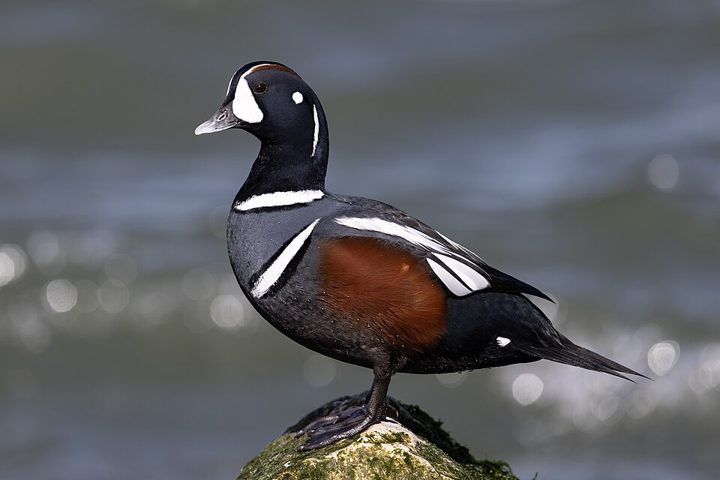
Harlequin duck
straumönd · Histrionicus histrionicus
One lagoon record: 7 birds on 28 September 2015
In the survey
Seven harlequin ducks, none of them sexed, were counted on the Lárvaðall lagoon on 28 September 2015. Bird and vegetation survey 2021, p. 12
That count, made by the observer Mark Colwell, is the only record of the species in the appendix table of lagoon counts, where it is listed as species number 7. Bird and vegetation survey 2021, p. 12
The record dates from 2015, six years before the 2021 survey visits, and no harlequin ducks were entered for any other date. Bird and vegetation survey 2021, p. 12
About
The drake is a small slate-blue duck with chestnut flanks and bold white crescents and spots on the head and neck, while the female is plain grey-brown with three white patches on the face.
It is a small sea duck, about 38 to 43 cm long with a wingspan of around 66 cm and a weight of roughly 600 g.
In summer it dives in fast rivers for blackfly larvae and pupae, and in winter it feeds among the breakers of rocky shores on snails, small shellfish and crustaceans.
Iceland holds the only breeding population in Europe, with pairs scattered along swift rivers in both lowland and highland and the largest concentration on the Laxá where it leaves Lake Mývatn.
The Icelandic breeding population is put at 3,000 to 5,000 pairs, based on a count of about 14,000 birds at sea in the winters of 1998 to 2001, and Breiðafjörður is the most important wintering area with 1,626 birds, 11.6 percent of the total.
The drakes leave the rivers for the sea from mid-June to moult, and the Icelandic name straumönd means stream duck, after the rushing water it feeds in.
Present
JFMAMJJASOND
At sea around Breiðafjörður all year, most in winter; nests by fast rivers, with eggs and ducklings from May to August, and the drakes back at sea from mid-June
Near threatened (NT) on the Icelandic Red List 2025; protected under the Wild Birds Act
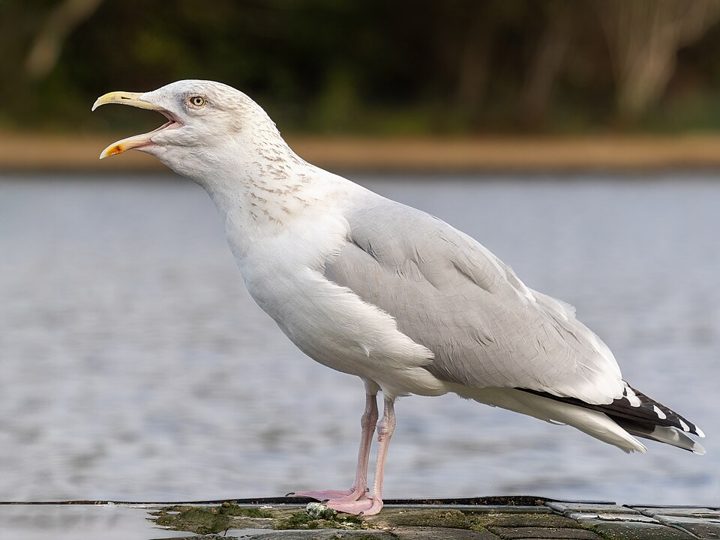
A single herring gull was counted on the Lárvaðall lagoon on 3 July 2021, the only record of the species in the survey's count table. Bird and vegetation survey 2021, p. 12
The survey text lists a herring gull, in the singular, among the few gulls of other species seen at Skerðingsstaðir. Bird and vegetation survey 2021, p. 7
It appears as species no. 24 in the appendix table of birds counted on the lagoon. Bird and vegetation survey 2021, p. 12
About
A large gull with a pale grey back, black wingtips spotted with white, pink legs and a yellow bill with a red spot near the tip.
Adults measure roughly 55 to 67 cm long with a wingspan of 125 to 155 cm, a good deal bigger than a kittiwake or a common gull.
It eats almost anything, from fish, crabs and shellfish to eggs, chicks, carrion and scraps from harbours and rubbish tips.
It is a newcomer to Iceland that began breeding here around 1930 and is still most numerous in the East Fjords, with scattered colonies on coasts around the country.
The Icelandic population has been guessed at 5,000 to 10,000 pairs, though no proper census has ever been made, and winter counts doubled up to 1990 and have since fallen by about 20 per cent, so the 2025 Icelandic Red List rates it Near Threatened.
In Iceland it interbreeds freely with the glaucous gull, and hybrid birds with paler wingtips breed in many places, so a gull that looks halfway between the two is not unusual here.
Breeding season
JFMAMJJASOND
Mostly resident in Iceland all year; eggs in May or June, chicks on the wing by late July or August
Near Threatened (NT) on the 2025 Icelandic Red List; may be hunted all year
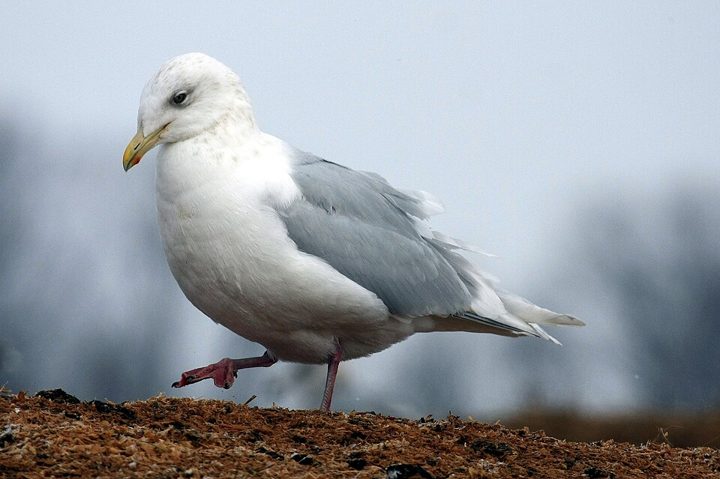
The 2021 bird survey recorded a few Iceland gulls at Lárvaðall and Skerðingsstaðir, without giving an exact count. Bird and vegetation survey 2021, p. 7
In the appendix table of earlier counts on the Lárvaðall lagoon the Iceland gull is listed as species number 26. Bird and vegetation survey 2021, p. 12
That table holds a single record of the species: one bird on 28 September 2015, seen by Mark Colwell. Bird and vegetation survey 2021, p. 12
About
A medium-sized gull, pale grey above and white below, smaller and thinner-billed than the glaucous gull, and the Greenland birds that make up most Icelandic visitors have pure white wingtips with no black at all.
It measures 50 to 64 cm long with a wingspan of 115 to 150 cm and weighs 480 to 1,100 g.
It is an omnivore that eats fish such as sandeel and capelin, fish waste, molluscs, crabs and kelp flies, and it gathers in thousands where fish is plentiful, as at Eyrarbakki in the capelin years.
Despite its name it does not breed in Iceland at all; it nests in Greenland, on Baffin Island and in Arctic Canada and comes to Icelandic coasts as a winter visitor.
Some 15,000 to 20,000 are thought to winter in Iceland each year, around 5 to 8 per cent of the world population, and the winter bird counts show a fairly steady increase since 1960.
When herring wintered in Kolgrafarfjörður, the next fjord east of Grundarfjörður, these gulls gathered there in their thousands, and the Icelandic name bjartmáfur means bright gull.
Present
JFMAMJJASOND
Winter visitor from Greenland, arriving from mid September; adults leave by the end of March and young birds by May, though a few were seen on the survey's summer visits in 2021.
Fully protected under Act 64/1994 on wild birds and mammals; Least Concern
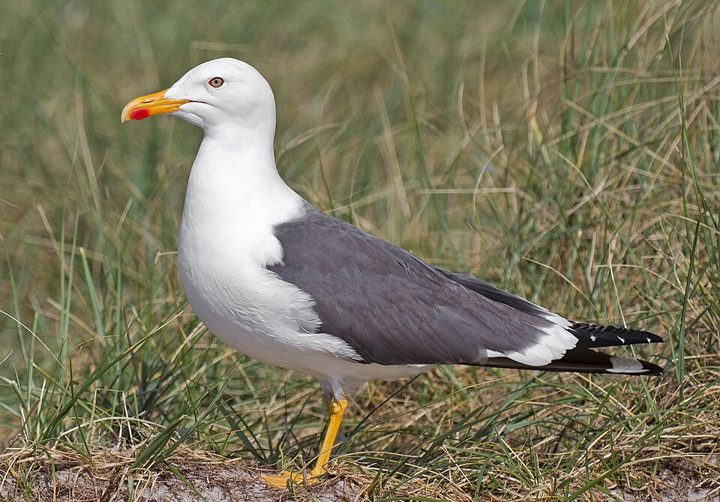
A few lesser black-backed gulls were seen around Lárvaðall and Skerðingsstaðir during the 2021 bird survey. Bird and vegetation survey 2021, p. 7
Counts on the Lárvaðall lagoon were 3 on 29 August 2018, 6 on 4 June 2021 and 3 on 2 September 2021. Bird and vegetation survey 2021, p. 12
About
A large gull with a dark slate-grey back, yellow legs and a yellow bill with a red spot, smaller and slimmer than the great black-backed gull, which has pink legs.
It measures 51 to 64 cm long with a wingspan of 124 to 150 cm.
Its Icelandic name means sand eel gull, and sand eels and other small fish are its main food, though it forages on land more than other big gulls, taking insects, worms, berries, carrion and scraps.
It only settled in Iceland around 1930, breeding first in the south and south west, yet by 2004 about 50,000 pairs bred here, most of them in one huge colony on Miðnesheiði by Keflavík airport.
When the sand eel stocks failed, the Miðnesheiði colony fell from over 40,000 pairs in 2004 to about 5,000 in 2005, and the species is now Near Threatened on the Icelandic Red List.
It is the only Icelandic gull that migrates completely, wintering on the coasts of Portugal, Spain and West Africa, and its early return in late February or March has earned it the nickname vorboðinn hrjúfi, the rough herald of spring.
Breeding season
JFMAMJJASOND
Summer visitor, first birds back in late February or March, most gone to Iberia and West Africa by October
Icelandic Red List: Near Threatened (NT); may be hunted all year
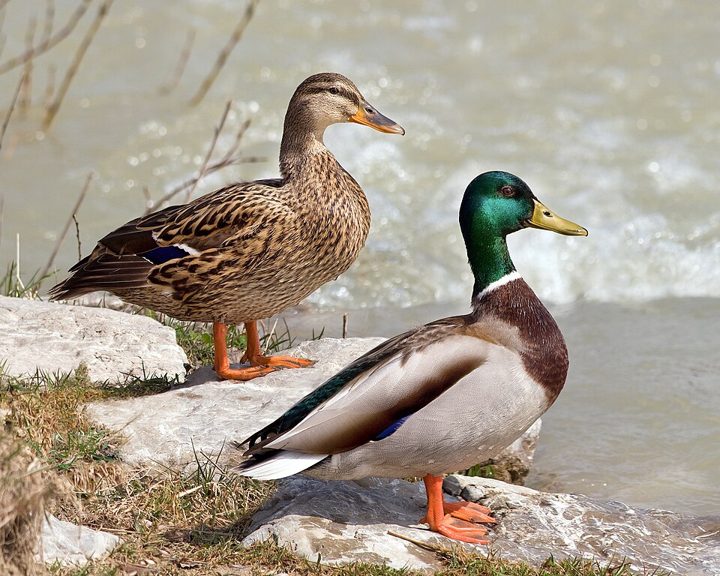
This picture was realized by Richard Bartz by using a Canon EF 70-300mm f/4-5.6 · CC BY-SA 2.5
Mallard
stokkönd · Anas platyrhynchos
Common breeding duck on Lárvaðall: 12 young counted September 2021
In the survey
The mallard was one of the commonest ducks on Lárvaðall in 2021, together with wigeon, scaup, tufted duck and red-breasted merganser. Bird and vegetation survey 2021, p. 6
It is a common breeding bird at Lárvaðall, and the breeding ducks together reared some tens of young in summer 2021. Bird and vegetation survey 2021, p. 6
The ducks keep mainly to the coves on the south side of the lagoon, near the main road. Bird and vegetation survey 2021, p. 6
On 4 June 2021 the count on the lagoon was 7 drakes and 4 females, and on 3 July 2021 it was 5 drakes and 1 female. Bird and vegetation survey 2021, p. 11
On 2 September 2021, 3 females were on the lagoon with 12 young, the highest count of mallard young in the survey table. Bird and vegetation survey 2021, p. 11
A female with a single duckling was seen on 29 August 2018, and 10 unsexed mallards were counted on 5 October 2021. Bird and vegetation survey 2021, p. 11
Other counts gave 8 unsexed birds on 15 July 2017, 2 unsexed birds on 5 May 2021 and a single drake on 24 July 2021. Bird and vegetation survey 2021, p. 11
Mallards were recorded on eight of the ten count dates between 2011 and 2021, missing only on 26 June 2011 and 28 September 2015. Bird and vegetation survey 2021, p. 11
About
The drake has a glossy bottle-green head, a white collar, a purple-brown breast and a curled black central tail feather, while the female is mottled brown, and both show a purple-blue wing patch edged in white.
It is 50 to 65 cm long with a wingspan of 81 to 98 cm and weighs 0.7 to 1.6 kg, a little heavier than most other dabbling ducks.
It feeds by dabbling and upending in shallow water and by grazing on land, taking seeds, water plants, insects, snails and small crustaceans.
Stokkönd is probably the most widespread duck in lowland Iceland, breeding by lakes, ponds, rivers and sheltered coastal lagoons, and most birds stay through the winter on the coast and other ice-free water.
The Icelandic breeding population is roughly estimated at 10,000 to 15,000 pairs, and the species is the main ancestor of most breeds of domestic duck.
The familiar loud quack is the female's call, while the drake gives a deeper and quieter version of it.
Breeding season
JFMAMJJASOND
Here all year; eggs from late April, ducklings on the lagoon from June, with late broods still present in early September
Least concern (LC) on the Icelandic Red List; may be hunted 1 September to 15 March
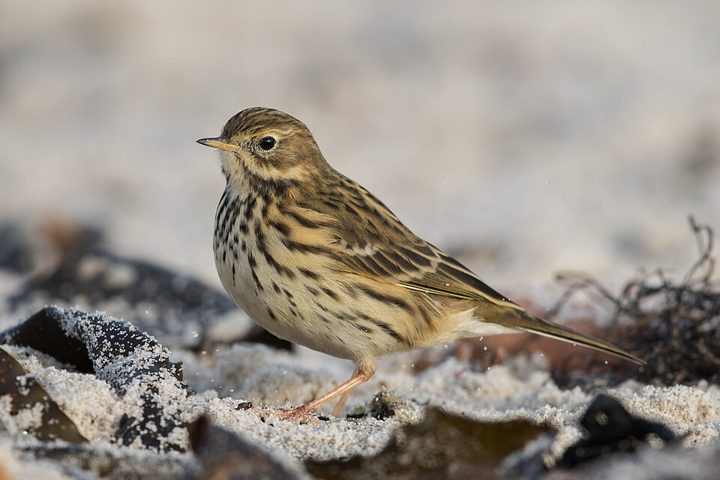
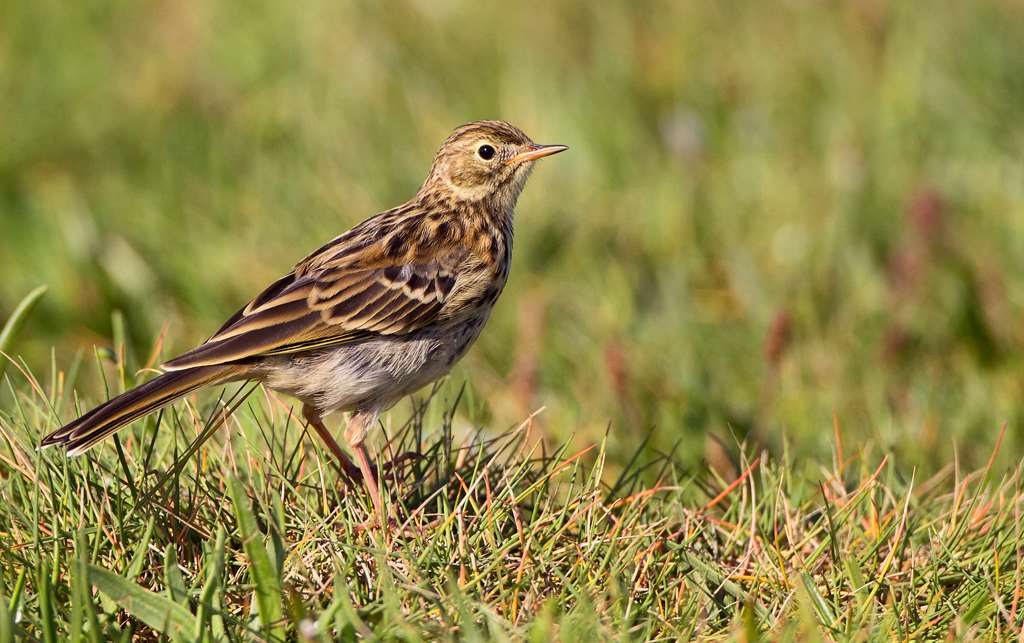
The meadow pipit is the commonest breeding bird on the land of Skerðingsstaðir, and it is the bird in the photograph on the cover of the vegetation and bird report. Bird and vegetation survey 2021, p. 3
In the breeding bird mapping of June and July 2021 it made up about half of all the breeding birds found, 9 pairs out of 19. Bird and vegetation survey 2021, p. 5
The surveyors describe the breeding density on the point as high, especially for the meadow pipit, and it was one of six moorland bird species found in the mapping. Bird and vegetation survey 2021, p. 5
Table 1 of the report gives 9 pairs at a density of 171 pairs per square kilometre. Bird and vegetation survey 2021, p. 6
The nine territories were spread over the whole point, from the north-west corner to the south-east corner by the road. Bird and vegetation survey 2021, p. 6
It was one of four songbird species recorded, and the report names it with the white wagtail as breeding at Skerðingsstaðir. Bird and vegetation survey 2021, p. 7
In the counts of birds on the Lárvaðall lagoon it was recorded on five dates: 2 on 15 July 2017, 4 on 5 May 2021, 2 on 4 June 2021, 2 on 3 July 2021 and 2 on 24 July 2021. Bird and vegetation survey 2021, p. 12
About
A small streaky brown songbird, 14.5 to 15 cm long and weighing 15 to 22 g, with a thin bill, pale pinkish legs, a long hind claw and a faint tsi-tsi call as it flits up from the grass.
It feeds mainly on insects, spiders and other small invertebrates picked from the ground and low vegetation, adding seeds and berries in autumn and winter.
It is the commonest moorland bird in Iceland and probably the commonest bird of any kind, with a population put at around one and a half million pairs by the Icelandic Institute of Natural History.
It nests across the lowlands in heath, moor, bog and grassland, from the coast up to about 600 m, hiding a neat cup of grass in the side of a tussock, usually laying four or five eggs and often raising two broods in a summer.
It is a summer visitor to Iceland, first seen around 20 April and mostly gone by the middle of October, spending the winter from Ireland and Britain down through western France and Spain to Morocco.
Its Icelandic name þúfutittlingur means roughly tussock bird, after the hummocks it nests in, and the male sings in a short song flight, rising steeply and then gliding back down on spread wings while still singing.
Breeding season
JFMAMJJASOND
Summer visitor, first birds about 20 April, most gone by mid October; eggs and chicks from mid May into July
Protected by law; Least Concern on the Icelandic Red List (2018)
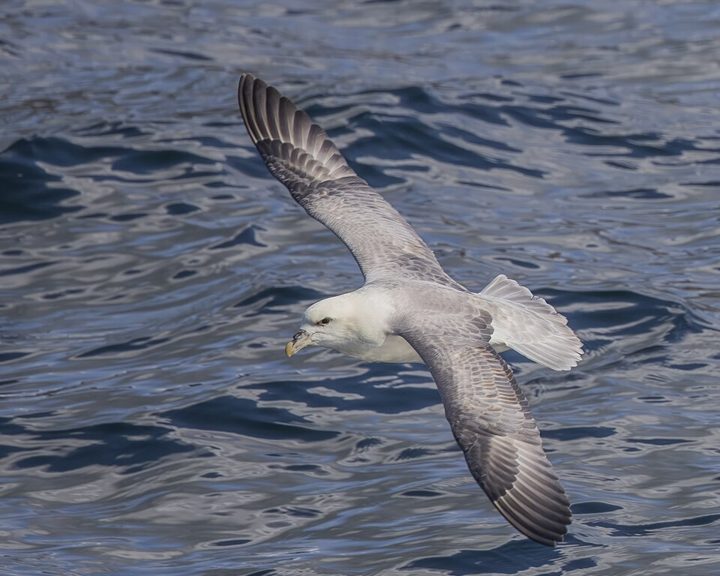
Fulmars were on Lárvaðall lagoon on every one of the four count dates: 20 on 15 July 2017, 3 on 29 August 2018, 2 on 4 June 2021 and 5 on 2 September 2021. Bird and vegetation survey 2021, p. 12
The survey names the fulmar among the birds found at Skerðingsstaðir and Lárvaðall that sit in the endangered (EN) category of the Icelandic Red List, the same category as the greater scaup. Bird and vegetation survey 2021, p. 9
About
A gull-like seabird with a thick neck, a stubby tube-nosed bill and stiff straight wings, it is in fact a petrel, and it glides low over the waves on the wind with barely a flap, quite unlike the loose flapping of a gull.
It is about 46 cm long with a wingspan of 102 to 112 cm, and Icelandic birds are mostly the pale form with a white head and body and grey wings and tail, though a few dark grey birds turn up too.
It feeds at the surface on fish, squid, shrimps, jellyfish and plankton, follows fishing boats for offal and discards, and dives no deeper than about 4 metres.
It nests on cliff ledges all round the Icelandic coast, with tens of thousands of pairs around Breiðafjörður, and unusually it also breeds inland, up to about 50 km from the sea at places such as Þingvallavatn, farther from salt water than fulmars nest anywhere else in the world.
Iceland holds about 1.2 million breeding pairs, the country's second commonest bird after the puffin, yet numbers are estimated to have fallen by about half since the mid 1980s and the decline has quickened since 2009, which is why it is classed as endangered here.
Its name comes from the Old Norse for foul gull, because a fulmar defends its single egg or chick by spitting a stinking stomach oil that mats a predator's feathers, and it can live for more than 50 years.
Breeding season
JFMAMJJASOND
Off the coast all year but fewest in autumn; back on the cliffs by February, one egg from early May, young fledge by mid September
Endangered (EN) on the Icelandic Red List, 2018 and 2025
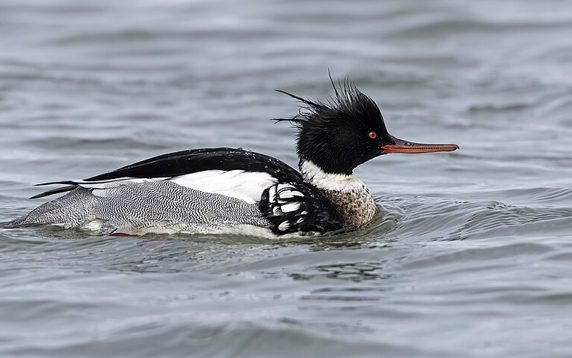
Breeds on Lárvaðall: 25 drakes and 7 females, June 2021
In the survey
The red-breasted merganser is one of the commonest ducks on Lárvaðall and a common breeding bird on the lagoon. Bird and vegetation survey 2021, p. 6
Together with the other breeding ducks it reared some tens of young on the lagoon in summer 2021. Bird and vegetation survey 2021, p. 6
The ducks keep mainly to the coves on the south side of the lagoon, near the main road. Bird and vegetation survey 2021, p. 6
In 2021 the counts were 8 unsexed birds on 5 May, 25 drakes and 7 females on 4 June, and 3 drakes and 7 females on 3 July. Bird and vegetation survey 2021, p. 12
Later in 2021 the count was 3 females and 15 unsexed or young birds on 24 July, 1 female and 17 unsexed or young on 2 September, and 15 unsexed or young on 5 October. Bird and vegetation survey 2021, p. 12
The 125 unsexed or young birds counted on 28 September 2015 is the largest count of any duck in the survey table. Bird and vegetation survey 2021, p. 12
Earlier visits found 2 unsexed or young birds on 26 June 2011 and 3 on 15 July 2017. Bird and vegetation survey 2021, p. 12
It was recorded on nine of the ten count dates between 2011 and 2021, with 29 August 2018 the only date without one. Bird and vegetation survey 2021, p. 12
About
A slim diving duck with a shaggy crest, a long thin red bill and a red eye, the drake with a glossy green head, white collar and speckled rusty breast, the female grey-brown with a rusty head.
It is about 51 to 64 cm long with a wingspan of 66 to 74 cm and weighs roughly 800 to 1,350 g, the drakes being the heavier.
It dives from the surface for small fish and grips them with a bill edged with backward-pointing serrations, which is why it is called a sawbill, and it also takes crustaceans, aquatic insects and worms.
Around 2,000 to 4,000 pairs breed in Iceland, and Breiðafjörður is one of only two breeding areas in the country ranked as internationally important, the other being Mývatn.
It is mostly a resident in Iceland, spending the winter almost entirely at sea along the coast, where the winter population is put at about 10,000 birds.
The nest is hidden on the ground near water and holds 7 to 12 eggs laid from June, the female alone incubates them for about a month, and the ducklings leave the nest within a day of hatching and take about two months to fly.
Present
JFMAMJJASOND
Mostly resident, wintering at sea along the coast; on the lagoon from May to October in the survey, eggs from June, ducklings on the water July to September
Near Threatened (NT) on the Icelandic Red List 2025; hunting allowed 1 September to 15 March
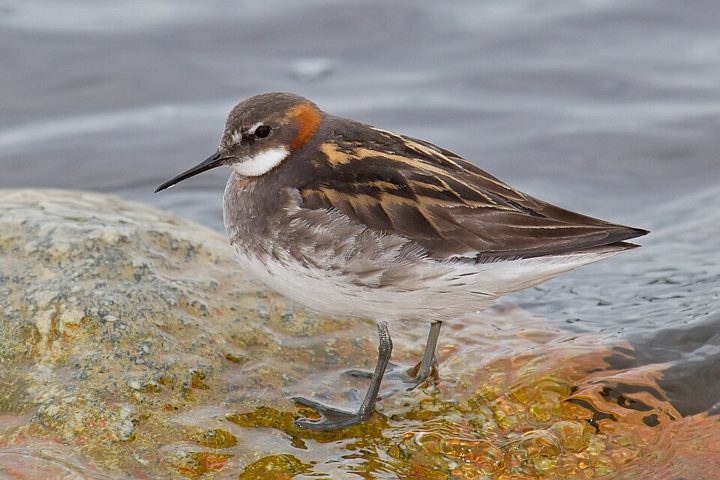
Lagoon visitor, not found breeding: 56 on 4 June 2021
In the survey
The survey lists the red-necked phalarope among the extra wader species found at Skerðingsstaðir beyond the four that breed there. Bird and vegetation survey 2021, p. 7
A flock of 56 red-necked phalaropes was seen on Lárvaðall on 4 June 2021, the first survey visit. Bird and vegetation survey 2021, p. 7
On the second visit, 3 July 2021, only 6 were counted on the lagoon. Bird and vegetation survey 2021, p. 12
The 56 birds in June were the largest count of any wader in the survey's count table. Bird and vegetation survey 2021, p. 12
About
A dainty wader about 18 cm long and only 35 to 40 g in weight that swims buoyantly like a tiny gull, with a needle-thin bill and, in summer, a chestnut patch on the neck.
The usual roles are reversed: the female is the brighter bird and does the courting, while the male alone incubates the clutch of four eggs and rears the chicks.
It feeds by spinning in tight circles on the water to stir up midges, other small insects and tiny crustaceans, then picks them off the surface with its fine bill.
In Iceland it nests in rich wetlands throughout the country, most densely on the heathland plateaus of the east and on Arnarvatnsheiði in the west.
The Icelandic breeding population is now put at about 10,000 pairs, far below an older rough estimate of 50,000 pairs, and it is generally agreed to have declined markedly since about 1960.
Unusually for a wader it winters far out at sea, and tracked Icelandic birds have been found off the coasts of Peru and Ecuador in the Pacific.
Present
JFMAMJJASOND
Summer visitor, among the last migrants to arrive, in May, and mostly gone to sea by the end of August
Near Threatened on the 2025 Icelandic Red List; protected in Iceland
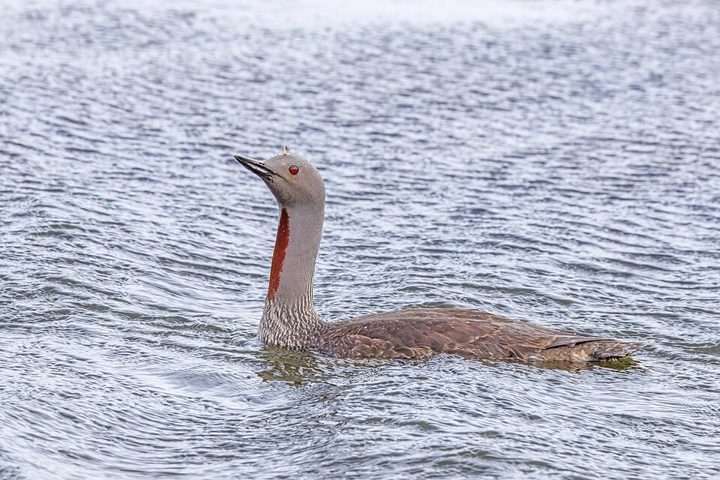
A single red-throated diver was counted on the Lárvaðall lagoon on 4 June 2021. Bird and vegetation survey 2021, p. 12
That single bird is the only record of the species in the survey's count table, where it is listed as species no. 10. Bird and vegetation survey 2021, p. 12
About
The smallest and lightest of the divers, slim and grey with a thin bill held tilted upwards and, in summer, the dark red throat patch that gives it its name.
It measures 53 to 69 cm long with a wingspan of 91 to 120 cm and weighs 1 to 2.7 kg.
It lives mainly on fish, taking sand eels at sea and sticklebacks and small trout in fresh water, and unlike other divers it nests beside tiny pools and flies to the sea or a larger lake to feed.
In Iceland it breeds beside ponds, lakes, rivers and streams across the country, with an estimated 1,500 to 2,000 pairs, and while many fly to western Europe for the winter, between 1,000 and 3,000 birds stay on, mostly off the west of the country.
It is the only diver that can take off directly from land, and it needs so little open water to get airborne that it can nest beside pools far too small for any other diver.
Its scientific name stellata means starry, after the white-speckled back of its winter plumage, and Icelanders once read the weather from its voice: a cackle promised dry days and a wail meant rain.
Present
JFMAMJJASOND
Summer visitor, first birds late March to April, breeds May to August, most leave for western Europe by October, some winter off the west coast
Protected in Iceland, not on the Icelandic Red List, population stable
Seen at Skerðingsstaðir; 1 on the lagoon, June 2021
In the survey
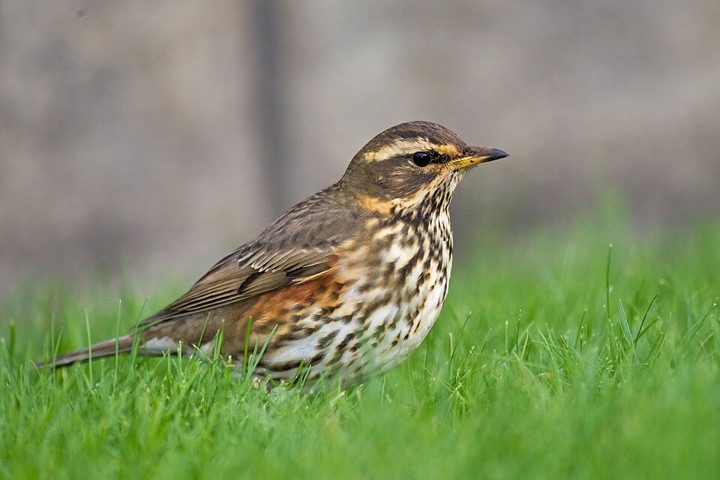
Redwings were seen at Skerðingsstaðir during the 2021 survey, one of only four passerine species recorded there. Bird and vegetation survey 2021, p. 7
In the appendix table of lagoon counts, where the redwing is species number 32, there were 2 redwings on the Lárvaðall lagoon on 15 July 2017 and 1 on 4 June 2021. Bird and vegetation survey 2021, p. 12
The report records redwings as seen but does not say whether they were breeding on the site. Bird and vegetation survey 2021, p. 7
About
A small thrush, 20 to 24 cm long and 50 to 75 g, told from the song thrush by the bold creamy stripe over the eye and the rusty red flanks and underwing that give it its English name.
It feeds on insects and earthworms through the year, turning to berries such as rowan in autumn and winter.
It is Iceland's commonest thrush, with a breeding population put at about 165,000 pairs nesting in birch scrub, plantations and gardens across the lowlands, and its Icelandic name means wood thrush.
The birds of Iceland and the Faroe Islands form their own slightly larger and darker subspecies, Turdus iliacus coburni, which winters from western Scotland and Ireland south to northern Spain.
The first arrive in early April and most leave again in October, though a few thousand now stay the winter in Reykjavík and other towns in the south west.
The nest is built low in a shrub or on the ground and holds four to six eggs, and the male's short fluting song, given from a rooftop, post or tree, is a familiar sound of the Icelandic spring.
Breeding season
JFMAMJJASOND
Summer visitor, arrives early April, most leave in October; a few thousand now winter in south-west towns
Protected in Iceland; Least Concern on the Icelandic red list and globally (IUCN 2025)
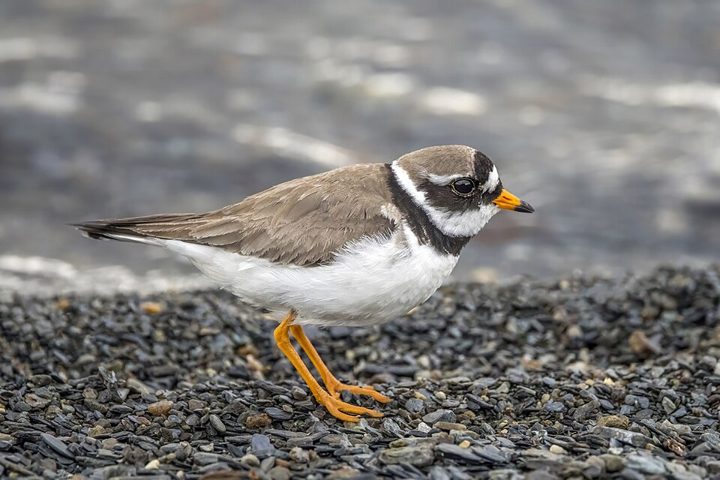
Breeding was confirmed at Skerðingsstaðir in 2021, in addition to the four wader species the report lists as breeding there. Bird and vegetation survey 2021, p. 7
Two were counted on Lárvaðall on 4 June 2021 and two again on 3 July 2021. Bird and vegetation survey 2021, p. 12
The highest count on Lárvaðall was 5 on 24 July 2021. Bird and vegetation survey 2021, p. 12
Earlier counts on the lagoon found 1 on 28 September 2015 and 1 on 15 July 2017. Bird and vegetation survey 2021, p. 12
It appears as species number 14 in the report's appendix table of lagoon counts. Bird and vegetation survey 2021, p. 12
About
A small, plump wader about 17 to 19.5 cm long, grey-brown above and white below, with a single black breast band, a black mask, orange legs and an orange bill tipped with black.
It feeds on insects, small crustaceans and worms, picked from sand and mud in short runs and sudden stops, by day and by night.
In Iceland it nests all over the country on bare gravel, sand and shingle, and although it is most familiar on beaches about 73% of Icelandic pairs breed on gravel flats above 300 metres.
The Icelandic breeding population is put at around 23,000 pairs and belongs to the subspecies psammodromus, shared with Greenland.
It is a summer visitor to Iceland, arriving around mid April and leaving by mid September to winter on mudflats and beaches in Britain, western France, Spain and south to Morocco.
If a predator comes near the nest, the adult walks away calling and drags a wing as if broken, luring the intruder from its 3 to 4 camouflaged eggs in a shallow scrape.
Breeding season
JFMAMJJASOND
Summer visitor, arrives mid April, most leave by mid September
Protected all year in Iceland; Least Concern on the Icelandic Red List
Common breeder on Lárvaðall: up to 64 counted in 2021
In the survey
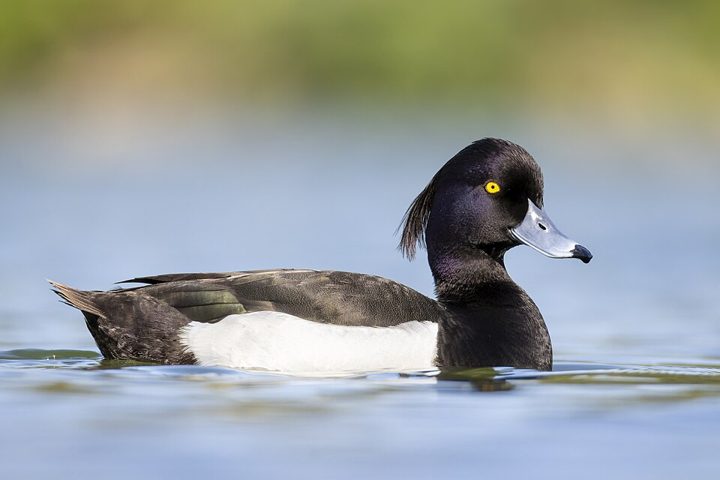
The tufted duck is one of the commonest ducks on Lárvaðall and a common breeding bird there. Bird and vegetation survey 2021, p. 6
The ducks keep mainly to the coves on the south side of the lagoon, near the main road. Bird and vegetation survey 2021, p. 6
Together with the other breeding ducks, tufted ducks reared some tens of young on the lagoon in summer 2021. Bird and vegetation survey 2021, p. 6
The counts found 20 drakes and 13 females on 4 June 2021, 12 drakes and 8 females on 24 July 2021, and 14 drakes and 16 females on 2 September 2021. Bird and vegetation survey 2021, p. 11
Birds recorded as not sexed or young numbered 8 on 24 July 2021, 34 on 2 September 2021 and 55 on 5 October 2021. Bird and vegetation survey 2021, p. 12
Earlier counts on the lagoon recorded 20 tufted ducks on 26 June 2011, a visit when only ducks were counted, then 18 on 15 July 2017 and 29 on 29 August 2018. Bird and vegetation survey 2021, p. 12
Adding the rows together, the lagoon held 33 tufted ducks on 4 June 2021, 28 on 24 July, 64 on 2 September and 55 on 5 October. Bird and vegetation survey 2021, p. 12
About
The drake is glossy black with bright white flanks, a yellow eye and a drooping tuft at the back of the head, while the female is dark brown with a shorter tuft.
It is a small diving duck, about 40 to 47 cm long and weighing around 700 g, that dives to the bottom for snails, small mussels, midge larvae and crustaceans, with a little plant material.
It settled in Iceland only in the late nineteenth century and has since become a common breeder on lowland lakes and ponds, with half to two thirds of the population at Mývatn in the north.
The Icelandic population is roughly estimated at 8,000 to 12,000 pairs, but it declined by 15 to 20 per cent between 2006 and 2024.
Most Icelandic birds migrate to winter in Ireland and Britain, though several hundred stay the winter on spring-fed waters in the south-west of Iceland.
It nests later than most ducks, hiding its 8 to 11 eggs in thick vegetation near water, and the ducklings hatch after about 25 days.
Present
JFMAMJJASOND
Summer visitor from April, nests from June, young on the lagoon from late July into October
Near Threatened on the 2025 Icelandic Red List; huntable 1 September to 15 March
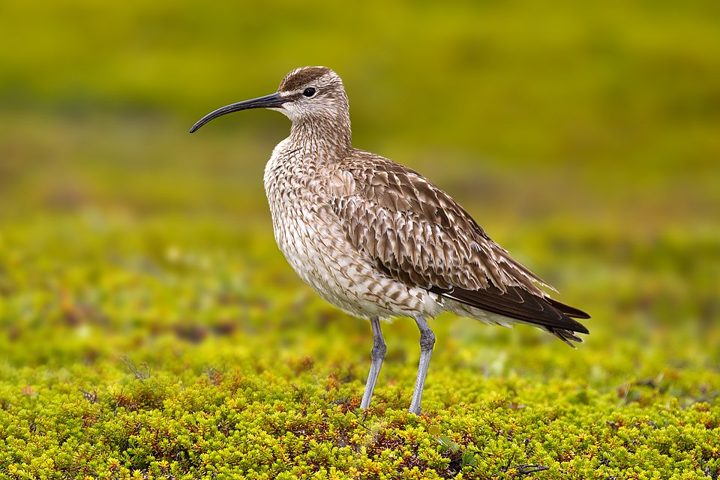
One pair of whimbrels was found breeding on the Skerðingsstaðir land during the breeding bird mapping visits of 4 June and 3 July 2021, the report noting a single pair each of whimbrel and white wagtail. Bird and vegetation survey 2021, p. 5
The whimbrel was one of 6 moorland bird species recorded in the 2021 breeding bird mapping. Bird and vegetation survey 2021, p. 5
Table 1 gives 1 pair on the land of Skerðingsstaðir, a density of 19 pairs per km². Bird and vegetation survey 2021, p. 6
The single whimbrel territory lies in the north-west-central part of the land, shown as a blue dot in Figure 3. Bird and vegetation survey 2021, p. 6
The appendix table of counts on Lárvaðall lagoon lists 3 whimbrels on 15 July 2017, the only record of the species in that table. Bird and vegetation survey 2021, p. 12
About
A large brown wader with a dark eye stripe, a pale stripe down the middle of the crown and a long bill that bends down near the tip, best known for its rippling whistle of about seven notes, which earned it the old folk name of seven whistler.
It measures 37 to 47 cm long with a wingspan of 75 to 90 cm and weighs 270 to 493 g, noticeably smaller than a curlew.
It probes soft mud, turf and shore sand for worms, molluscs, insects and small crabs, and berries such as crowberries become an important part of its diet before the autumn migration.
In Iceland it nests on lowland heath and moorland and feeds on mudflats and shores like those of Lárvaðall lagoon.
Iceland holds roughly 250,000 breeding pairs, thought to be a quarter to a third of all the world's whimbrels, but monitoring shows the Icelandic population falling by about 2 per cent a year.
Tracked Icelandic whimbrels fly non-stop from Iceland to West Africa in about four or five days, part of a round trip of some 11,000 km with two long sea crossings.
Breeding season
JFMAMJJASOND
Summer visitor, arrives around the start of May, flocks gather in late August and most have left for West Africa by mid September
Vulnerable (VU) on the Icelandic red list; a responsibility species
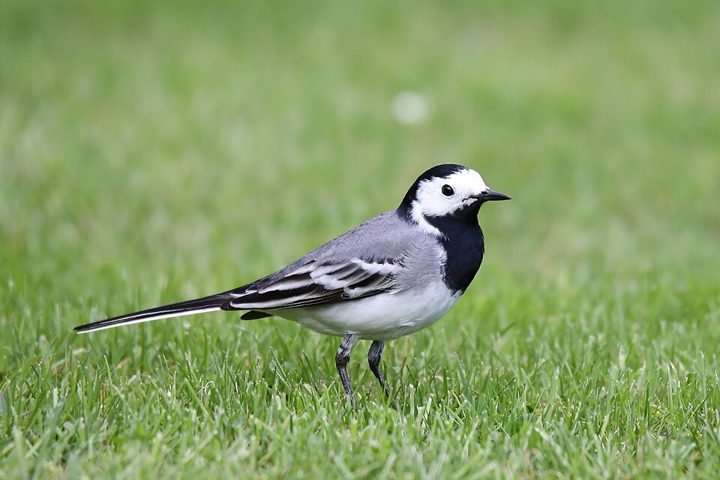
One pair of white wagtails was found breeding on the Skerðingsstaðir land during the breeding bird mapping visits on 4 June and 3 July 2021. Bird and vegetation survey 2021, p. 5
It was one of 6 moorland bird species found in the breeding bird mapping. Bird and vegetation survey 2021, p. 5
Table 1 gives 1 pair, which works out at 19 pairs per km² for the land of Skerðingsstaðir. Bird and vegetation survey 2021, p. 6
Figure 3 places the single territory at the ruin of the old farm building on the western side of the land. Bird and vegetation survey 2021, p. 6
The white wagtail is one of four passerine species recorded, and the report notes that it breeds at Skerðingsstaðir. Bird and vegetation survey 2021, p. 7
The appendix table of lagoon counts lists 10 white wagtails on Lárvaðall on 15 July 2017, seen by Peter Kaestner, the only record of the species in that table. Bird and vegetation survey 2021, p. 12
About
A slim black, white and grey bird about 18 cm long, easily known by the long tail it pumps up and down almost without pause.
It runs and darts after flies, midges, beetles and other small insects on open ground, along the shore and at the water's edge.
In Iceland it is a familiar bird of farms, towns and lowland shores, nesting in a hole or crevice in a stone wall or ruin, under the eaves of a building or under a bridge.
It is a summer visitor to Iceland, arriving in April and gone again by the end of September for its wintering grounds in West Africa.
Its Icelandic name maríuerla means Mary's wagtail, while the genus name Motacilla originally meant little mover and was read by medieval writers as wag-tail.
The pair at Skerðingsstaðir kept to the ruin of the old farm building on the west side of the land, just the sort of old stonework the species likes to nest in.
Breeding season
JFMAMJJASOND
Summer visitor, arrives in April, leaves for West Africa by the end of September
Protected under Icelandic law; Least Concern on the Icelandic Red List
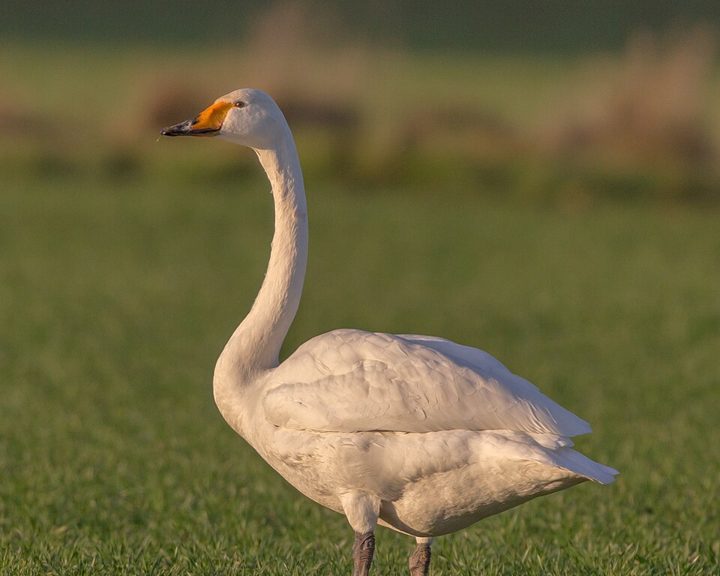
Small flocks of whooper swans were seen on and around Lárvaðall in both spring and late summer 2021. Bird and vegetation survey 2021, p. 6
One pair attempted to breed in summer 2021 but reared no young, and a second, non-breeding pair was also in the area. Bird and vegetation survey 2021, p. 6
Adult swans were counted on the lagoon on every 2021 visit: 11 on 5 May, 14 on 4 June, 4 on 3 July, 2 on 24 July, 2 on 2 September and 2 on 5 October. Bird and vegetation survey 2021, p. 11
The highest count in the surveys' count table was 21 adults on 29 August 2018, and 5 were counted on 28 September 2015. Bird and vegetation survey 2021, p. 11
No swans were recorded on the 15 July 2017 count, and the 26 June 2011 visit counted ducks only. Bird and vegetation survey 2021, p. 11
About
A huge all-white swan with a long, straight neck and a yellow and black bill, the yellow running forward in a wedge, whereas the mute swan has an orange bill with a black knob at the base.
Adults are 140 to 165 cm long with a wingspan of 205 to 275 cm and weigh between 7.4 and 14 kg, which makes it one of the heaviest birds that can fly.
It grazes mainly on water plants such as sedges and pondweeds, in shallow sea lagoons its main food is eelgrass, tasselweed and green algae, and flocks also feed on hayfields and barley fields, which has led Icelandic farmers to ask, so far without success, for permission to shoot them.
In Iceland it is a common breeder on lowland lakes, ponds and marshes and in well-vegetated parts of the highlands, building a big mound of plants lined with down for its 2 to 6 eggs, which hatch after 34 to 35 days, and the cygnets can fly after 77 to 91 days.
The Icelandic population has grown steadily for at least 30 years and 43,255 birds were counted in January 2020, most of them wintering in Britain and Ireland, with about 7 per cent (2,923 birds) staying in Iceland on ice-free coasts of the south-west and west, including Breiðafjörður, and on spring-fed waters.
Its loud, bugling call carries far across the water, and a flock of about 30 leaving Iceland for Ireland in December 1967 was picked up by radar west of Scotland at 8,200 metres, the highest altitude ever recorded for a bird over Britain.
Breeding season
JFMAMJJASOND
Seen all year: most leave for Britain and Ireland in autumn and return in early spring, but a few winter on the ice-free coasts of Breiðafjörður
Fully protected under Icelandic law 64/1994; Least Concern on the Icelandic Red List 2025
Breeds in both streams: 119 juveniles caught in 2021
In the survey
On 4 August 2021 electrofishing over 579.5 m² in Víkurgil, Hólalækur and on the inner shore of Lárvaðall yielded 119 char juveniles: 66 hatched that spring, 51 one year old and 2 two years old. Fish survey 2021, p. 13
The richest stretch was upper Hólalækur above the road, with 31.7 juveniles per 100 m², most of them fry of the year, against 29.8 in Víkurgil and 8.5 in lower Hólalækur. Fish survey 2021, p. 13
In Víkurgil the char was the only fish caught, lower Hólalækur held both char and salmon juveniles, and nothing at all was caught on the stony inner shore of the lagoon. Fish survey 2021, p. 12
One of the two two-year-old char from upper Hólalækur, photographed in the report, was already a sexually mature male. Fish survey 2021, p. 16
The juveniles grow rather slowly, which the researchers take as a sign that the streams are rather cold. Fish survey 2021, p. 5
Both sea-run and resident char live in the streams and the lagoon, but because the lagoon is salty and the eggs would probably not survive there, they most likely spawn only in the streams. Fish survey 2021, p. 17
When salmon sea ranching was practised at the Lárós outlet, considerable runs of sea-run char were always noticed in the station's reception structures, though no estimate of the char stock exists. Fish survey 2021, p. 9
Men laying nets on the lagoon told the vegetation surveyors that it was mainly char they caught there. Bird and vegetation survey 2021, p. 8
About
A trout-like fish with a dark back, pale rather than black spots, white leading edges on the lower fins and, in autumn males especially, a belly flushed orange or red.
Icelandic char rarely weigh more than half a kilogram, though the largest lake fish can reach several kilograms, and where food is scarce a dwarf form may mature at only 7 to 12 cm long.
In fresh water it eats midge larvae, snails, water fleas and other small crustaceans and smaller fish, and at sea it feeds mostly on copepods, krill and small fish.
It is found throughout Iceland in lakes, rivers and streams, and the sea-run form spends a few weeks at sea each summer before returning to fresh water in late summer to spawn in the autumn and overwinter.
Lake Þingvallavatn holds four distinct forms of char, from a dwarf that never grows beyond about 13 cm to a fish-eater, all descended from char that colonised Iceland as the ice retreated about 10,000 years ago.
It is the world's most northerly freshwater fish, and its Icelandic name bleikja refers to the reddish pink of its belly.
In the lagoon and streams
JFMAMJJASOND
Juveniles and resident fish are in the streams and lagoon all year; sea-run fish come back from the sea in late summer and spawn in the streams in the autumn
Least Concern (IUCN); Icelandic stocks have declined in recent decades
Spawns occasionally in Hólalækur: 18 juveniles caught in 2021
In the survey
Electrofishing shows that salmon spawn now and then in Hólalækur, but they do not appear to use Víkurgil for spawning or for rearing their young. Fish survey 2021, p. 16
On 4 August 2021 the surveyors caught 18 salmon juveniles across the 579,5 m² they electrofished, all of them in Hólalækur and none in Víkurgil or on the inner shore of the lagoon. Fish survey 2021, p. 13
At the lower station in Hólalækur only young of the year were caught, eleven fish at a density of 5,5 juveniles per 100 m², while the upper station above the road held one young of the year and six four-year-old juveniles. Fish survey 2021, p. 13
Only two year classes turned up, young of the year averaging 3,1 cm and four-year-olds averaging 9,2 cm, with no one-, two- or three-year-old salmon caught at either station. Fish survey 2021, p. 14
The salmon juveniles grow rather slowly, which suggests the streams are rather cold, and Hólalækur is passable to fish for only a relatively short distance, so the salmon habitat is not large in extent. Fish survey 2021, p. 16
Salmon were not thought to live in Lárvaðall before a dam was built across the outlet from 1965 for sea ranching; just under 130 thousand smolts were released in the catchment between 1964 and 1980, some of them into Hólalækur, about 1000 salmon returned each year, and the Laxeyri fish farm ran the ranching from 1994 to 2004. Fish survey 2021, p. 9
The surveyors think young salmon may also grow up in the lagoon itself, which is much warmer than the streams and salty enough to support the amphipods that salmonids feed on, and they say the stream habitats must not be disturbed because the salmon and char stocks depend on them. Fish survey 2021, p. 17
Local net fishers told the vegetation and bird surveyors that salmon are also caught in the lagoon, possibly a legacy of the sea ranching. Bird and vegetation survey 2021, p. 8
About
A sleek silver-blue fish with black spots mostly above the lateral line and none on the tail, the males taking on a reddish or greenish tinge as spawning nears, while the young parr in streams carry a row of dark thumbprint marks along their flanks with red spots between them.
Fish that come back after one winter at sea, called grilse, usually weigh 2 to 3 kg, those that stay two winters average 71 to 76 cm and 3.6 to 5.4 kg, and the species can reach a metre or more in length.
In streams the young feed on insect larvae such as midges, blackflies, mayflies and caddisflies, and at sea the adults hunt capelin, herring, sand eels and small cod along with krill and other shrimp-like crustaceans.
Iceland has some eighty to a hundred salmon rivers spread around the west, north and south of the country, and Norðurá in Borgarfjörður, just south of Snæfellsnes, is famous for its salmon fishing.
Icelandic salmon spend two to five years as parr in their cold home river before turning into silvery smolts of 10 to 15 cm and heading to sea in spring, then come back after one or two winters in the ocean, guided it is thought by the smell of their native river, to spawn in the gravel in October and November.
Iceland has banned fishing for salmon at sea since 1932, so every returning fish is left to run the rivers, where anglers increasingly release their catch and on many rivers large salmon must be put back.
In the lagoon and streams
JFMAMJJASOND
Parr live in Hólalækur the whole year and may also use the lagoon; adults return from the sea in summer and spawn in October and November
IUCN Near Threatened since 2023; no fishing for salmon at sea in Iceland since 1932
Named only in the report's spawning notes; no catch recorded
In the survey
The fish report notes that both salmon and brown trout spawn only in running water, whereas Arctic char can spawn in both running and still water. Fish survey 2021, p. 5
The survey recorded no brown trout in its catch, and the species is named only in the report's notes on spawning biology. Fish survey 2021, p. 5
In its discussion of spawning the report counts brown trout among the salmon and trout stocks of the streams that flow into Lárvaðall, namely Víkurgil and Hólalækur, and again notes that the species spawns exclusively in running water, citing Guðni Guðbergsson and Þórólfur Antonsson (1996). Fish survey 2021, p. 17
The report says these stream habitats must not be disturbed because of their importance for the survival of the salmon and silungur stocks, silungur being the Icelandic collective word for brown trout and Arctic char. Fish survey 2021, p. 17
About
A brassy brown to silvery fish with dark and often red spots along its flanks that stop short of the tail, and with the small fleshy adipose fin near the tail that marks it as a salmonid.
Most brown trout weigh between half a kilo and one kilo, but lake fish grow far larger, and Þingvallavatn in south-west Iceland has produced brown trout of over 15 kg.
It eats aquatic insects and their larvae, small crustaceans and snails, and the larger fish turn to hunting other fish such as sticklebacks.
Brown trout are native to Iceland, which is the western limit of the species' natural range, and they live in rivers and lakes across much of the country.
Some brown trout go to sea to feed and return to fresh water to spawn, and Icelanders call these sea-run fish sjóbirtingur while the freshwater fish is urriði.
Spawning takes place in autumn on gravel beds in running water, the eggs lie in the gravel over winter and hatch in spring, and a brown trout can live for 20 years.
In the lagoon and streams
JFMAMJJASOND
No catch was recorded; brown trout hold in streams all year and spawn on gravel in running water from September to the turn of the year
IUCN Least Concern; fishing regulated by Iceland's Salmon and Trout Fishing Act
Reported by local net fishers as caught in the lagoon
In the survey
Local net fishers told the survey team that flounder was also among the fish they catch in Lárvaðall lagoon. Bird and vegetation survey 2021, p. 8
The mention is a single word at the end of the fishers' list of catch, so the record rests on their word rather than on a catch made by the survey team. Bird and vegetation survey 2021, p. 8
The report gives no numbers, sizes or season for flounder in the lagoon. Bird and vegetation survey 2021, p. 8
About
A flatfish with a dull brown, mottled back that usually lies right side up, though left-sided fish are common, and the rows of small bony knobs along its fin bases and lateral line tell it at once from the plaice.
It usually grows to about 30 cm and seldom beyond 40 cm, though fish of up to 60 cm have been recorded.
It feeds on the bottom, mostly at night, on bristle worms, small crustaceans, shellfish and small fish, and in Icelandic estuaries it has been found with young char and even young salmon in its stomach.
It is a newcomer to Iceland, first caught at the mouth of the Ölfusá in the south west in September 1999, and it has since spread along the south and west coasts and round to the north as far as Skagafjörður.
Unlike most flatfish it is at home in brackish and even fresh water, so the young grow up in river mouths and lagoons and sometimes wander up into rivers and lakes, while the adults spawn in shallow sea water in spring.
Icelandic researchers treat it as an invasive species because it competes with young plaice, char and trout for food and space in the same shallow nursery grounds.
In the lagoon and streams
JFMAMJJASOND
Few arrive in spring, numbers build through summer and peak in autumn, and most move out to deeper sea water for the winter
Least Concern globally; a non-native newcomer treated as invasive in Iceland
Alpine bartsia was found in the Skerðingsstaðir study area and is listed in the plant table, Table 2, of the vegetation and bird survey. Bird and vegetation survey 2021, p. 8
It is one of 67 vascular plant species recorded at Skerðingsstaðir during the 2021 survey. Bird and vegetation survey 2021, p. 8
The survey records it under its Icelandic name, smjörgras. Bird and vegetation survey 2021, p. 8
About
A low, hairy plant with pairs of rounded, toothed leaves, the uppermost ones stained dark violet, and dark purple hooded flowers 1.5 to 2 cm long tucked among the top leaves.
It is usually 10 to 30 cm tall, and the whole plant often has a dusky purple look that makes it easy to pick out in the green of a June hillside.
It is a hemiparasite: its green leaves make their own sugars, but its roots also tap into the roots of neighbouring plants such as sedges and sorrel to take water and minerals.
It is common throughout Iceland from the lowlands up to 800 to 900 m, in grassy hollows, stream gullies, moist banks and on mountain slopes.
The Icelandic name smjörgras means butter grass, though botanists admit nobody knows quite why, and an older name, lokasjóðsbróðir, makes it the brother of the yellow rattle, another root parasite.
Its range straddles the North Atlantic: the mountains of Europe from the Pyrenees to Scandinavia and northern Russia, plus Iceland, Greenland and north-eastern Canada, and in Britain it survives at only a few upland sites.
In flower
JFMAMJJASOND
Perennial, leafs out in May, in flower in June and July, dies back in September
Common throughout Iceland, not threatened or protected
Recorded at Skerðingsstaðir in 2021, one of 67 species
In the survey
Listed under its Icelandic name kornsúra in the plant table (Table 2) of the 2021 vegetation survey as a species found in the Skerðingsstaðir study area. Bird and vegetation survey 2021, p. 8
One of 67 vascular plant species recorded at Skerðingsstaðir. Bird and vegetation survey 2021, p. 8
About
A small plant, usually 5 to 15 cm tall, with a single slender spike carrying tiny white or occasionally pink flowers at the top and a row of reddish brown bulbils below them.
The bulbils are its main way of reproducing: they drop off in late summer, root where they land and grow into new plants, while the flowers rarely set viable seed.
It is one of the commonest plants in Iceland, growing in almost every kind of ground from sea level to 1150 m in the mountains, in heath, mires and on gravel flats alike.
Beneath the plant is a short, thick, starchy rootstock that is an important food for pink-footed goose goslings in the Icelandic highlands, where moss carpets are often pitted with little holes left by geese digging it out.
Rock ptarmigan and reindeer eat the bulbils, and Arctic peoples have gathered the bulbils and roots as food.
The Icelandic name kornsúra pairs korn, grain, for the bulbils with súra, the Icelandic word for the sorrels, its relatives in the knotweed family.
In flower
JFMAMJJASOND
Perennial: in leaf from May, flower spikes with bulbils in June and July, bulbils drop in late summer and the plant dies back by September
Listed in the plant table (Table 2) of the vegetation and bird survey as one of the plants found in the study area at Skerðingsstaðir. Bird and vegetation survey 2021, p. 8
It is one of 67 vascular plant species recorded at Skerðingsstaðir in the 2021 survey. Bird and vegetation survey 2021, p. 8
The report records it under its Icelandic name, gullmura. Bird and vegetation survey 2021, p. 8
About
A low perennial of the rose family, usually 5 to 20 cm tall, with leaves divided like a hand into three to five coarsely toothed leaflets.
The flowers are about 1.5 cm across with five golden yellow petals, each notched at the tip and marked with a reddish orange spot at its base.
It is common throughout Iceland in grassy hollows on heathland and in rich soil on tussocks, and has been found as high as 1200 m in the mountains where birds perch and manure the ground.
It is an arctic and alpine species found across the mountains of Europe and the far north.
The Icelandic name gullmura means gold cinquefoil, and at a glance its flowers can be mistaken for buttercups.
Like several of its relatives it usually sets seed without the egg being fertilised, so each seedling is a near-identical copy of its mother plant.
In flower
JFMAMJJASOND
Perennial, in leaf from May to September, golden flowers from late May to July
Recorded in the 2021 plant list, one of 67 species
In the survey
Alpine lady's-mantle was recorded in the plant list (Table 2) of the 2021 vegetation survey as found in the Skerðingsstaðir study area. Bird and vegetation survey 2021, p. 8
It is one of 67 vascular plant species recorded at Skerðingsstaðir. Bird and vegetation survey 2021, p. 8
The survey lists it under its Icelandic name, ljónslappi. Bird and vegetation survey 2021, p. 8
About
A low perennial of the rose family, 5 to 20 cm tall, whose leaves are split like fingers into five to seven narrow leaflets, green and smooth above and clothed in silky silver hairs beneath.
The Icelandic name ljónslappi means lion's paw, after the shape of the leaf.
Its flowers are tiny, only 2.5 to 3.5 mm across, yellow-green and without petals, and the seeds develop without fertilisation, so each plant is essentially a copy of its parent.
It grows throughout Iceland from the lowlands up to around 700 or 800 m, on dry heaths, scree, hollows and gullies, and is common on almost any dry ground.
Its natural range is northern Europe, the mountains further south such as the Alps and the Pyrenees, and southern Greenland, so Iceland sits in the heart of its world.
Ljónslappi has long been prized in Iceland as one of the best herbs for tea and folk medicine, gathered in June and July and dried, and a warm infusion of the leaves was once gargled for a sore throat.
In flower
JFMAMJJASOND
Perennial; leaves unfold in May, flowers in June and into July, foliage dies back by October
Recorded growing in the Skerðingsstaðir study area during the 2021 vegetation survey, listed in Table 2 under its Icelandic name fjallafoxgras. Bird and vegetation survey 2021, p. 8
One of 67 vascular plant species recorded at Skerðingsstaðir. Bird and vegetation survey 2021, p. 8
About
A short tufted grass 15 to 40 cm tall with a dense, often purple-tinged, egg-shaped to short-cylindrical flower head 2 to 4 cm long and a conspicuously inflated sheath on the uppermost leaf.
It is told from the cultivated timothy of Icelandic hayfields, vallarfoxgras, by its much shorter head, its bristle-tipped glumes and that swollen upper leaf sheath.
It is common throughout Iceland from sea level to above 700 m, favouring grassy hollows, brook gullies and sheltered dips in the hills.
Its world range is remarkable, spanning the Arctic and the mountains of the northern hemisphere and running down the Americas to the far south of South America and even the subantarctic island of South Georgia.
It also goes by the Icelandic nickname skollapuntur, and its flat leaves, 3 to 6 mm wide, are often tinged violet where they meet the sheath.
Each spikelet holds a single flower with only two stamens, which is unusual among grasses, most of which have three.
In flower
JFMAMJJASOND
Perennial grass, greens up in May, flower heads mainly July and August, withers in autumn
Alternate water-milfoil, an aquatic plant, was one of 67 vascular plant species recorded in the Skerðingsstaðir study area during the 2021 vegetation survey. Bird and vegetation survey 2021, p. 8
It is listed in the survey's plant table (Table 2) under its Icelandic name Síkjamari. Bird and vegetation survey 2021, p. 8
About
A submerged water plant with slender stems usually half a metre to a metre long, occasionally more, carrying whorls of three or four feathery leaves, each cut into 8 to 18 thread-like segments.
Only the short flower spike rises above the water, with small male flowers at the top set singly or in pairs rather than in rings, which is what alternate in its name refers to, and female flowers in whorls below.
It favours clear, nutrient-poor, lime-poor and slightly acidic water and is one of the commonest water plants of shallow lakes in Iceland, growing too in ponds, ditches and slow streams across the country.
Its Icelandic name means ditch milfoil, from síki, a water-filled ditch or channel, where it is often found.
In hot dry summers, when Rauðavatn near Reykjavík runs low, dense beds of this plant with their reddish flower stems turn the water red, living up to the lake's name, which means Red Lake.
Native to Europe and much of Asia and introduced to North America, it stays green through the winter under the ice and spreads mostly by pieces of stem that drift away and take root.
In flower
JFMAMJJASOND
Submerged perennial that stays green under the ice but grows from May to September; the small flower spikes break the surface in July and August.
Kristian Peters -- Fabelfroh 10:06, 7 May 2007 (UTC) · CC BY-SA 3.0
Annual meadow-grass
varpasveifgras · Poa annua
Recorded here in 2021, one of 67 plant species
In the survey
The 2021 vegetation survey recorded it in the Skerðingsstaðir study area, one of 67 vascular plant species found there. Bird and vegetation survey 2021, p. 8
It is listed in the survey's plant table (Table 2) under its Icelandic name, varpasveifgras. Bird and vegetation survey 2021, p. 8
About
A small, soft, pale green grass, rarely more than 25 cm tall, with slightly crinkled leaves that end in a blunt boat-shaped tip and a loose, open flower head.
Despite the name, it can live on as a short-lived perennial, and it can flower within six weeks of germinating, so several generations can follow one another in a single summer.
One of the most widespread plants on Earth, it grows on every continent and has even established itself on King George Island off the Antarctic Peninsula, where it is treated as an invader.
In Iceland it is common throughout the country around farms, along paths and roadsides, on trampled ground and anywhere the soil is rich in nutrients.
It tolerates trampling and close mowing better than most grasses, which is why it lines footpaths, gateways and doorsteps.
It is the grass of lawns and golf greens the world over, prized for its fine turf in one place and cursed as a weed in the next.
In flower
JFMAMJJASOND
Grows whenever the ground is free of frost, roughly May to October, and flowers from June to September
Not red-listed or protected in Iceland; common and widespread
Recorded in the 2021 plant survey: one of 67 species
In the survey
Hrossanál was found in the Skerðingsstaðir study area and is listed in the report's table of plants (Table 2). Bird and vegetation survey 2021, p. 8
It is one of 67 vascular plant species the vegetation survey recorded at Skerðingsstaðir. Bird and vegetation survey 2021, p. 8
About
A rush with stiff, round, hollow, needle-like stems 25 to 45 cm tall and only 1.5 to 2 mm thick, with no leaf blades, only sheaths at the base, rising in straight rows from a strong creeping rootstock that pushes on a little further every year.
The dark brown flower cluster looks as if it sits on the side of the stem, but the point above it is really a bract that continues the stem upwards.
Seen close up in June and July the flowers are surprisingly ornate, with dark brown tepals, a red ovary, yellow anthers and bright pink three-lobed stigmas.
It is very common all over Iceland from the coast up to 700 or 800 m, growing where wet ground meets dry: marsh edges, damp sandy river flats and moist banks.
The species is circumpolar, native to the subarctic and subalpine northern hemisphere, and Icelandic botanists list hrossanál as the subspecies intermedius, while its coastal relative the Baltic rush, Juncus balticus, has an Icelandic name of its own, krakanál.
The Icelandic name hrossanál means horse needle, a fair description of the sharp stiff stems.
In flower
JFMAMJJASOND
Perennial rush, fresh green stems from May; flowers June to July in West Iceland
Common throughout Iceland; not on the Icelandic Red List
Recorded in the 2021 plant survey, one of 67 species
In the survey
Recorded in the study area at Skerðingsstaðir during the 2021 vegetation survey and listed in its plant table, Table 2. Bird and vegetation survey 2021, p. 8
One of 67 vascular plant species recorded at Skerðingsstaðir. Bird and vegetation survey 2021, p. 8
The survey's plant table gives it under its Icelandic name, blóðberg. Bird and vegetation survey 2021, p. 8
About
A creeping evergreen dwarf shrub only a few centimetres high, with woody stems, tiny oval leaves and dense heads of pink to purple flowers that smell of thyme when crushed.
In Iceland the plant is the northern subspecies arcticus, very common across the whole country from the lowlands up to about 1,000 m in the mountains, forming mats on dry heath, gravel and sand.
It flowers from June to August, and on warm days the mats are busy with bumblebees and flies.
Icelanders have long brewed the dried plant as blóðbergste, a tea an old herbal recommended for coughs and for curing the morning after too much wine.
The same subspecies grows in Greenland, Norway, Britain and Ireland, and the plant is a close relative of the thyme used in the kitchen and can season food in the same way.
Being evergreen, its mats stay on the ground through winter and are among the first patches of colour to show as the snow goes.
In flower
JFMAMJJASOND
Evergreen dwarf shrub whose mats stay green through winter; flowers from June to August, at their best in July
Kristian Peters -- Fabelfroh 15:15, 10 August 2007 (UTC) · CC BY-SA 3.0
Autumn hawkbit
skarifífill · Scorzoneroides autumnalis
Found in the study area, one of 67 plant species
In the survey
Autumn hawkbit was one of 67 vascular plant species recorded in the Skerðingsstaðir study area during the 2021 vegetation survey. Bird and vegetation survey 2021, p. 8
It is listed in the survey's plant table (Table 2) under its Icelandic name Skarifífill. Bird and vegetation survey 2021, p. 8
About
A perennial of the daisy family, usually 15 to 30 cm tall in Iceland, with a rosette of narrow, deeply lobed leaves and branched, leafless stems carrying bright yellow dandelion-like heads about 3 cm across.
Tell it from a dandelion by the solid, branched stems with a few small scale-like bracts, several heads to a stem, and the outer florets, which are often striped red on the underside.
It is common across Iceland except in the barren highland deserts, growing in hayfields, grassland, pastures, along roads and on grassy shores.
As the name says it flowers late, from July into September, turning old hayfields yellow after most other flowers have finished.
The heads are pollinated mainly by flies and bees, which find them still open when most other flowers have gone over.
Linnaeus named it Leontodon autumnalis in 1753, and botanists revived the older genus Scorzoneroides for it in 2006, so older Icelandic floras still list it under Leontodon, while its Icelandic name ends in fífill, the word for dandelion.
In flower
JFMAMJJASOND
Perennial, in leaf from May to September; flowers from July into September, later than most Icelandic wildflowers.
Recorded in the 2021 plant survey, one of 67 species
In the survey
Blinks was one of 67 vascular plant species recorded in the study area at Skerðingsstaðir during the vegetation survey visits of June and July 2021. Bird and vegetation survey 2021, p. 8
It appears in the survey's plant list (Table 2) under its Icelandic name lækjagrýta. Bird and vegetation survey 2021, p. 8
About
A tiny fleshy plant with pairs of small spoon-shaped leaves and white flowers only 2 to 3 mm across, easy to miss until you kneel beside a brook.
It creeps and roots along the ground, forming soft green mats up to half a metre across in springs, seepages, shallow pond margins and the edges of small streams, and sometimes floats in the water itself.
It is common throughout Iceland wherever there is water, missing only from the driest parts of the interior, and its name lækjagrýta ties it to the lækur, the brook.
It goes with clean water, so botanists treat it as a sign that a spring or stream is in good health.
The leaves are edible and are eaten as a salad in Spain and Portugal.
Botanists tell its three subspecies apart by the tiny dark seeds, which range from smooth and shiny to warty under a lens.
In flower
JFMAMJJASOND
In leaf from May to September, flowers June to August, and lives on as a perennial in springs that do not freeze
Kristian Peters -- Fabelfroh 15:28, 18 July 2006 (UTC) · CC BY-SA 3.0
Carnation sedge
belgjastör · Carex panicea
Recorded in the 2021 plant survey, one of 67 species
In the survey
Recorded in the study area at Skerðingsstaðir during the 2021 vegetation survey and listed in its plant table, Table 2. Bird and vegetation survey 2021, p. 8
One of 67 vascular plant species recorded at Skerðingsstaðir. Bird and vegetation survey 2021, p. 8
The survey's plant table gives it under its Icelandic name, belgjastör. Bird and vegetation survey 2021, p. 8
About
A neat sedge 10 to 50 cm tall whose grey-green leaves recall those of a garden carnation, which is how it got its English name.
Like all sedges it has a solid three-sided stem, remembered by the rhyme sedges have edges, with one slim male spike at the top standing above two or three stouter female spikes.
The Icelandic name belgjastör, bag sedge, points to the small swollen sacs, each 3 to 4 mm long, that hold the fruits.
It grows in fens, marshes and damp grassland, and in Iceland it is found in bogs and wet ground across the whole country apart from the central highlands.
Its range covers northern and western Europe and reaches north-eastern North America, so a visitor from Britain or Scandinavia may well know it from home.
In Iceland it flowers in June and July, and its ripe fruiting spikes stand into late summer.
In flower
JFMAMJJASOND
Perennial sedge, new leaves from May, flowers in June and July, fruits ripen in August
Listed in the plant table (Table 2) of the vegetation and bird survey as one of the plants found in the study area at Skerðingsstaðir. Bird and vegetation survey 2021, p. 8
It is one of 67 vascular plant species recorded at Skerðingsstaðir in the 2021 survey. Bird and vegetation survey 2021, p. 8
The report records it under its Icelandic name, haugarfi. Bird and vegetation survey 2021, p. 8
About
A sprawling annual of the pink family with weak juicy stems up to 40 cm long, oval pointed leaves and tiny white flowers whose five petals are so deeply split that they look like ten.
A single line of fine hairs runs down one side of the stem and switches sides at each pair of leaves, which is the surest way to identify it.
It is common throughout Iceland wherever people live, thriving in rich manured soil in gardens and around farms, and sheep carry it far into the highlands along their paths and shelters.
It can germinate, flower and set seed within a few weeks, and flowers from early summer until the autumn frosts.
The Icelandic name haugarfi means heap chickweed, from its habit of growing on dung heaps and middens.
It almost certainly arrived with the first settlers and their livestock, and its leaves have long been eaten as a spring green and fed to chickens.
In flower
JFMAMJJASOND
Annual of disturbed ground, up in May, flowers from June until the autumn frosts
Recorded at Skerðingsstaðir in 2021, one of 67 species
In the survey
Listed under its Icelandic name klófífa in the plant table (Table 2) of the 2021 vegetation survey as a species found in the Skerðingsstaðir study area. Bird and vegetation survey 2021, p. 8
One of 67 vascular plant species recorded at Skerðingsstaðir. Bird and vegetation survey 2021, p. 8
About
A sedge of wet ground, easiest to recognise in summer when each stem carries several nodding heads of white cotton, usually three to six, unlike its cousin hrafnafífa, which carries just one.
It grows 20 to 60 cm tall and spreads by creeping underground stems, so it often forms wide stands that can turn a whole bog white in July.
The true flowers are small and brown and open in June, and the cotton is a mass of silky white bristles 2 to 3 cm long that carries the seeds away on the wind.
It is very common throughout Iceland in mires, fens and wet heath, from the coast up to 700 or 800 m, and has been found as high as 1200 m.
Before paraffin and electricity, Icelanders twisted the cotton into wicks, fífukveikir, for their fish-oil lamps.
Geese graze the young shoots, and in late summer the leaves turn red and colour whole fens in the highlands.
In flower
JFMAMJJASOND
Perennial: new growth in May, brown flowers in June, white cotton heads from late June to August, dying back in autumn
The 2021 vegetation survey recorded it in the Skerðingsstaðir study area, one of 67 vascular plant species found there. Bird and vegetation survey 2021, p. 8
It is listed in the survey's plant table (Table 2) under its Icelandic name, vegarfi. Bird and vegetation survey 2021, p. 8
About
A low, straggling perennial that forms loose mats, usually 10 to 20 cm tall, with softly hairy leaves in opposite pairs, which is where the mouse-ear name comes from.
The small white flowers have five petals, each so deeply notched at the tip that there appear to be ten, and they open from June into late summer.
The flowers can pollinate themselves, so the plant sets seed reliably even in a cold, wet Icelandic summer.
In Iceland it is common throughout the country, in hayfields, pasture, roadsides, gravel and disturbed ground, from the shore up into the mountains.
The Icelandic name vegarfi means road chickweed, a fair description of a plant that follows tracks, farmyards and people wherever they go.
It is native to Europe and Greenland and has travelled with people to almost every temperate part of the world, including all fifty of the United States.
In flower
JFMAMJJASOND
In leaf from May to October, flowering from June to August
Not red-listed or protected in Iceland; common and widespread
Common sorrel was found in the study area at Skerðingsstaðir during the 2021 vegetation survey and appears in its table of plants (Table 2). Bird and vegetation survey 2021, p. 8
It is one of 67 vascular plant species recorded at Skerðingsstaðir. Bird and vegetation survey 2021, p. 8
The survey lists it under its Icelandic name, túnsúra. Bird and vegetation survey 2021, p. 8
About
A slender upright plant of the dock family with arrow-shaped leaves whose two basal lobes point backwards down the stalk.
In Iceland it usually stands 20 to 40 cm tall, and its small reddish flowers grow in loose spikes that give meadows a rusty tint in June.
Male and female flowers grow on separate plants, and each tiny three-sided fruit is wrapped in papery flaps that help the wind and passing animals carry it.
It is common all over Iceland in hayfields, meadows and other rich grassland, from the lowlands up to about 800 m, and the Icelandic name túnsúra means the sour plant of the hayfield.
The leaves taste sharply sour from oxalic acid and are rich in vitamin C, and Icelanders once made a sour soup, súrusúpa, from them and valued them against scurvy.
Because of the oxalic acid it is best eaten in small amounts, as a tang in a soup or salad rather than a whole plateful.
In flower
JFMAMJJASOND
Perennial, in leaf from May to September, flowering May and June, then reddening as the seed ripens in July
Creeping bent was found in the Skerðingsstaðir study area and is listed in the plant table, Table 2, of the vegetation and bird survey. Bird and vegetation survey 2021, p. 8
It is one of 67 vascular plant species recorded at Skerðingsstaðir during the 2021 survey. Bird and vegetation survey 2021, p. 8
The survey records it under its Icelandic name, skriðlíngresi. Bird and vegetation survey 2021, p. 8
About
A fine-leaved grass with a narrow red-brown flower head 3 to 10 cm long, told from the very similar common bent by its slimmer head and a longer, pointed ligule, the little flap where the leaf meets the stem.
It spreads by long runners, often reddish, that root as they go and creep across wet mud or even out into shallow water, while on drier ground it forms dense tufts and creeps less.
Because it knits into a tight, close-cropped turf it is the classic grass of golf putting greens, and most of the putting greens of the northern United States are creeping bent.
It is common throughout Iceland from the shore up to about 800 m, most at home on wet ground, pond margins and damp mud, and it tolerates a little salt, so it can creep across brackish mud at the top of the shore.
Flóra Íslands says there is no doubt it was growing in Iceland long before the Norse settlement, so it counts as a native rather than one of the grasses that arrived with farming.
A genetically modified strain bred for golf courses escaped from an experimental farm in Oregon in 2003 and established wild populations there, a well known cautionary tale for this humble grass.
In flower
JFMAMJJASOND
Perennial grass, green from May to September, in flower in July with the red-brown heads lasting into August
Common throughout Iceland, not threatened or protected
Recorded in the 2021 plant list: one of 67 species
In the survey
Creeping spearwort was found in the Skerðingsstaðir study area and is listed in the plant table (Table 2) of the vegetation survey. Bird and vegetation survey 2021, p. 8
It is one of 67 vascular plant species recorded at Skerðingsstaðir in 2021. Bird and vegetation survey 2021, p. 8
About
A tiny creeping buttercup that lies flat on wet ground, its slender stems arching from joint to joint and putting down roots at every node.
The flowers are pale yellow, about 1 cm across, and rise singly from the nodes among small tufts of narrow leaves.
It grows on the bottoms of shallow ponds and lake margins, in dried-up pond beds and on damp clay flats, ground that floods in spring and dries out through the summer.
It is common all over Iceland except high in the interior, and reaches about 700 m above sea level.
Its Icelandic name flagasóley pairs sóley, buttercup, with flag, a bare patch of wet mud, and where it creeps over a pond bottom the mud can look embroidered with its looping stems.
It has a circumpolar range across northern Europe, Asia and North America, and some botanists treat it as a variety of the lesser spearwort, Ranunculus flammula.
In flower
JFMAMJJASOND
Perennial of wet mud and pond margins, in leaf from May, flowers July and August as water levels fall, dies back in September
Recorded in the 2021 plant survey: one of 67 species
In the survey
Hrafnaklukka was found in the Skerðingsstaðir study area and is listed in the report's table of plants (Table 2). Bird and vegetation survey 2021, p. 8
It is one of 67 vascular plant species the vegetation survey recorded at Skerðingsstaðir. Bird and vegetation survey 2021, p. 8
About
A hairless perennial of the cabbage family, usually 15 to 35 cm tall, with a short dense cluster of four-petalled flowers 1 to 1.5 cm across, pink or pale lilac with darker veins and now and then white, held above a rosette of feathery divided leaves.
In Iceland it flowers in May and June, one of the first showy blooms of spring, and it is common throughout the country in damp grassland, marsh edges and wet pasture from sea level up to about 700 m, with a record as high as 1150 m.
Icelandic botanists often give the local plant its own name, Cardamine nymanii, an arctic form with smooth entire leaflets that grows right round the pole, from Greenland and arctic Canada to Svalbard and northern Scandinavia.
The English name comes from the flowers opening as the first cuckoos reach Britain, a bird that is only a rare stray in Iceland, where the plant is named for the raven instead: hrafnaklukka means raven's bell.
It has a curious way of multiplying: tiny plantlets sprout on the leaflets of the basal leaves and take root when the leaves fall to the ground in late summer, so many patches are clones of one plant.
The leaves are edible, with a peppery taste like watercress, which belongs to the same family.
In flower
JFMAMJJASOND
Perennial, in leaf from May; flowers May to June, one of the first of the season in West Iceland
Common throughout Iceland; not on the Icelandic Red List
Dandelions were found in the study area at Skerðingsstaðir during the 2021 vegetation survey and appear in its table of plants (Table 2). Bird and vegetation survey 2021, p. 8
They count as one of 67 vascular plant species recorded at Skerðingsstaðir. Bird and vegetation survey 2021, p. 8
The survey lists them under the Icelandic name túnfífill and the collective scientific name Taraxacum spp. rather than a single species. Bird and vegetation survey 2021, p. 8
About
Everyone knows it: a rosette of toothed leaves, a hollow leafless stalk with milky sap, a bright yellow flower head and then the white seed clock.
In Iceland the flower heads are 3 to 5 cm across on stalks 10 to 40 cm tall, and each head is made of dozens of tiny florets rather than a single flower.
Most northern dandelions, Iceland's included, set seed without pollination, a trick called apomixis, so each plant founds a line of near identical clones, and botanists who do not wish to separate the hundreds of resulting microspecies simply write Taraxacum spp.
It is extremely common across lowland Iceland in hayfields, around farms and houses, on roadsides and in grassland, and the Icelandic name túnfífill means hayfield dandelion.
The flowers are an early source of nectar and pollen for bumblebees and other insects in spring, and afterwards the seeds sail off on the wind under their little parachutes.
The leaves are eaten in salads and the roots roasted as a coffee substitute, and the name dandelion comes from the French dent de lion, lion's tooth, after the jagged leaf edge.
In flower
JFMAMJJASOND
Perennial, in leaf from May to October, flowering May to August with the great yellow flush in June
Not recorded; the mapped dwarf birch heath is not here
In the survey
The national habitat map of the Icelandic Institute of Natural History shows dwarf birch heath at Skerðingsstaðir, but the surveyors state that this does not hold for the site. Bird and vegetation survey 2021, p. 7
Dwarf birch is absent from the survey's list of 67 vascular plant species found at Skerðingsstaðir. Bird and vegetation survey 2021, p. 8
About
A low, spreading shrub, seldom more than a metre high and often much less, with small round leaves only 5 to 12 mm across, dark green above, paler below and neatly toothed round the edge.
It is a plant of the Arctic tundra, native right round the pole in Greenland, Iceland, northern Europe, northern Asia and northern North America, and it is one of the few woody plants native to Iceland.
In Iceland it is common over most of the country except the eastern part of the South, growing on damp shrub heath and tussocky bog in the lowlands and climbing well above the birch to about 700 m, with a record at 850 m.
Small catkins open in June, and each seed is a tiny nutlet with a narrow wing on either side, carried off by the wind.
In autumn its leaves turn red, colouring whole hillsides for a few weeks before they fall.
It quite often crosses with Iceland's downy birch, and the hybrid, which Icelanders call skógviðarbróðir, has pointed leaves like a birch but usually sprawls close to the ground.
In flower
JFMAMJJASOND
Deciduous shrub, in leaf from late May to September, catkins in June; not found on the point
Recorded in the 2021 plant list: one of 67 species
In the survey
Dwarf willow was found in the Skerðingsstaðir study area and is listed in the plant table (Table 2) of the vegetation survey. Bird and vegetation survey 2021, p. 8
It is one of 67 vascular plant species recorded at Skerðingsstaðir in 2021. Bird and vegetation survey 2021, p. 8
About
One of the smallest woody plants in the world, a true willow whose stems creep along or just under the ground so that the leafy shoots stand only a few centimetres tall.
The leaves are rounded, up to 2 cm across, glossy green with paler undersides and finely toothed edges, and they are shed each autumn.
Male and female catkins grow on separate plants, the male ones yellow and the female ones bright red when ripe, each holding only about 5 to 15 fruits.
It is common all over Iceland above 1,000 m and turns up here and there in the lowlands, most at home in mountain snow beds where the snow lies late, but also on heath and even bog tussocks.
In Iceland its leaves and catkins are among the main foods of the ptarmigan, the rjúpa.
The Icelandic name grasvíðir means grass willow, because it hides among the grasses and mosses, and since it spreads by cloning a single plant can be ancient, with clones in the Italian Apennines at least 2,000 years old.
In flower
JFMAMJJASOND
Deciduous dwarf shrub, in leaf from late May, catkins in June and July, lowland plants often flower sparingly, leaves fall in September
No machine-readable author provided. Fabelfroh assumed (based on copyright claim · CC BY-SA 3.0
Field forget-me-not
gleym-mér-ei · Myosotis arvensis
Recorded in the 2021 plant list: one of 67 species
In the survey
Field forget-me-not was found in the Skerðingsstaðir study area and is listed in the plant table (Table 2) of the vegetation survey. Bird and vegetation survey 2021, p. 8
It is one of 67 vascular plant species recorded at Skerðingsstaðir in 2021. Bird and vegetation survey 2021, p. 8
About
A small, softly hairy annual or short-lived plant, 10 to 30 cm tall, with narrow lance-shaped leaves and a flower stalk that is coiled like a scorpion's tail before the buds open.
The flowers are only 4 to 5 mm across, pale blue with a yellow or whitish eye, and the buds are reddish before they open.
In Iceland it is common in the lowlands, on grassy banks, in hayfields and around farms and villages, though it is missing from part of the north east.
It flowers from June into August, and the seeds sit in a calyx covered in hooked hairs which catch on wool and fur, so sheep and dogs carry them about.
A German legend has a knight picking the flowers for his lady beside the Danube, falling in, and calling out 'forget me not' as the river swept him away.
The same name is used across Europe, from the German Vergissmeinnicht to the Icelandic gleym-mér-ei, a word-for-word translation of forget me not, though Icelanders also call it kattarauga, the cat's eye.
In flower
JFMAMJJASOND
Annual or short-lived plant, in leaf from May, flowers June to August, sets seed by September
Listed in Table 2 of the Tringa vegetation and bird survey as one of the 67 vascular plant species found in the Skerðingsstaðir study area in 2021. Bird and vegetation survey 2021, p. 8
The report records it under its Icelandic name, klóelfting. Bird and vegetation survey 2021, p. 8
About
A horsetail with two kinds of shoot: pale, leafless spore-bearing stems with black sheaths that push up in spring, followed by green, bushy, jointed shoots 20 to 40 cm tall that look like small fir trees.
It is very common throughout Iceland, from sea level to about 1000 m, in pastures, hayfields, wet ground, gardens, roadsides and disturbed soil.
Horsetails reproduce by spores rather than seeds and belong to a lineage more than 300 million years old, whose tree-sized relatives helped form the world's coal seams.
The stems contain 2 to 3 per cent silica, and they were once used to scour pots and polish pewter and wood, which earned the plant the old English name pewterwort.
It spreads by deep creeping rhizomes that can reach nearly 2 m down and carry small dark tubers, which makes it famously hard to remove from gardens.
It is poisonous to horses if it makes up a large part of their hay, because an enzyme in the plant destroys vitamin B1.
Spore cones
JFMAMJJASOND
Never flowers: spore-bearing shoots appear in May, green shoots follow and last until September
Recorded at Skerðingsstaðir in 2021, one of 67 species
In the survey
Listed under its Icelandic name krossfífill in the plant table (Table 2) of the 2021 vegetation survey as a species found in the Skerðingsstaðir study area. Bird and vegetation survey 2021, p. 8
One of 67 vascular plant species recorded at Skerðingsstaðir. Bird and vegetation survey 2021, p. 8
About
A small annual weed, 10 to 40 cm tall, with lobed leaves and clusters of little yellow flower heads only 3 to 4 mm wide that lack the petal-like rays of a daisy, so they look like buds that never quite open.
Each head turns into a fluffy white seed clock, which gave it the Latin name Senecio, from senex, an old man, and the English nickname old-man-in-the-spring.
A single plant can shed around 1,700 seeds and the species manages up to three generations in a year, flowering from early summer until the autumn frosts.
In Iceland it is an introduced plant, carried in by people long ago, that is very common in gardens, yards and on pavements around Reykjavík and the south-west but seldom seen elsewhere, and then only in settlements.
Native to Europe, northern Asia and parts of North Africa, it has followed people to disturbed ground around the world.
It contains pyrrolizidine alkaloids that cause lasting liver damage, so it is poisonous to horses and other livestock and is not a plant for the kitchen.
In flower
JFMAMJJASOND
Annual: germinates in spring, flowers from June until the first hard frosts, with more than one generation in a year
Introduced species in Iceland, not red-listed, not protected
One of 67 vascular plants recorded on the site, 2021
In the survey
Hairy lady's-mantle was found in the Skerðingsstaðir study area during the 2021 vegetation survey and appears in its plant list, Table 2, under the Icelandic name hlíðamaríustakkur. Bird and vegetation survey 2021, p. 8
It is one of 67 vascular plant species that the survey recorded at Skerðingsstaðir. Bird and vegetation survey 2021, p. 8
The table records presence only, so the survey gives no count of the plant and no note of exactly where on the site it grew. Bird and vegetation survey 2021, p. 8
About
A low perennial, 15 to 40 cm high, with rounded, pleated, kidney-shaped leaves 4 to 10 cm across cut into shallow toothed lobes, and loose clusters of tiny yellow-green flowers that have no petals.
Dense, spreading hairs on the leaf stalks are the surest way to tell it from Iceland's other lady's-mantles, and its name hlíðamaríustakkur, hillside Mary's cloak, marks the grassy slopes it favours.
It is native to Iceland and very common across the whole country, in sheltered hollows, on grassy slopes and in stream gullies, and it also does well in towns.
Lady's-mantle tea has a long place in European folk medicine, chiefly for women's ailments, and the pleated leaves, thought to resemble a cloak, earned the plant its dedication to the Virgin Mary.
Drops of water gather along the toothed edges of the leaves overnight, and alchemists once collected them as the purest water there was, which gave the genus its name, Alchemilla.
It sets seed without fertilisation, so each seedling is a clone of its parent, which is why botanists recognise dozens of near-identical lady's-mantle microspecies across Europe.
In flower
JFMAMJJASOND
Perennial, in leaf from May, flowers June and July, dies back in autumn
Konstantin Ryabitsev from Montréal, Canada · CC BY-SA 2.0
Hawkweeds
undafíflar · Hieracium spp.
Recorded in the study area, not identified to species
In the survey
Hawkweeds were recorded in the Skerðingsstaðir study area during the 2021 vegetation survey and appear in its plant list, Table 2. Bird and vegetation survey 2021, p. 8
They were listed as a group rather than identified to species, one of 67 vascular plant taxa found at Skerðingsstaðir. Bird and vegetation survey 2021, p. 8
About
Hawkweeds look like slender dandelions, with bright yellow flower heads on hairy stems and dark, bristly bracts beneath each head.
Icelandic hawkweeds range from the low-growing fellafífill of the mountains to the stately glæsifífill, which is often nearly a metre tall and can carry 20 to 30 heads on one stem.
They set seed without pollination, so each plant is a clone of its mother, and botanists have split the genus into thousands of near-identical microspecies, roughly 200 of them named from Iceland alone.
Hawkweeds of one kind or another grow all over Iceland, from lowland grassland and heath up to at least 800 m in the mountains.
The Icelandic name undafífill joins und, an old poetic word for a wound, to fífill, the everyday word for a dandelion.
The scientific name comes from hierax, the Greek word for hawk, after the ancient belief that hawks ate the plant to sharpen their eyesight.
In flower
JFMAMJJASOND
Perennials whose leaf rosettes are green from May to September; in flower in July and August
Recorded growing in the Skerðingsstaðir study area during the 2021 vegetation survey, listed in Table 2 under its Icelandic name brönugrös. Bird and vegetation survey 2021, p. 8
One of 67 vascular plant species recorded at Skerðingsstaðir. Bird and vegetation survey 2021, p. 8
About
A sturdy orchid 15 to 45 cm tall with a dense head of pink to purple flowers, each lower lip marked with dark red spots and streaks, above lance-shaped leaves 6 to 10 cm long that are usually blotched with dark spots.
It is fairly common in lowland Iceland on heaths, grassy slopes, bogs and damp meadows, though absent from several inland districts of the north and from stretches of the south coast.
The flowers offer no nectar at all and rely on fooling bumblebees into visiting them.
Below ground it has two finger-like divided tubers, one feeding this year's stem and the other storing food for next year's, which gives the genus its name from the Greek words for finger and root.
Icelandic folklore knew it as elskugras and hjónarót, the love grass and the marriage root, and held that a piece of its forked root slipped under someone's pillow would win their affection.
Icelandic plants vary a great deal, some with short compact flower spikes and others with long ones, and the pattern on the lip differs from plant to plant.
In flower
JFMAMJJASOND
Perennial, leaves show from late May, flowers late June to July, dies back by September
The 2021 vegetation survey recorded it in the Skerðingsstaðir study area, one of 67 vascular plant species found there. Bird and vegetation survey 2021, p. 8
It is listed in the survey's plant table (Table 2) under its Icelandic name, vallhæra. Bird and vegetation survey 2021, p. 8
About
A tufted perennial of the rush family, 10 to 40 cm tall, with flat grass-like leaves fringed with long white hairs that give it away at a glance.
The small dark brown flowers are packed into several round heads that sit on stalks of unequal length at the top of the stem.
It is pollinated by the wind and asks for nothing but light, rain and thin soil, growing in grassland, heath and moorland from the shore up into the hills.
Common throughout Iceland in hayfields, pasture and dry heath, it is one of the everyday plants of the farmed landscape.
Each seed carries a small oily body that ants collect and carry off in warmer countries, a service the plant goes without in Iceland, which has no native ants.
The Icelandic name vallhæra means field wood-rush, and the word hæra, used for all the wood-rushes, echoes the grey hairy look of the leaves.
In flower
JFMAMJJASOND
Perennial tufts in leaf from May to October, flowering in June and July
Not red-listed or protected in Iceland; common and widespread
Listed in the plant table (Table 2) of the vegetation and bird survey as one of the plants found in the study area at Skerðingsstaðir. Bird and vegetation survey 2021, p. 8
It is one of 67 vascular plant species recorded at Skerðingsstaðir in the 2021 survey. Bird and vegetation survey 2021, p. 8
The report records it under its Icelandic name, grávorblóm. Bird and vegetation survey 2021, p. 8
About
A small grey-green plant of the cabbage family, up to 30 cm tall, with a rosette of narrow hairy leaves and a leafy stem topped by tiny white four-petalled flowers only 3 to 5 mm across.
The stem is crowded with grey hairy toothed leaves, which is the easiest way to tell it from Iceland's other whitlowgrasses, and its flat seed pods are often twisted.
It is a short-lived plant, biennial or perennial, that grows in dry grassland, on hillocks and heath and on gravel flats.
It is common in the lowlands all over Iceland but seldom found above 600 m, and it flowers in June and July.
The English name comes from an old belief that whitlowgrasses cured whitlows, the painful infections that form beside a fingernail.
The Icelandic name grávorblóm means grey spring flower, after its grey hairy leaves and early bloom.
In flower
JFMAMJJASOND
Short-lived perennial, in leaf from May to September, flowers in June and July on dry ground
Listed in Table 2 of the Tringa vegetation and bird survey as one of the 67 vascular plant species found in the Skerðingsstaðir study area in 2021. Bird and vegetation survey 2021, p. 8
The report records it under its Icelandic name, íslandsfífill. Bird and vegetation survey 2021, p. 8
About
A hawkweed 20 to 35 cm tall with a rosette of lance-shaped, bristly-edged leaves about 8 cm long and usually two to four bright yellow flower heads, each 2 to 2.5 cm across, clustered at the top of the stem.
The stem is covered in long, stiff black hairs 5 to 7 mm long, the surest way to tell it from Iceland's other hawkweeds.
It is common in the lowlands throughout Iceland in grassland and on hillsides and slopes, usually below 400 m, though it has been found at 580 m beside hot springs in the highlands.
It was first named from Icelandic plants in 1881, when the Danish botanist Johan Lange described it as a variety of the European hawkweed Hieracium floribundum, and botanists have since treated it both as a species of its own and as a form of that species.
It belongs to the Pilosella group of hawkweeds, whose flowers need pollination to set seed, unlike most of Iceland's other hawkweeds, which produce seed without it.
The Icelandic name íslandsfífill means Iceland dandelion, since fífill is the word Icelanders use for the dandelion and its yellow-flowered relatives.
In flower
JFMAMJJASOND
Perennial, leaf rosettes from May, flowers June to July and sometimes into August
Recorded in the 2021 plant survey: one of 67 species
In the survey
Hvítmaðra was found in the Skerðingsstaðir study area and is listed in the report's table of plants (Table 2). Bird and vegetation survey 2021, p. 8
It is one of 67 vascular plant species the vegetation survey recorded at Skerðingsstaðir. Bird and vegetation survey 2021, p. 8
About
A low, trailing perennial 5 to 15 cm tall with square stems, narrow pointed rough-edged leaves 5 to 10 mm long in whorls of 6 to 8, and clouds of tiny white or cream four-lobed flowers only 3 to 4 mm across.
It comes into flower in June and is very common all over lowland Iceland on dry heath, grassland, moss heath, dry knolls and banks, gravel flats and rock ledges, reaching 900 m in many mountains and 1000 m at its highest.
Its world range is tiny: outside Iceland it is known only from western Norway, so it is one of very few flowering plants whose home is centred on this island.
It was named just over a century ago by the Norwegian botanist Ove Dahl in honour of Johannes Norman, a doctor turned forester who catalogued the plants of arctic Norway.
Bedstraws take their English name from the medieval practice of stuffing mattresses with the dried, sweet-scented stems of lady's bedstraw, a relative, and the whole family is kin to coffee.
In Icelandic it is hvítmaðra, the white bedstraw, to tell it from gulmaðra, the yellow lady's bedstraw that also grows in Iceland, while in English it has no settled name and is called Icelandic bedstraw, slender bedstraw or Norman's bedstraw.
In flower
JFMAMJJASOND
Perennial, in leaf from May; flowers from June on dry ground in West Iceland
Not on the Icelandic Red List; near-endemic, known only from Iceland and western Norway
Recorded at Skerðingsstaðir in 2021, one of 67 species
In the survey
Listed under its Icelandic name laugasef in the plant table (Table 2) of the 2021 vegetation survey as a species found in the Skerðingsstaðir study area. Bird and vegetation survey 2021, p. 8
One of 67 vascular plant species recorded at Skerðingsstaðir. Bird and vegetation survey 2021, p. 8
About
A tufted rush, typically 15 to 50 cm tall, with round hollow leaves 1 to 2.5 mm wide divided inside by cross walls; run a leaf between your fingers and you can feel the joints that give the plant its name.
Small brown flowers sit in 3 to 10 tight clusters on a loosely branched head in July and August, followed by pointed dark brown seed capsules, and the lowest leaf sheaths are usually a conspicuous red.
In Iceland it is widespread in the lowlands and common in the warmer districts, growing in ditches, wet mud, stream gravel and warm soil beside hot springs.
The Icelandic name laugasef means hot spring rush: in cold ground it stays below about 350 m, but beside geothermal springs it grows far into the highlands and has been recorded at 1050 m at Hrafntinnuhryggur.
It is native across Europe, Asia and North America, including Greenland, and is more sensitive to drought and salt than its seaside relatives.
A perennial with a short creeping rootstock, its stems can root at the joints where they touch the ground and start a new tuft.
In flower
JFMAMJJASOND
Perennial: shoots in late spring, brown flower clusters in July and August, seed heads into September
Listed in the plant table (Table 2) of the vegetation and bird survey as one of the plants found in the study area at Skerðingsstaðir. Bird and vegetation survey 2021, p. 8
It is one of 67 vascular plant species recorded at Skerðingsstaðir in the 2021 survey. Bird and vegetation survey 2021, p. 8
The report records it under its Icelandic name, gulmaðra. Bird and vegetation survey 2021, p. 8
About
A perennial of the bedstraw family with slender stems, usually 15 to 30 cm tall in Iceland, and whorls of six to twelve narrow needle-like leaves.
In July and August it carries dense frothy clusters of tiny four-petalled yellow flowers, each only 3 to 4 mm across, with a sweet scent of hay and honey.
It is common throughout Iceland on dry level grassland, and also widely on heath and hillsides, and is the only Icelandic bedstraw with yellow rather than white flowers.
The name bedstraw comes from the old practice of stuffing mattresses with the dried plant, whose scent was said to keep fleas away.
Its flowers were once used to curdle milk for cheese, and its roots give a red dye.
The Icelandic name gulmaðra means yellow bedstraw, and the farm names Möðruvellir and Möðrudalur are thought to come from this plant.
In flower
JFMAMJJASOND
Perennial, shoots up in May, flowers in July and August, dies back in September
Kristian Peters -- Fabelfroh 07:15, 26 September 2006 (UTC) · CC BY-SA 3.0
Lesser stitchwort
akurarfi · Stellaria graminea
Recorded 2021 as akurarfi, one of 67 plant species
In the survey
Lesser stitchwort was recorded at Skerðingsstaðir in the 2021 vegetation survey, listed under its Icelandic name akurarfi in Table 2. Bird and vegetation survey 2021, p. 8
It is one of 67 vascular plant species found in the study area. Bird and vegetation survey 2021, p. 8
The survey reports it as neither rare nor red-listed. Bird and vegetation survey 2021, p. 8
About
A slender, much-branched perennial of the pink family, 20 to 50 cm tall, with weak four-angled stems that lean on the grass around them and pairs of narrow, pointed, stalkless leaves 15 to 20 mm long.
The white flowers are 10 to 14 mm across with five petals split almost to the base, so each flower seems to have ten petals like a little star.
It is a newcomer to Iceland, brought in early in the twentieth century, and has spread quite quickly, though it is hardly ever found far from settlements.
It grows chiefly in grassland, along hayfield edges and in roadside ditches and verges, and has been recorded up to about 300 m above sea level.
In Iceland it flowers in June and July, often in drifts of white among fairly tall grass that props up its floppy stems.
It is native to Eurasia but has travelled with farming across the temperate world, and the Icelandic name akurarfi means field chickweed.
In flower
JFMAMJJASOND
Perennial, shoots up through the grass from May, flowers in June and July, dies back with the autumn frosts
Lyngbye's sedge is one of 67 vascular plant species recorded at Skerðingsstaðir in the 2021 survey. Bird and vegetation survey 2021, p. 8
The national habitat map of the Icelandic Institute of Natural History shows a Lyngbye's sedge fen at Skerðingsstaðir, but the surveyors state that this does not match what is on the ground. Bird and vegetation survey 2021, p. 7
The Lyngbye's sedge fen habitat type (8.14), rated by the Institute as of very high conservation value, was not found on the site. Bird and vegetation survey 2021, p. 10
About
A robust sedge with stems 25 cm to well over a metre tall, broad coarse leaves 4 to 10 mm wide, reddish brown sheaths at the base and two to four stiff, nodding female spikes hanging on long stalks.
It spreads from a network of long underground rhizomes and is a pioneer plant, one of the first to colonise the mud of tidal flats, preferring silty ground and brackish water.
Its main home is the Pacific coast of North America from California to Alaska, with outposts in the Aleutians and Kamchatka, and then, oddly far apart, south Greenland, Iceland and the Faroe Islands, but nowhere else in Europe.
In Iceland it is common in the lowlands right round the country, growing in tidal marshes by the sea and along rivers, and its leaves turn yellow-green in late summer, which gives it the Icelandic name gulstör, yellow sedge.
Its broad leaves made it a valued hay plant on Iceland's wet meadows in the days before drained and sown fields, cut by scythe to feed livestock through the winter.
It is named after Hans Christian Lyngbye, a Danish priest and botanist best known for his work on seaweeds, who visited the Faroe Islands in 1817.
In flower
JFMAMJJASOND
Perennial sedge, green from May to September, flowers in June and July
Not threatened; its fen habitat type is rated of very high conservation value
Recorded growing in the Skerðingsstaðir study area during the 2021 vegetation survey, listed in Table 2 under its Icelandic name engjarós. Bird and vegetation survey 2021, p. 8
One of 67 vascular plant species recorded at Skerðingsstaðir. Bird and vegetation survey 2021, p. 8
About
A creeping marsh plant, seldom more than 45 cm tall, with grey-green leaves of five, rarely seven, toothed leaflets and wine-red flowers whose large pointed sepals of 8 to 12 mm dwarf the tiny 4 to 5 mm petals.
It is common in marshes, bog pools and wet lake and stream margins in lowland Iceland right across the country, and rarely climbs above 500 to 600 m.
After flowering the many small pistils on the domed flower base ripen into reddish nutlets, so the fruit looks like a small dry strawberry.
Its trailing stems, which can be 1.5 m long or more, root wherever they touch mud or water, so a single plant can spread into a wide patch, and the leaves are downy underneath.
Icelanders once called it fimmfingrajurt, the five-finger herb, after the shape of its leaves.
It is a close relative of the strawberry and has been crossed with garden strawberries to produce ornamental hybrids.
In flower
JFMAMJJASOND
Perennial, leafs out in May, flowers from late June through July into August, fruits by late summer
One of 67 vascular plants recorded on the site, 2021
In the survey
Marsh marigold was found in the Skerðingsstaðir study area during the 2021 vegetation survey and appears in its plant list, Table 2, under the Icelandic name hófsóley. Bird and vegetation survey 2021, p. 8
It is one of 67 vascular plant species that the survey recorded at Skerðingsstaðir. Bird and vegetation survey 2021, p. 8
The table records presence only, so the survey gives no count of the plant and no note of exactly where on the site it grew. Bird and vegetation survey 2021, p. 8
About
A stout, hairless relative of the buttercup, usually 15 to 30 cm high in Iceland, with glossy, kidney-shaped leaves and large golden flowers 3 to 4 cm across.
What look like petals are in fact coloured sepals, since the flower has no true petals at all.
It is native to Iceland and common on the lowlands throughout the country, in ditches, along streams, in marshes and beside springs, though more thinly spread in the east.
Its Icelandic name hófsóley means hoof buttercup, after the shape of the leaves, and it has also been called lækjasóley, stream buttercup, and kúablóm, cow flower.
The fresh plant is acrid and mildly poisonous, like other buttercups, but drying or cooking destroys the irritant, and the young flower buds have been pickled as a substitute for capers.
It is one of the first plants to flower in the Icelandic spring, and a ditch turned bright yellow in May is usually hófsóley, feeding hoverflies and other early insects.
In flower
JFMAMJJASOND
Perennial of wet ground, flowers May and June, among the first of the year
Recorded in the 2021 plant survey, one of 67 species
In the survey
Recorded in the study area at Skerðingsstaðir during the 2021 vegetation survey and listed in its plant table, Table 2. Bird and vegetation survey 2021, p. 8
One of 67 vascular plant species recorded at Skerðingsstaðir. Bird and vegetation survey 2021, p. 8
The survey's plant table gives it under its Icelandic name, brennisóley. Bird and vegetation survey 2021, p. 8
About
A tall buttercup, 30 cm to a metre high, with glossy yellow flowers about 25 mm across, each with five overlapping petals, held on branching stems above deeply cut, hairy leaves.
It is the familiar buttercup of Iceland, turning lowland meadows, hayfields and roadsides yellow in high summer.
The petals have a very smooth upper surface that reflects light like a mirror, which is why a buttercup held under the chin throws a yellow glow and why the flash catches the eye of pollinating insects.
The fresh plant is poisonous, its juice blistering the mouth, so grazing animals leave it alone and it stands tall in pastures, though drying in hay makes it harmless.
The Icelandic name brennisóley joins sóley, the word for buttercup, with brenni, from the burning taste of that juice.
Native across Europe and temperate Asia, it flowers here from June to August and has spread with farming to North America and New Zealand, where it is a pasture weed.
In flower
JFMAMJJASOND
Perennial, leaves from May, flowers from June into August, dies back in autumn
One of 67 vascular plants recorded on the site, 2021
In the survey
Meadow foxtail was found in the Skerðingsstaðir study area during the 2021 vegetation survey and appears in its plant list, Table 2, under the Icelandic name háliðagras. Bird and vegetation survey 2021, p. 8
It is one of 67 vascular plant species that the survey recorded at Skerðingsstaðir. Bird and vegetation survey 2021, p. 8
The table records presence only, so the survey gives no count of the plant and no note of exactly where on the site it grew. Bird and vegetation survey 2021, p. 8
About
A tall, soft-leaved grass, 30 to 120 cm high, with a dense grey-green cylindrical flower head that looks like a small fox's brush.
It is one of the earliest grasses to flower, and its head is softer and appears weeks before that of timothy, the hayfield grass Icelanders call vallarfoxgras, which it otherwise resembles.
Meadow foxtail is not native to Iceland but was brought in as a hayfield grass, and it is now common in and around hayfields in farmed districts all over the country and along roadsides.
It is widely grown for pasture and hay, valued for its early growth in spring.
When it flowers the stamens dangle out of the spike, and their violet or brown anthers give the grey head a dusty look.
Its pollen is among the grass pollens that cause hay fever, and in Iceland it is one of the first grasses to shed it, from late May, well before the grass pollen peak in late July and early August.
In flower
JFMAMJJASOND
Perennial grass, in leaf from May, flowers June and July, dies back in autumn
Recorded in the 2021 plant survey, one of 67 species
In the survey
Mossy saxifrage was one of 67 vascular plant species recorded in the study area at Skerðingsstaðir during the vegetation survey visits of June and July 2021. Bird and vegetation survey 2021, p. 8
It appears in the survey's plant list (Table 2) under its Icelandic name mosasteinbrjótur. Bird and vegetation survey 2021, p. 8
About
It forms soft mossy mats and cushions of finely cut leaves, from which stems of 10 to 15 cm carry pure white five-petalled flowers.
The buds nod before they open, a small detail that helps tell it from the other white mossy saxifrages.
It grows on well-vegetated steep slopes, mossy screes and rocks, is fairly common through most of Iceland, and at times climbs above 1,200 m in the mountains.
It is native to north-western Europe, from Iceland, the Faroes and Norway to Britain, Ireland, Belgium and France, and Icelandic plants belong to the tetraploid form that rules the north of its range.
Both the Latin Saxifraga and the Icelandic steinbrjótur mean stone-breaker, from the old belief that these plants could break up rocks, and kidney stones too.
Long leafy runners spread outward from the mat, so that a single plant can carpet a boulder, and the leaves stay green through the winter.
In flower
JFMAMJJASOND
The mats keep their leaves all year, flowers in June and July
Mountain sorrel was one of 67 vascular plant species recorded in the Skerðingsstaðir study area during the 2021 vegetation survey. Bird and vegetation survey 2021, p. 8
It is listed in the survey's plant table (Table 2) under its Icelandic name Ólafssúra. Bird and vegetation survey 2021, p. 8
About
A low perennial of the dock family, 10 to 30 cm tall, with fleshy kidney-shaped leaves on long stalks and open spikes of tiny flowers that start green and turn reddish.
The leaves taste sharply sour and are rich in vitamin C, and Icelanders, Inuit and Sami alike ate them raw or cooked to ward off scurvy, though too many are unwise because of their oxalic acid.
It is common all over Iceland, most of all in the mountains, growing in damp loose ground such as screes, gravel and late snow patches.
It is a true arctic-alpine plant, found right around the Arctic and on high mountains as far south as the Alps, the Himalaya and the Sierra Nevada of California.
The flat fruits have a broad papery wing that turns bright red by late summer.
The Icelandic name means Olaf's sorrel and may be linked to Ólafsmessa, St Olaf's day on 29 July, and the plant has many folk names besides, among them fjallakál, mountain cabbage, and súrkál, sour cabbage.
In flower
JFMAMJJASOND
Perennial, in leaf from May to September; flowers in June and July, the winged fruits turning red by August.
Recorded in the 2021 plant survey, one of 67 species
In the survey
Northern dock was one of 67 vascular plant species recorded in the study area at Skerðingsstaðir during the vegetation survey visits of June and July 2021. Bird and vegetation survey 2021, p. 8
It appears in the survey's plant list (Table 2) under its Icelandic name njóli. Bird and vegetation survey 2021, p. 8
About
A tall sturdy dock of 60 to 120 cm with big broad lance-shaped leaves with crinkled wavy edges on a stout stem that turns woody with age.
In summer the top of the plant becomes a dense branched mass of tiny greenish flowers that turn rusty brown as the glossy three-sided seeds ripen.
It loves rich ground, so it gathers around farms, rubbish heaps and roadsides, and forms dense patches where fertile land has fallen out of use.
It was brought to Iceland by people and today grows mainly around farms and in towns and villages.
Icelanders once cooked the leaves as a green vegetable, and the leaves also gave a green or a strong yellow dye.
The fresh leaves were thought good for the health, and the plant served as a medicinal herb in Iceland as well as a food.
In flower
JFMAMJJASOND
Shoots in May, flowers in June and July, brown seed heads stand on into autumn
Kristian Peters -- Fabelfroh 12:31, 9 September 2006 (UTC) · CC BY-SA 3.0
Red fescue
rauðvingull · Festuca rubra
Found in the study area, one of 67 plant species
In the survey
Red fescue was one of 67 vascular plant species recorded in the Skerðingsstaðir study area during the 2021 vegetation survey. Bird and vegetation survey 2021, p. 8
It is listed in the survey's plant table (Table 2) under its Icelandic name Rauðvingull. Bird and vegetation survey 2021, p. 8
About
A fine-leaved perennial grass, 20 to 60 cm tall, with narrow rolled leaves and slender flower heads, and the whole plant takes on a reddish tinge as the summer goes on, which gives it its name in both English and Icelandic.
It spreads by creeping underground stems and forms a dense springy turf, which is why it is sown in lawns, golf greens and landscaping across the northern world.
Red fescue and its close relative túnvingull, which Icelandic botanists long treated as a subspecies of it, are among the commonest grasses in Iceland, growing from the shore up to about 1200 m on grassland, hayfields, dunes, wetlands and peat mounds.
In Iceland it has long been the main grass sown along new roads and in land reclamation, because it is hardy, tolerates drought and is among the first grasses to settle dry sand after marram grass.
Some forms tolerate salt well and grow on the upper edge of salt marshes and along shores.
Wild animals graze it, but farmers have never rated it highly as fodder because it grows slowly and is not very palatable, and it has the odd talent of drawing arsenic out of polluted mine soils.
In flower
JFMAMJJASOND
Perennial grass, green from May to September; flowers in June and July, the reddish seed heads standing into August.
Red fescue, its close relative, by Lihagen · CC BY-SA 3.0
Richardson's fescue
túnvingull · Festuca richardsonii
Recorded here in 2021, one of 67 vascular plants
In the survey
Richardson's fescue was found in the study area at Skerðingsstaðir during the 2021 vegetation survey and appears in its table of plants (Table 2). Bird and vegetation survey 2021, p. 8
It is one of 67 vascular plant species recorded at Skerðingsstaðir. Bird and vegetation survey 2021, p. 8
The survey lists both túnvingull, Festuca richardsonii, and its close relative rauðvingull, the red fescue Festuca rubra, so both fescues grow here. Bird and vegetation survey 2021, p. 8
About
A fine-leaved grass with narrow, furrowed, bristle-like leaves less than 1 mm wide, often bluish or greyish green, growing in tufts and spreading by creeping underground runners.
It stands 10 to 60 cm tall, and its narrow flower heads are greyish green with short bristly hairs on the spikelets, which helps tell it from the redder, smoother red fescue sown in Iceland.
It is the most common grass in Iceland, found from farmyards and the seashore to highland sand and gravel deserts up to 1200 m, forming much of the turf in meadows and old hayfields, and the Icelandic name túnvingull means hayfield fescue.
It puts up with drought, cold and poor sandy soil, and it is one of the main grasses sown by Iceland's soil conservation service to hold eroded land together.
It is a grass of the far north, growing from Iceland and Scandinavia across Siberia to Alaska and Canada, and many botanists treat it as an arctic subspecies of red fescue, Festuca rubra.
It is named after Sir John Richardson, the Scottish naval surgeon and naturalist who collected the first specimen on the Arctic coast of Canada in the 1820s on Franklin's expeditions, and William Hooker described it in 1840.
In flower
JFMAMJJASOND
Perennial grass, among the first to green in May and still green in October, flowering June and July
Listed in Table 2 of the Tringa vegetation and bird survey as one of the 67 vascular plant species found in the Skerðingsstaðir study area in 2021. Bird and vegetation survey 2021, p. 8
The report records it under its Icelandic name, kattartunga. Bird and vegetation survey 2021, p. 8
About
A rosette plant 5 to 30 cm tall with narrow, fleshy leaves 10 to 20 cm long and only 3 to 5 mm wide, and a thin spike of tiny greenish-brown flowers whose four yellow anthers dangle on long stalks.
The Icelandic name kattartunga means cat's tongue, a good fit for the narrow, slightly rough-haired leaves.
It tolerates salt spray and tidal flooding and grows on rocky shores and salt marsh all round the coast of Iceland, but unusually for a shore plant it also grows inland on rocks and gravel up to about 600 m.
It is pollinated by the wind rather than by insects, which is why its anthers hang so far out of the flowers.
The fleshy leaves are edible raw or cooked, and on the coasts of Maine and the Bay of Fundy they are gathered in early summer as goose tongue greens.
It is found in temperate and Arctic regions across the northern hemisphere, from Europe and Asia to North America, and even reaches the far south of South America.
In flower
JFMAMJJASOND
Perennial, in leaf from May, flowers June to July and into August on shores and salt marsh
Recorded growing in the Skerðingsstaðir study area during the 2021 vegetation survey, listed in Table 2 under its Icelandic name fjöruarfi. Bird and vegetation survey 2021, p. 8
One of 67 vascular plant species recorded at Skerðingsstaðir. Bird and vegetation survey 2021, p. 8
About
A low, hairless, fleshy, yellow-green plant of the shore whose upcurved shoots spread from branching underground stems into round mats that can be more than a metre across.
Plants are either male or female: male flowers have ten showy stamens with white anthers and petals about as long as the sepals, while female flowers have tiny petals and swell into a green pea-like capsule 6 to 10 mm across.
It is very common on sandy and stony beaches all around Iceland, sometimes in sand some way inland, and only on Skeiðarársandur and Surtsey has it been found 100 m or more above the sea.
It was one of the first plants to colonise the new volcanic island of Surtsey and the first to make it green, forming great round patches in the sand over almost the whole island.
Icelanders once ate it chopped and boiled in milk or fermented it in whey to make a drink, and the leaves are rich in vitamins A and C, though eating too much was said to stain the mouth yellow.
Its conspicuous round fruits earned it the alternative Icelandic name berjaarfi, the berry chickweed.
In flower
JFMAMJJASOND
Perennial, shoots up on the shore in May, flowers June and July, pea-like fruits swell in late summer
Kristian Peters -- Fabelfroh 17:32, 12 August 2006 (UTC) · CC BY-SA 3.0
Shady horsetail
vallelfting · Equisetum pratense
Recorded in the study area, one of 67 plant species
In the survey
Shady horsetail was found in the Skerðingsstaðir study area during the 2021 vegetation survey and appears in its plant list, Table 2. Bird and vegetation survey 2021, p. 8
It is one of 67 vascular plant species recorded at Skerðingsstaðir. Bird and vegetation survey 2021, p. 8
About
A delicate horsetail with jointed green stems 12 to 45 cm long, each joint carrying a whorl of fine branches that spread out flat or droop slightly, giving the plant a feathery look.
It has no flowers and no seeds, but in spring sends up shoots tipped with a cone 8 to 18 mm long that sheds dust-like spores, and these shoots start pale brown before turning green and branching.
The stems are ridged and studded with tiny spines of silica, which is why horsetails were once used for scouring pots.
It is common all over Iceland from the lowlands to about 700 m, growing mostly in dry soil in heathland, on woodland floors and in grassland.
Horsetails are living fossils, the last survivors of a group that grew as trees 300 million years ago and helped form the world's coal seams.
Each spore carries four ribbon-like arms that coil and uncoil with changes in humidity, so the spores can crawl and even jump.
Spore cones
JFMAMJJASOND
Horsetails never flower; the cone-tipped shoots shed spores in May and June and the green shoots last into September
One of 67 vascular plants recorded on the site, 2021
In the survey
Shepherd's purse was found in the Skerðingsstaðir study area during the 2021 vegetation survey and appears in its plant list, Table 2, under the Icelandic name hjartarfi. Bird and vegetation survey 2021, p. 8
It is one of 67 vascular plant species that the survey recorded at Skerðingsstaðir. Bird and vegetation survey 2021, p. 8
The table records presence only, so the survey gives no count of the plant and no note of exactly where on the site it grew. Bird and vegetation survey 2021, p. 8
About
A small annual of the cabbage family, usually 10 to 40 cm tall, with a rosette of lobed leaves at the base and a thin stalk of tiny white flowers only a few millimetres across.
The flat, heart-shaped seed pods gave it its English name, from the leather bag a shepherd carried his food in, and its Icelandic names hjartarfi, heart weed, and smalapungur, the shepherd's pouch.
It came originally from the Mediterranean and has spread across nearly the whole world, and in Iceland it is very common on the lowlands around houses and farms, in gardens and on any patch of disturbed soil.
One plant can ripen thousands of seeds, which stay alive in the soil for years and germinate as soon as the ground is turned.
Its seeds are coated in a sticky mucilage that traps tiny soil worms called nematodes, which has led botanists to call it a protocarnivore.
The peppery young leaves are eaten as a spring green in China, Korea and Japan, where it is one of the seven herbs of the spring festival, and old Icelandic medical texts prescribed it to stop nosebleeds and heavy bleeding.
In flower
JFMAMJJASOND
Annual of open ground, in flower from May until the autumn frosts
Silverweed was found in the study area at Skerðingsstaðir during the 2021 vegetation survey and appears in its table of plants (Table 2). Bird and vegetation survey 2021, p. 8
It is one of 67 vascular plant species recorded at Skerðingsstaðir. Bird and vegetation survey 2021, p. 8
The survey lists it under its Icelandic name, tágamura, as Argentina anserina, with the older name Potentilla anserina alongside. Bird and vegetation survey 2021, p. 8
About
A low creeping plant only 5 to 15 cm tall, with feathery, toothed leaves that are silvery white beneath, and often on top too, from a dense coat of silky hairs.
The golden yellow flowers have five petals, are about 2 cm across and sit singly on long stalks, and the plant spreads by red runners that root as they go, much like a strawberry.
In Iceland it is common all round the coast but seldom found far from the sea, growing mostly on sand and sandy soil by the shore.
Its starchy roots were dug and eaten in Iceland, boiled in milk, and in the Scottish Hebrides they kept whole communities alive in famine years before the potato.
The species name anserina means of the goose, either because geese were fed on it or because the leaf was thought to look like a goose's footprint.
Botanists moved it out of the cinquefoil genus Potentilla into Argentina, so older Icelandic floras list it as Potentilla anserina, and it also goes by the Icelandic name silfurmura for its silver leaves.
In flower
JFMAMJJASOND
Perennial, in leaf from May to September, flowering mainly in June and July
Recorded in the study area, one of 67 plant species
In the survey
Smooth meadow-grass was found in the Skerðingsstaðir study area during the 2021 vegetation survey and appears in its plant list, Table 2. Bird and vegetation survey 2021, p. 8
It is one of 67 vascular plant species recorded at Skerðingsstaðir. Bird and vegetation survey 2021, p. 8
About
A turf-forming grass with creeping underground runners, 30 to 70 cm tall, with a loose conical flower head 5 to 15 cm long and spikelets that are usually tinged violet.
The easiest clue is the leaf tip, which is folded along its keel and shaped like the prow of a boat.
It is a very common grass all over Iceland, growing in hayfields, lawns, wild grassland, grassy slopes and on bog tussocks, and it favours rich ground such as bird tussocks or spots where sheep leave their droppings.
It has been found up to 1100 m in the Icelandic mountains, and once at 1360 m on a bird tussock on Staðargangnafjall by Tungnahryggsjökull.
It is a valuable pasture and hayfield grass and the mainstay of many lawns, where its runners forever need cutting back from the flower beds.
Americans call it Kentucky bluegrass, though it is native to Europe and northern Asia, and botanists still argue over whether it reached North America on its own or with European settlers.
In flower
JFMAMJJASOND
Perennial grass, green from May to October; in flower from late June into July
Spiked woodrush was recorded at Skerðingsstaðir in the 2021 vegetation survey, listed under its Icelandic name axhæra in Table 2. Bird and vegetation survey 2021, p. 8
It is one of 67 vascular plant species found in the study area. Bird and vegetation survey 2021, p. 8
About
A tufted perennial of the rush family, 15 to 30 cm tall, with narrow channelled grass-like leaves 1.5 to 2.5 mm wide fringed along the edges with long hairs, as woodrush leaves are.
The flowers are gathered into a dense, dark brown to almost black spike that hangs bowed over at the tip of the stem, and the Icelandic Institute of Natural History says it resembles no other Icelandic plant.
It is extremely common throughout Iceland, growing in heath, on dry grassland, on fairly well vegetated gravel flats and on mountain slopes, from the lowlands high into the mountains.
It climbs higher than its cousin the heath woodrush, often reaching 1,000 m, and has been found above 1,200 m on Hvannadalshnjúkur, Iceland's highest mountain.
Woodrushes have no showy petals; each flower has six small brown tepals and six stamens, and the wind carries the pollen.
It is a circumpolar plant of cold places, growing at sea level in Iceland and the Arctic but only on high mountains further south, such as the Scottish Highlands.
In flower
JFMAMJJASOND
Perennial, in leaf from May, flowers in June, the dark seed heads stay on the plant through the summer
Starry saxifrage was found in the Skerðingsstaðir study area and is listed in the plant table, Table 2, of the vegetation and bird survey. Bird and vegetation survey 2021, p. 8
It is one of 67 vascular plant species recorded at Skerðingsstaðir during the 2021 survey. Bird and vegetation survey 2021, p. 8
The survey records it under its Icelandic name, stjörnusteinbrjótur. Bird and vegetation survey 2021, p. 8
About
A small rosette of fleshy, coarsely toothed leaves sends up a leafless stem with a loose spray of white star-shaped flowers 1 to 1.4 cm across, each petal marked with two yellow spots near its base.
The flowering stems are usually only 3 to 15 cm tall, at most about 20 cm, and the twin-lobed ovary at the centre of each flower may be pale yellow-green, pink or deep red, ringed by ten red-yellow anthers.
It needs cold, clean, constantly wet ground and grows where springs well up, along streams, in mossy seepages and on dripping rock, often beside bright green spring moss.
It is common throughout Iceland from the lowlands up to about 1000 m, and in the mountains it is the signature plant of spring-fed flushes, often growing with chickweed willowherb and starwort mouse-ear.
Both the Latin Saxifraga and the Icelandic steinbrjótur mean stone breaker, a name given long ago because these rock-dwelling plants were thought to break up stones in the body, and an old English name for this species is hairy kidney-wort.
Linnaeus named it Saxifraga stellaris in 1753, but DNA studies have since moved it and its relatives into the genus Micranthes, meaning small flower, so many books still list it under the old name.
In flower
JFMAMJJASOND
Perennial rosette, in flower in June and July by springs and streams
Common throughout Iceland, not threatened or protected
Stiff sedge was found in the Skerðingsstaðir study area and is listed in the plant table, Table 2, of the vegetation and bird survey. Bird and vegetation survey 2021, p. 8
It is one of 67 vascular plant species recorded at Skerðingsstaðir during the 2021 survey. Bird and vegetation survey 2021, p. 8
The survey records it under its Icelandic name, stinnastör. Bird and vegetation survey 2021, p. 8
About
A tough, bright green sedge with stiff, sharply three-angled stems, broad leaves whose edges curl under, and a black-scaled flower head of one male spike above usually two short upright female spikes.
It is a medium-sized sedge, usually 15 to 40 cm tall, spreading by a creeping rhizome with strong runners so that shoots come up singly or in loose tufts rather than tussocks, and last year's dead leaves often stay on the plant.
In Iceland it is a typical companion of the grey woolly fringe-moss that carpets old lava fields, and it also grows in heath, moss heath, screes and mountain snowbeds.
Flóra Íslands calls it the most common dryland sedge in Iceland, found from sea level up to 1100 m and once as high as 1220 m on Kirkjufjall in the north.
It grows right around the Arctic and south along the mountains to Utah and Colorado, and it is named after Jacob Bigelow (1787 to 1879), the Boston doctor and botanist who discovered it.
It is a close relative of the common sedge, mýrastör, and the two can cross where they meet, producing hybrids that can be hard to name.
In flower
JFMAMJJASOND
Perennial sedge, in flower in June and into early July; dead leaves persist through winter
Common throughout Iceland, not threatened or protected
Listed in Table 2 of the Tringa vegetation and bird survey as one of the 67 vascular plant species found in the Skerðingsstaðir study area in 2021. Bird and vegetation survey 2021, p. 8
The report records it under its Icelandic name, ilmreyr. Bird and vegetation survey 2021, p. 8
About
A slender perennial grass, usually 20 to 40 cm tall in Iceland, with flat leaves and a narrow, spike-like flower head only 2 to 4 cm long.
Crush or dry a leaf and it smells of new-mown hay, because the plant is rich in coumarin, which is why its Icelandic name ilmreyr means fragrant reed.
It is among the first grasses in Iceland to green up and flower in spring, coming into bloom in late May and June.
It grows on dry grassy slopes, in meadows and on heath throughout Iceland, from sea level up to about 700 m, and has been found as high as 1000 m.
It is native to Europe, northern Asia and north-west Africa and has been carried to North America, Australia and New Zealand, where it now grows wild.
If hay or silage containing the grass goes mouldy its coumarin can turn into dicoumarol, a blood thinner that has killed cattle, and the same chemistry in mouldy sweet clover led to the discovery of the drug warfarin.
In flower
JFMAMJJASOND
Perennial grass, among the first to green up in May, flowers from late May to early July in West Iceland
The brown patch of semi-wet ground north of the gate, around the middle of the study area and photographed on 4 June 2021, is dominated by thread rush. Bird and vegetation survey 2021, p. 5
The survey describes this ground as a mire or half-bog in the middle of the area, clearly visible on the aerial figure, where thread rush is the dominant plant. Bird and vegetation survey 2021, p. 7
Thread rush is one of 67 vascular plant species recorded at Skerðingsstaðir in the 2021 survey. Bird and vegetation survey 2021, p. 8
About
A slender perennial rush with round, needle-thin stems seldom more than 40 cm tall, growing in loose tufts from a creeping rootstock.
Its small head of pale brown or greenish flowers seems to sit at or below the middle of the stem, because the bract above it carries straight on looking exactly like the stem.
It grows right round the northern hemisphere in wetlands and on the borders of lakes and streams, and has even been introduced to the island of South Georgia.
In Iceland it is common across the north of the country but rarely seen in the south east of the river Ölfusá, growing in well-vegetated semi-wet ground, mire edges and stream hollows from the lowlands up to about 500 m.
Both its Latin name, filiformis, and its Icelandic name, þráðsef, mean the same thing: thread rush.
It looks a little like the coarser Arctic rush, hrossanál, but is finer and has a paler flower head.
In flower
JFMAMJJASOND
Perennial rush, greens up in June, in flower in July and August, dies back by October
Recorded in the 2021 plant list: one of 67 species
In the survey
Thrift was found in the Skerðingsstaðir study area and is listed in the plant table (Table 2) of the vegetation survey. Bird and vegetation survey 2021, p. 8
It is one of 67 vascular plant species recorded at Skerðingsstaðir in 2021. Bird and vegetation survey 2021, p. 8
About
Thrift forms dense evergreen cushions of narrow, grass-like leaves, from which leafless stalks carry round heads of pink flowers 1.5 to 2 cm across.
In Iceland it flowers mainly in June and July, and the papery calyces stay on the heads long after the petals have faded.
It shrugs off salt spray and wind, growing on shingle, sand, sea cliffs and salt marsh edges on coasts right around the northern hemisphere, and inland on mountain rocks.
It is very common all over Iceland, not only by the sea but on gravel flats, sands and dry heath, and has been found as high as 1,300 m on Tröllaskagi.
The Icelandic name geldingahnappur means the wether's button, from geldingur, a castrated ram, and hnappur, a button, for the tight round flower head.
Its roots, called harðasægjur, were eaten in Iceland in hard years, and in Britain the plant was pictured on the threepenny bit from 1937 to 1952.
In flower
JFMAMJJASOND
Evergreen cushions can be seen all year; flowers in June and July, sometimes into August
Recorded in the 2021 plant list, one of 67 species
In the survey
Thyme-leaved speedwell was recorded in the plant list (Table 2) of the 2021 vegetation survey as found in the Skerðingsstaðir study area. Bird and vegetation survey 2021, p. 8
It is one of 67 vascular plant species recorded at Skerðingsstaðir. Bird and vegetation survey 2021, p. 8
The survey lists it under its Icelandic name, lækjadepla. Bird and vegetation survey 2021, p. 8
About
A creeping perennial only 10 to 20 cm high, with prostrate stems that root as they go and small oval leaves that look like thyme, hence the English name.
The flowers are tiny, only 3 to 6 mm across, white to very pale blue with fine darker blue veins, held in loose spikes at the tips of the upright shoots.
The Icelandic name lækjadepla means brook speedwell, and it does favour damp ground such as stream banks, ditches and moist grassland near ponds.
It grows all over Iceland from the lowlands up to about 600 m and is the only native Icelandic speedwell with nearly white flowers.
Its native range covers Eurasia and, in some of its forms, North America, and it has spread far beyond that in the company of people, as far as New Zealand.
Like all speedwells each flower has just two stamens, and the corolla drops at the lightest touch, which is one explanation for the old name speedwell, a wish of good speed or farewell on parting.
In flower
JFMAMJJASOND
Perennial; in leaf from May, flowers in June and July, creeping stems overwinter under the snow
Kristian Peters -- Fabelfroh 11:49, 16 June 2007 (UTC) · CC BY-SA 3.0
Toad rush
lindasef · Juncus bufonius
Recorded in the 2021 plant list, one of 67 species
In the survey
Toad rush was recorded in the plant list (Table 2) of the 2021 vegetation survey as found in the Skerðingsstaðir study area. Bird and vegetation survey 2021, p. 8
It is one of 67 vascular plant species recorded at Skerðingsstaðir. Bird and vegetation survey 2021, p. 8
The survey lists it under its Icelandic name, lindasef. Bird and vegetation survey 2021, p. 8
About
A small tufted annual rush, in Iceland usually only 4 to 15 cm tall, with thin soft branching stems and thread-like leaves that are easy to overlook.
Its tiny greenish flowers are scattered singly along the branched upper stems rather than gathered in heads, and many of them never open, setting seed by pollinating themselves inside the closed flower.
It grows on wet, bare or trampled ground such as spring seeps, muddy tracks, pond margins and flooded flats, and the Icelandic name lindasef means spring rush.
It is common throughout Iceland outside the central highlands and is one of the most widespread plants on Earth, found on every inhabited continent.
As an annual it lives for a single season and relies on a huge store of dormant seed in the soil, so it reappears wherever ground is freshly disturbed.
Its minute seeds, each weighing about a fiftieth of a milligram, survive passage through the gut of gulls and other waterbirds, which carry them between wetlands over tens or even hundreds of kilometres.
In flower
JFMAMJJASOND
Annual; seedlings appear in June, flowers July to August, dies back with the autumn frosts
Old ruins in the middle of the area are overgrown with tufted hair-grass and other hayfield grasses. Bird and vegetation survey 2021, p. 7
Tufted hair-grass is one of 67 vascular plant species recorded at Skerðingsstaðir in the 2021 survey. Bird and vegetation survey 2021, p. 8
About
A big, dense tussock grass with coarse, sharply ribbed, dark green leaves 2 to 4 mm wide that feel rough and can cut a finger drawn along them the wrong way.
In summer it sends up flowering stems that can reach well over a metre, topped by a loose, cone-shaped plume 15 to 20 cm long of tiny purplish or dark brown spikelets.
It is one of the most widespread grasses in the world, native to Eurasia, North America, Central Africa, eastern Australia and New Zealand, and it prefers poorly drained ground.
In Iceland it is common throughout the country and is a familiar grass of hayfields and farmland, though in the Westfjords it seems to be a recent arrival.
Nobody is sure whether it came to Iceland with the Norse settlers and spread with their sheep, or was here long before them, since in the north east it grows far into the highlands up to 700 m.
It is also grown in gardens, and the cultivars Goldschleier and Goldtau have won the Royal Horticultural Society's Award of Garden Merit.
In flower
JFMAMJJASOND
Perennial tussock grass, green from May to October, flowers in July and August
The 2021 vegetation survey recorded it in the Skerðingsstaðir study area, one of 67 vascular plant species found there. Bird and vegetation survey 2021, p. 8
It is listed in the survey's plant table (Table 2) under its Icelandic name, þúfusteinbrjótur. Bird and vegetation survey 2021, p. 8
About
A cushion plant that forms dense, rounded tufts of small leaves with three to five lobes, sticky with glandular hairs, and its flowering stems stand only 5 to 10 cm tall.
Each short stem carries one or two white flowers with five rounded petals, sometimes smaller and tinged yellowish green, and on the coast it is in bloom from May.
It grows on rock ledges, scree and gravel from the sea shore to the mountain tops, and it is common throughout Iceland.
An arctic-alpine species, it reaches Greenland, Svalbard, Siberia and Arctic North America, and further south the mountains of Norway, Scotland, Wales and the Alps.
The tight cushion traps warmth and shelters the plant from the wind, a classic arctic adaptation that lets it live where little else grows.
The name Saxifraga is Latin for stone-breaker, a nod to its habit of growing in rock cracks, and the Icelandic steinbrjótur says the same, with þúfa, a tussock, describing its shape.
In flower
JFMAMJJASOND
Evergreen cushions grow from April to October and flower early, in May and June
Not red-listed or protected in Iceland; common and widespread
Variegated horsetail was recorded at Skerðingsstaðir in the 2021 vegetation survey, listed under its Icelandic name beitieski in Table 2. Bird and vegetation survey 2021, p. 8
It is one of 67 vascular plant species found in the study area. Bird and vegetation survey 2021, p. 8
About
A small, wiry evergreen horsetail, 10 to 35 cm tall, with slender dark green jointed stems that are ridged, hard and rough to the touch and unbranched except at the base.
Each joint is ringed by a flared sheath with 5 to 8 teeth, black with a broad white papery edge, which is what the name variegated refers to.
At the tip of a fertile stem sits a small blackish cone, only 3 to 4 mm across, tipped with a sharp black point, which sheds spores in summer, for horsetails have no flowers or seeds.
It is very common throughout Iceland in all sorts of dry ground as well as in bogs and marshes, from the shore up to about 1,000 m in the highlands, and grows almost everywhere except on the glaciers.
Silica packed into the stems makes them hard and rough, which is why horsetails were once used to scour pots and are also called scouring rushes.
Horsetails belong to an ancient lineage whose tree-sized relatives, up to 30 m tall, grew in the coal swamps of the Carboniferous more than 300 million years ago, so this little plant is a living link to a far older world.
Spore cones
JFMAMJJASOND
Evergreen, the wiry stems stay green all year; it has no flowers, and the cones ripen in high summer
Recorded in the 2021 plant survey, one of 67 species
In the survey
Recorded in the study area at Skerðingsstaðir during the 2021 vegetation survey and listed in its plant table, Table 2. Bird and vegetation survey 2021, p. 8
One of 67 vascular plant species recorded at Skerðingsstaðir. Bird and vegetation survey 2021, p. 8
The survey's plant table gives it under its Icelandic name, blávingull. Bird and vegetation survey 2021, p. 8
About
A small tufted grass 10 to 40 cm tall with short bristle-thin leaves, whose Icelandic name blávingull means blue fescue.
Instead of setting seed, its flower heads sprout tiny leafy plantlets that drop off, root and grow into new tufts, the habit behind the name viviparous, meaning bearing live young.
The heads are short, only 2 to 5 cm long and often tinged brown or violet-blue, and by late summer each one looks like a bundle of miniature grass plants.
It is common throughout Iceland, growing on gravel flats, bare patches of soil and moorland.
Its range circles the north through northern Europe, northern Asia and subarctic North America from Greenland and Labrador to Alaska.
Growing plantlets rather than seed is thought to suit the short cool northern summer, where seed might not ripen in time.
In flower
JFMAMJJASOND
Tufted perennial grass, green from May; its heads carry plantlets rather than flowers in July and August
Recorded 2021, one of 67 plants; habitat map disputed
In the survey
Wavy hair-grass was recorded at Skerðingsstaðir in the 2021 vegetation survey, listed under its Icelandic name bugðupuntur in Table 2. Bird and vegetation survey 2021, p. 8
It is one of 67 vascular plant species found in the study area. Bird and vegetation survey 2021, p. 8
The Icelandic Institute of Natural History's habitat map shows wavy hair-grass grassland (bugðupuntsvist) at Skerðingsstaðir, but the surveyors state that this classification does not hold for the site. Bird and vegetation survey 2021, p. 7
About
A medium-sized tufted grass, 20 to 70 cm tall, with thread-fine bright green leaves and a loose reddish flower head 10 to 15 cm long whose red-violet branches kink and wave, which is where the name comes from.
Each floret carries a long awn bent like a knee and a tuft of white hairs at its base, handy marks when you have the plant in your hand.
It is common all over Iceland, at home in heather heath, scrub and grassy hollows and also on woodland floors, from the lowlands up to about 600 to 700 m.
It likes acid, free-draining ground and avoids lime, and in Britain it is a key grass of moorland and of the floor of birch and oak woods.
In Iceland it flowers in July, when the delicate shaking heads catch the light on a breezy day, and many books still list it under its older name Deschampsia flexuosa.
The Icelandic Institute of Natural History names a habitat type after it, bugðupuntsvist, a rather sparse grassland of lower slopes and hillsides found mainly in the west of Iceland and the East Fjords and covering about 200 square kilometres in all.
In flower
JFMAMJJASOND
Perennial grass, in leaf from May, in flower in July, straw-coloured by autumn
Recorded in the 2021 plant survey: one of 67 species
In the survey
Hvítsmári was found in the Skerðingsstaðir study area and is listed in the report's table of plants (Table 2). Bird and vegetation survey 2021, p. 8
It is one of 67 vascular plant species the vegetation survey recorded at Skerðingsstaðir. Bird and vegetation survey 2021, p. 8
About
A low creeping perennial of the pea family, 10 to 15 cm tall, whose runners creep along the ground and root at the joints, so a single plant can spread into a patch that widens by up to 18 cm a year.
Each leaf has three rounded leaflets, usually marked with a pale band, and round white heads 1.5 to 2.5 cm across, made of florets 8 to 10 mm long, appear from June to August and bend down as the seeds ripen.
It is common all over lowland Iceland in grassland, heath and hayfields; in some districts it keeps close to the farms and behaves like an old, well-rooted introduction, while in the north and east it spreads across open pasture and up to 550 m.
Native to Europe, North Africa and western and central Asia, it now grows in grassy places worldwide and is the most important forage legume of the temperate zones.
Bacteria in its root nodules fix nitrogen from the air, typically 110 to 170 kg per hectare a year, so the grass inside a spreading clover ring grows visibly stronger and greener.
Bumblebees work the flowers all summer, and a four-leaved clover, a rare variation on the usual three, has been carried for luck since at least the 17th century.
In flower
JFMAMJJASOND
Perennial, in leaf from May; flowers June to August in grassland and along tracks
Common throughout Iceland; not on the Icelandic Red List
Recorded in the study area, one of 67 plant species
In the survey
Yarrow was found in the Skerðingsstaðir study area during the 2021 vegetation survey and appears in its plant list, Table 2. Bird and vegetation survey 2021, p. 8
It is one of 67 vascular plant species recorded at Skerðingsstaðir. Bird and vegetation survey 2021, p. 8
About
A strongly scented perennial, 10 to 50 cm tall in Iceland, with feathery, twice-divided leaves and flat-topped clusters of tiny flower heads only 4 to 5 mm across.
The heads are usually white but often pinkish and occasionally almost red.
It grows around farms and settled places all round Iceland, but in the south and west it keeps close to the homesteads and probably arrived around the time of settlement, while in the north and north-east it grows wild far into the highlands, up to 900 m.
The Latin name honours Achilles, who by legend carried the plant with his army to treat battle wounds, and millefolium means a thousand leaves.
The Icelandic name vallhumall means field hop, and yarrow was indeed used to flavour ale before hops took over.
Icelanders still dry it for herbal tea and healing ointments, and in older times it was prized for staunching bleeding wounds.
In flower
JFMAMJJASOND
Perennial, in leaf from May to October; main flowering in July, continuing into August
Recorded in the 2021 plant list, one of 67 species
In the survey
Yellow rattle was recorded in the plant list (Table 2) of the 2021 vegetation survey as found in the Skerðingsstaðir study area. Bird and vegetation survey 2021, p. 8
It is one of 67 vascular plant species recorded at Skerðingsstaðir. Bird and vegetation survey 2021, p. 8
The survey lists it under its Icelandic name, lokasjóður. Bird and vegetation survey 2021, p. 8
About
An annual of 10 to 50 cm, usually 10 to 30 cm in Iceland, with yellow two-lipped flowers poking out of an inflated green calyx, opposite toothed leaves and an upright stem often streaked or spotted with black.
It is a hemiparasite whose roots tap into the roots of neighbouring grasses and draw off water and minerals, which weakens the grass and opens space for other wildflowers.
When the seeds ripen inside the papery pod they rattle in the wind, and in old farming lore that sound meant the hay was ready to cut.
Icelanders call it lokasjóður, a purse, explained either as Loki's purse or as luktur sjóður, a closed purse, after the swollen seed pod, and also peningagras, money grass, because the flat ripe pods look like coins.
It is common throughout Iceland outside the central highlands, in hayfields, pastures, grassy slopes and disturbed ground, flowering in June and July.
Its range is circumpolar, from Europe and Russia to northern North America, and in Britain it is sown on purpose to restore flower-rich meadows.
In flower
JFMAMJJASOND
Annual; seedlings appear in May, flowers June to July, the plant dries and the pods rattle by August
Reported from the lagoon bed; important food for salmonids
In the survey
Earlier work on the lagoon bed found a range of bottom animals in Lárós, including midges, amphipods and bivalves (Ingólfsson 2002). Fish survey 2021, p. 9
The lagoon has considerable salinity, and crustaceans such as amphipods make use of that salt water. Fish survey 2021, p. 17
Amphipods are an important and popular food for the salmonids of Lárvaðall. Fish survey 2021, p. 17
The fish report names them only at order level, Amphipoda, and does not say which species live in the lagoon. Fish survey 2021, p. 17
About
Amphipods are small shrimp-like crustaceans, flattened from side to side and with no shell over the back, and many swim tilted on one flank, which is why anglers call them sideswimmers.
Most are less than 1 cm long, but the deep-sea giant Alicella gigantea can reach about 35 cm.
Most are scavengers and detritus feeders, eating dead plant and animal matter and grazing the film of algae on mud and weed, so they recycle what the tide leaves behind.
More than 10,700 species are known, in almost every watery habitat from fresh water to the deepest ocean, and a few live in damp leaf litter on land.
The Icelandic name marfló means sea flea, and they are common on shores all round Iceland, where they are an important food for fish such as cod and haddock.
Iceland has two groundwater amphipods found nowhere else, Crangonyx islandicus and Crymostygius thingvallensis, discovered in springs near Þingvallavatn in the 2000s, and Crangonyx islandicus is thought to have survived the ice ages in water beneath the glaciers.
In the lagoon
JFMAMJJASOND
Present all year on the lagoon bed; neither report gives a season for them
Blue mussel, a bivalve of these shores, by H. Zell · CC BY-SA 3.0
Bivalves
samlokur · Bivalvia
Recorded among the lagoon's bottom animals in earlier literature (2002)
In the survey
The fish survey cites an earlier study (Ingólfsson 2002) that found various bottom animals in Lárós, the Lárvaðall lagoon, listed in the report as 'rykmý, marflær og samlokur', that is midges, amphipods and bivalves. Fish survey 2021, p. 9
The bivalve record comes from that earlier literature rather than from the 2021 fieldwork, and no species names or numbers are given. Fish survey 2021, p. 9
The report's word samlokur covers the whole class of bivalves, so which kinds live in the lagoon is not known from the survey. Fish survey 2021, p. 9
About
Bivalves are molluscs whose soft body sits between two hinged shells, and unlike snails they have no head and no rasping tongue.
Icelandic kinds range from the common cockle, three to five centimetres long, to the Iceland scallop at up to fourteen centimetres and the ocean quahog at up to thirteen.
They feed by drawing water across their gills and sifting out plankton and fine organic particles, so a bed of them quietly filters the water around it.
The blue mussel is the bivalve most people meet in Iceland, common on tidal shores all round the country except the south coast and sometimes forming dense beds.
Bivalves are staple food for eiders, which swallow mussels whole and crush them in the gizzard, and for oystercatchers, which prise the shells open with their strong red bills.
The oldest individual animal ever precisely aged, an ocean quahog named Ming or Hafrún, was dredged off the north coast of Iceland in 2006 and had lived for 507 years.
Present
JFMAMJJASOND
In the lagoon bed all year round; Icelandic bivalves such as the blue mussel spawn in spring and summer, and the Iceland scallop in Breiðafjörður spawns in July
Few studies exist of the small animals living in Lárvaðall (which the report calls Lárós), but earlier work published in 2002 found various bottom-dwelling animals there, among them non-biting midges. Fish survey 2021, p. 9
Chironomid larvae were the most common food of the young char and salmon sampled by electrofishing in the streams Víkurgil and Hólalækur on 4 August 2021. Fish survey 2021, p. 13
The survey identified the midges only to family level, so no individual species is named. Fish survey 2021, p. 13
About
Adult non-biting midges look like small, delicate mosquitoes, but they lack the long biting mouthparts and cannot bite, and the males have feathery antennae and gather in tall mating swarms that the females fly into.
Adults range from a few millimetres up to about 1.5 centimetres in the largest Icelandic males, and they live only a few days, feeding little if at all and usually mating and laying eggs just once.
The larvae live on the bottom of lakes, streams and lagoons, among plants or buried in the mud, feeding mostly on algae and fine organic matter, and some are the bright red bloodworms whose haemoglobin lets them survive in oxygen-poor mud.
About 80 species are known in Iceland, and their larvae are a staple food for char, trout, young salmon and ducks, as the 2021 survey found in the streams here.
Lake Mývatn in the north of Iceland takes its name from these midges, the midge lake, whose summer swarms and abundant larvae feed the lake's famous ducks.
Unlike the blackflies (bitmý) that bite along some Icelandic rivers, non-biting midges are harmless, so a cloud of them over the lagoon on a still evening is nothing to fear and simply means the water is rich in food for fish and birds.
Larvae in the water; adults on the wing
JFMAMJJASOND
Larvae live in the lagoon and streams all year; adults emerge, swarm and lay eggs mainly from May to September
Map of Lárvaðall with the sampling stations circled: three at the Lárós outlet in the northwest corner, one on the stream Víkurgil to the west and two on Hólalækur in the southeast by the road crossing.Fish survey 2021 (HV 2021-55), Figure 1, composite from map.is.The sampling stations as the surveyors found them on 4 August 2021: the Lárós outlet, the shores of the outer and inner lagoon and the stream Víkurgil, each with its station number.Fish survey 2021 (HV 2021-55), Figure 2, stations 1 to 4. No photographer named.Where the inner lagoon spills into the outer lagoon at neap tide and low water; the concrete, timber and rusted iron are the old salmon traps from the sea-ranching years 1965 to 2004. The left view looks out to sea and the lower right view looks inland.Fish survey 2021 (HV 2021-55), Figure 3. No photographer named.Salmon and Arctic char juveniles from upper Hólalækur (station 6) on 4 August 2021: four-year-old salmon on the left and char of 0+, 1+ and 2+ on the right, laid against a ruler; below, a two-year-old male char that was already sexually mature.Fish survey 2021 (HV 2021-55), Figure 7. No photographer named; the ruler carries the name Veiðimálastofnun.A meadow pipit on a tussock, the commonest breeding bird on the point with 9 of the 19 pairs mapped in 2021.Bird and vegetation survey 2021, cover photograph, JÓH (Jóhann Óli Hilmarsson).The western part of Lárvaðall from the air, Skerðingsstaðir at lower left and the dammed Lárós outlet at top right; the coves along the south shore are where the ducks gather.Bird and vegetation survey 2021, Figure 1, photo JÓH (Jóhann Óli Hilmarsson) 4 June 2021.The study area on the point from above: the greenest growth is on the old farmstead sites, the brown patch north of the gate is wet ground dominated by thread rush, and the road shoulder runs out to the fence.Bird and vegetation survey 2021, Figure 2, photo JÓH (Jóhann Óli Hilmarsson) 4 June 2021.Breeding birds on the point in 2021, each dot one territory: 9 meadow pipit, 4 common snipe, 2 oystercatcher, 2 redshank, 1 whimbrel and 1 white wagtail, mapped on the visits of 4 June and 3 July.Bird and vegetation survey 2021, Figure 3, aerial photo JÓH (Jóhann Óli Hilmarsson) 3 July 2021.A lichen-covered concrete block on the point, with the lagoon, the farm Lárkot and the mountain Kirkjufell beyond.Bird and vegetation survey 2021, Figure 5, photo JÓH (Jóhann Óli Hilmarsson) 3 July 2021.
How the surveys were made
The fish survey
The fish survey was made by Fjóla Rut Svavarsdóttir and Sigurður Már Einarsson of the Marine and Freshwater Research Institute (Hafrannsóknastofnun) at the request of Jogk ehf and Zeppelin arkitektar, because a hotel of up to 100 rooms and five guest houses was planned on the Skerðingsstaðir land.
All the fieldwork was done on one day, 4 August 2021, with the outlet visited at neap tide and low water.
Temperature, conductivity and pH were measured with a YSI Pro 1030 meter at six stations: three at the Lárós outlet, one on the stream Víkurgil and two on the stream Hólalækur near the road crossing.
Juvenile fish were caught by single-pass electrofishing at stations 3 to 6, a total of 579.5 square metres, using a wand fed with 300 volt direct current that briefly stuns the fish so they can be netted.
Every fish was measured, weighed and identified to species; some were kept as samples and aged from their ear bones, and the rest were released back into the stream.
Catches are given as a density index, the number of juveniles per 100 square metres of fished bottom, the standard method in Icelandic rivers.
What the fish survey found
The nets brought up 119 Arctic char juveniles and 18 Atlantic salmon juveniles, and nothing at all on the 50 square metres of stony shore fished in the inner lagoon.
Char were caught at all three stream stations: 29.8 per 100 square metres in Víkurgil, 8.5 in lower Hólalækur and 31.7 in upper Hólalækur.
Salmon juveniles were found only in Hólalækur, 5.5 per 100 square metres at the lower station and 3.6 at the upper station, where six of the seven fish were four years old.
Young-of-the-year char averaged 3.4 to 3.8 cm, one-year-old char 6.2 to 8.4 cm, salmon fry 2.9 to 3.2 cm and the four-year-old salmon 9.2 cm.
One two-year-old male char from upper Hólalækur was already sexually mature, at maturity stage 3.
The commonest food in the sampled fish was the larvae of non-biting midges (Chironomidae).
Net fishers met on the lagoon by the bird surveyors said they catch mainly Arctic char, some salmon and flounder.
The lagoon and its water
Lárvaðall covers 2.01 square kilometres, is 11 metres deep at most and gathers water from a catchment of about 15 square kilometres of steep mountain streams, the largest being Hólalækur and Víkurgil.
Until 1965 it was a shallow tidal bay with wide mudflats behind the 1.5 km bar of Víkurrif; that year the outlet was dammed for salmon sea ranching and since then it has been a lake without ebb and flow.
Sea ranching at Lárós ran until 2004; just under 130 thousand salmon smolts were released in 1964 to 1980 and about 1000 salmon returned each year.
On 4 August 2021 the lagoon stations read 15.4 to 16.2 degrees Celsius and pH 8.51 to 8.62, while the streams ran at 9 to 9.5 degrees and pH 6.97 to 7.28.
Conductivity was 1083 microsiemens per cm at the outlet, 1118 in the inner lagoon and 1706 in the outer lagoon, against only 56.7 to 59.1 in the streams, so the lagoon is under considerable salt influence through the gap in the old trap works.
Those readings were taken near the surface, and the surveyors expect saltier water deeper down because salt water is denser than fresh.
The bird survey
Tringa ehf (Jóhann Óli Hilmarsson, Björn Hjaltason and Alex Máni Guðríðarson) visited the point on 4 June and 3 July 2021 and mapped every bird that showed breeding behaviour as a territory.
The lagoon was counted by telescope from the main road between Látravík and Langholt six times between 5 May and 5 October 2021, and older counts from 2011, 2015, 2017 and 2018 were added to make ten in all.
On the point of about 5.3 hectares they found 19 pairs of 6 moorland species: 9 meadow pipit, 4 common snipe, 2 oystercatcher, 2 redshank, 1 whimbrel and 1 white wagtail, a density of 361 pairs per square kilometre.
In the ten counts 33 bird species were recorded on Lárvaðall, with the highest total of 416 birds on 4 June 2021.
Arctic tern was the most numerous, nesting in two colonies of about 50 pairs each on Víkurrif and at Mýrarhús/Lá on the north shore.
The commonest ducks were mallard, wigeon, greater scaup, tufted duck and red-breasted merganser, and they keep mainly to the coves on the south side of the lagoon near the main road.
A pair of great northern divers bred on the eastern side of the lagoon and raised young, and a flock of 56 red-necked phalaropes was seen on 4 June 2021.
The vegetation survey
Vegetation was examined on three visits, 4 June, 3 July and 2 September 2021, by walking the whole area and recording every plant, helped by aerial photographs from 4 June and 3 July.
67 species of vascular plant were found, none of them rare or on the Icelandic red list.
The national habitat type map shows five habitat types on the point, including Carex nigra mire and Lyngbye's sedge fen of very high conservation value, but the surveyors found none of them on the ground.
In their judgement the whole area is hayfield and cultivated land (habitat code L14.2), mown and grazed by a few horses, with old ruins overgrown by tufted hair-grass in the middle.
The brown patch north of the gate is semi-wet ground dominated by thread rush (Juncus filiformis).
Plant growth is furthest advanced on the old farmstead sites.
Protection and law
Lárvaðall is part of the Breiðafjörður conservation area and is known for its birdlife, among other things for a flock of diving ducks that stays there.
The bird and vegetation survey had to assess effects on ecosystems and habitat types that enjoy special protection under the Nature Conservation Act no. 60/2013; the report prints Article 37, the number from the earlier act, where the current act's article is 61.
No habitat type with that special protection was found on the Skerðingsstaðir point.
Under the Water Management Act no. 36/2011 the lagoon is classified as estuarine water body number 101-620-T.
Among the breeding birds on the point, oystercatcher is listed as Vulnerable and redshank as Near Threatened on the Icelandic red list, but only two pairs of each were found and both tolerate people.
On the lagoon, greater scaup, glaucous gull, great black-backed gull, fulmar and arctic skua are red-listed as Endangered, and great northern diver, arctic tern, kittiwake and eider as Vulnerable.
The work was carried out to the requirements of the National Planning Agency (Skipulagsstofnun).
What the surveyors concluded
The fish surveyors concluded that Víkurgil and Hólalækur are the precondition for salmonid stocks in the area and that the lagoon is without doubt an important rearing area, so the stream habitats must not be disturbed.
Salmon spawn now and then in Hólalækur but apparently not in Víkurgil, and char probably spawn only in the streams because their eggs would not survive the salt in the lagoon.
The slow growth of both species shows that the streams are rather cold.
Both reports judged the hotel's effects on aquatic life, birds and vegetation to be insignificant provided that wastewater is handled properly and operations follow the zoning plan, which keeps the shores in their original form.
Because the plan shows a jetty, the bird surveyors asked that the coves on the south shore where the ducks keep be spared from boating.
The fish surveyors recommended setting nets of different mesh sizes in the lagoon to learn the numbers, sizes, maturity, diet and species of its fish, which their one-day visit could not.
The bird surveyors suggested that the hotel teach its guests about the birdlife of Lárvaðall and offered their report as the basis for it.
Sources
Rannsóknir í Lárvaðli á Snæfellsnesi (Studies in Lárvaðall on Snæfellsnes). Fjóla Rut Svavarsdóttir and Sigurður Már Einarsson. Hafrannsóknastofnun, Marine and Freshwater Research Institute, Hafnarfjörður, 26 November 2021. Haf- og vatnarannsóknir HV 2021-55, ISSN 2298-9137, project 15371, commissioned by Jogk ehf, reviewed by Friðþjófur Árnason, 10 pages, open distribution
Gróður og fuglar á Skerðingsstöðum og Lárvaðli í Eyrarsveit (Vegetation and birds at Skerðingsstaðir and Lárvaðall in Eyrarsveit). Jóhann Óli Hilmarsson, Björn Hjaltason and Alex Máni Guðríðarson. Tringa ehf, October 2021. Commissioned by Zeppelin arkitektar (Orri Árnason), draft read by Ólafur Einarsson, 11 pages with a count appendix
Species pictures are from Wikimedia Commons under their stated licences, or from the survey reports where credited. General facts summarise the published literature on each species; the site facts are the surveyors' own findings. Corrections are welcome at team@districthive.com.